Skip to content

The story below is an excerpt from our September/October 2016 issue. For the rest of this story and more like it subscribe today, log in to read our digital edition or download our FREE iOS app. Thank you!
Elegant theatres were the art and soul of our small towns—until they buckled under the pressure of multiplexes and TV. Now, they’re coming back to life…and may well prove to be the social and economic engines powering small-town revivals across our region.
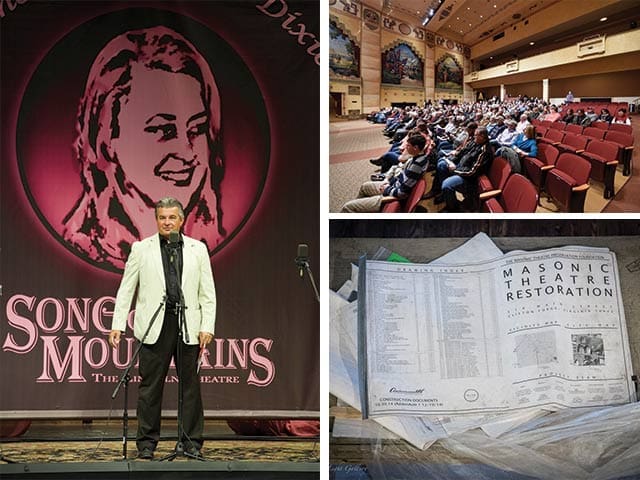
The Appalachian Theatre in Boone, North Carolina. The Paramount in Bristol, Tennessee. The Lincoln in Marion, Virginia. The Historic Masonic Theatre in Clifton Forge, Virginia. Four Blue Ridge theatres in different stages of restoration and reinvention. Remodelling is just beginning at the Appalachian, while the Historic Masonic just re-opened its doors July 1st, after years of financial and architectural planning and fourteen months of restoration. Bristol’s Paramount and Marion’s Lincoln theatres are up and running, drawing visitors from all over the country.

As different as these four theatres and their locations are, one shared truth places them at the center of their communities: Theatres draw us because we want—need—to come together to witness and celebrate the beautiful intricacy of being human.
The Masonic‘s Jeff Stern puts it this way: “Theatre is in our DNA. From the very beginning, we gathered around the fire to share our stories, our values and our dreams.”
Traveling the Blue Ridge to visit these four historic theatres, I saw the light from these fires and felt their heat. Let me share a few stories with you. And then go visit these theatres and be amazed at what committed passion, energy, and community can accomplish.
The Appalachian Theatre in Boone, North Carolina: Careful Planning by the Experts
There’s a spring snow falling on blooming daffodils as I drive into Boone. It’s a college town—home to Appalachian State University—and students are everywhere. Boone has the wonderful feel of a place that travels to the beat of its own drummer, with quirky shops lining the main street and coffee shops and vegetarian cafes plentiful.
Appalachian State has a strong arts emphasis, and Boone has long benefitted from its presence. The current Appalachian Theatre renovation supporters include several university faculty and faculty emeriti, including Keith Martin, the John M. Blackburn Distinguished Professor of Theatre, and Dr. Frank Mohler.
I find Dr. Mohler, who chairs the design and construction committee for the Appalachian Theatre restoration, and Gail Hearn, the secretary of the Board of Trustees and campaign coordinator, wearing coats in the cold office of the theatre restoration nonprofit, Appalachian Theatre of the High Country.
The story they tell is rich with historical detail. The Appalachian Theatre opened its doors in 1938, the only known Art Deco building in Watauga County. The owners stopped one chair short of creating a 1,000-seat theatre to avoid additional taxes. It must have been beautiful, reported to have featured lime green, white and black tiles and a massive projecting marquis illuminated with hundreds of red, yellow and white lights.
The list of first-run movies the Appalachian hosted reads like a history of Hollywood: “Gone with the Wind,” of course; “Hamlet” with Laurence Olivier; Brigitte Bardot in “A Woman Like Satin;” “Great Expectations;” “King Kong vs. Godzilla;” “Easy Rider.” Numerous stars shone on the Appalachian’s stage in the theatre’s heyday: Uncle Dave Macon, Bill Monroe and His Blue Grass Boys, Doc Watson, Minnie Pearl, Pee Wee King and His Golden West Cowboys, Flatt and Scruggs and the Foggy Mountain Boys.
Mohler shows a photograph of a large crowd outside the Appalachian. “This is where the town gathered to hear news from the front during World War II. The newsreels were a big draw to the theatre.”
In 1981, in an effort to compete with a seven-screen theatre at the local mall, the Appalachian became a duplex, with the balcony housing a second screen. Various owners ran it as a second-run movie house, a “dollar cinema.” But in late 2007, the Appalachian closed its door. And when it was purchased by a hopeful restaurateur the following year, the theatre was gutted…and then abandoned when the owner filed for bankruptcy.
With the support of the Town of Boone (which purchased the Appalachian in late 2011) and the Downtown Boone Development Authority (which purchased it from the town three years later), the Appalachian Theatre renovation push was on. John Cooper (whose guest column ran in the Jan/Feb. 2016 issue of this magazine) called together a talented and passionate group to form a nonprofit. The Appalachian Theatre of the High Country now owns the theatre and is overseeing its rebirth.
The restoration of the Appalachian has been skillfully planned and funded. In four years, the Appalachian Theatre of the High Country Board members have raised nearly $7 million, an especially impressive figure given that the theatre didn’t qualify for historic tax credits due to its having been stripped of its architectural detail. The committed board has put partnerships at the center of its planning, with more than 50 user groups for the remodeled theatre already identified. The Appalachian Theatre Economic Impact Study published in 2014 forecasts huge financial benefits to the Boone area—more than $3 million in local spending by those attending theatre events will magnify regionally to $4.5 million.
While it’s too early to cite a completion date, there’s no doubt the Appalachian will re-open its doors, and that it will once again be a gathering place for the community. “It’s like it was all meant to be,” says Gail Hearne.
Visit savetheapptheatre.com for photographs, updates on the renovation, and plans for the future.
… The story above is an excerpt from our September/October 2016 issue. For the rest of this story and more like it subscribe today, log in to read our digital edition or download our FREE iOS app. Thank you!