Skip to content


Soldiers scale the Humphrey’s Head rock formation at Seneca Rocks, August, 1943 during West Virginia Maneuvers. Photograph by A. Aubrey Bodine Courtesy of Jennifer B. Bodine
Our mountain terrain served as a World War II training ground for U.S. Army troops preparing for combat in Italy.

It’s a cold day in November, 1943. Pvt. Anthony Silva, speeding along a rock-strewn meandering mountain road, loses control of his U.S. Army Jeep, lurches sideways over a precipice and crashes into a gulch below. Silva clambers out of the wreckage of his Willy’s Jeep, checking to see if all appendages are in working order and that he is still ambulatory.
Silva, a member of the 305th Infantry, 77th Infantry Division, had just become up-close-and-personal with the rugged terrain of the Blue Ridge Mountains near Buena Vista, Virginia. Terrain that the U.S Army brass had selected to mimic the rocky island of Sicily, and thus provide a low-mountain training program with a similarity to an anticipated combat scenario.
With combat in mind, the U.S. Army set up shop in Buena Vista, Virginia, and Elkins, West Virginia, during 1943 and 1944 as elements of seven standard infantry divisions—the 28th, 31st, 35th, 36th, 45th, 77th, and 95th—descended upon the region.
At times during the army’s war games, live ammunition whizzed through the air. Area newspapers gave a heads-up to hunters and area residents about the use of live rounds. The July 12, 1943, edition of the Hinton Daily News informed that U.S. Army troops would begin maneuvers in the Monongahela National Forest “any day now.” Area residents were no strangers to the sound of gunfire related to hunting, but the barrages let loose by the U.S. Army were in preparation to confront Nazis and Fascists rather than bears, deer and turkeys.
A column by Mrs. Charles Brooke Smith in the Hinton Daily News of August 5, 1943, noted that the army maneuvers in the region likely marked the first time the sound of cannon and rifle fire had been heard in the region since Robert E. Lee marched through the mountainous regions of the state. Smith recalled General Lee’s statement during his West Virginia Campaign that this country was “too beautiful to be fought over.”
The soldiers weren’t sure what to expect from the West Virginia mountaineers. A pamphlet entitled Mountain Lore, handed out to the GIs, informed them not to be startled upon seeing “a giant bearded man emerging from a dense thicket with a long-barreled rifle in the crook of his arm.” But they soon found there was little difference between themselves and the residents. A rapport quickly developed, as local residents looked upon the soldiers as “our boys.”
For their part the soldiers offered treats to area children and put on skits and serenades for their hosts. The soldiers were rewarded with good southern cooking, including homemade pies; many a soldier reminisced about, “oh those pies.”
When the GIs left for Europe or the Pacific, they carried with them their new appetite for such West Virginia staples as slaw dogs and pepperoni rolls.

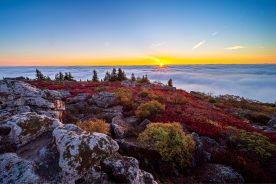
For such a large operation, the exercises in the West Virginia Maneuver Area left relatively few permanent impacts. A significant exception was that residents have had to tread lightly in some forest areas, as for years following the U.S. Army exercises, old ordnance (artillery and mortar shells) has still occasionally been found in these areas. In 1997, an expert ordnance-removal crew plotted the trail locations and known campsites at Dolly Sods for shells. Fifteen were found and the live ones were detonated. But more may still exist. Several Five-Year Reviews were carried on by the U. S. Army Corps of Engineers to check behind the 1997-1998 ordnance removal.
And there was one more lingering consequence of the exercises: A number of marriages took place between the soldiers and local women.
The story above first appeared in our November / December 2022 issue.