Skip to content



The pre-California gold rushes in North Carolina and Georgia overwhelmed the Philadelphia mint to the point that gold coins came to be struck here in the Southern Appalachians.
Photo Above: North Georgia’s U.S.-sanctioned Dahlonega Mint building, shown here in the late 1870s, was opened to supplement the original U.S. mint at Philadelphia.

The term “Gold Rush” likely first evokes the mid-1800s in California, where over the seven year period of 1848-1855 nearly 300,000 people arrived to seek their fortunes.

In this part of the world, “Gold Rush” likely brings first to mind the 1828 rush in the north Georgia mountains.
It’s the combination of that rush, along with an even earlier one—spawned by John Reed’s 1799 discovery of gold in the foothills of North Carolina—that by the 1830s was testing the capability of the Philadelphia Mint—the nation’s only—to turn out coinage for the United States government. In the 1830s, over 50 mines were operating in North Carolina, and north Georgia was home to some 500 mines.

Adding to the challenge was that miners often faced difficulties in taking their gold north to Philadelphia. The trek by stage, in the saddle or for a few, on foot was tedious; and it could prove dangerous, as miners risked losing their treasure to armed highwaymen.
The result was two new mints—the first one not sanctioned by the government. Christopher Bechtler, an émigré to Rutherford County, North Carolina, from the Grand Duchy of Baden (later to become part of Germany), had arrived in the United States in 1829. Bechtler, a jeweler, announced in the July 2, 1831 edition of the North Carolina Spectator and Western Advertiser, that his private mint was now open. It would coin the miners’ gold into $1, $2.50 and $5 gold pieces.

Bechtler minted the nation’s first $1 gold coin. Although not legally sanctioned, his coins were of high-carat gold, with the degree of fineness stamped upon the face—ranging from 20 to 22 carats.
By 1835, with the passage of the Mint Act, an official southern mint was to operate at Dahlonega, Georgia. This mint was the direct result of the government requiring more coinage, with the Philadelphia Mint having apparently met capacity.
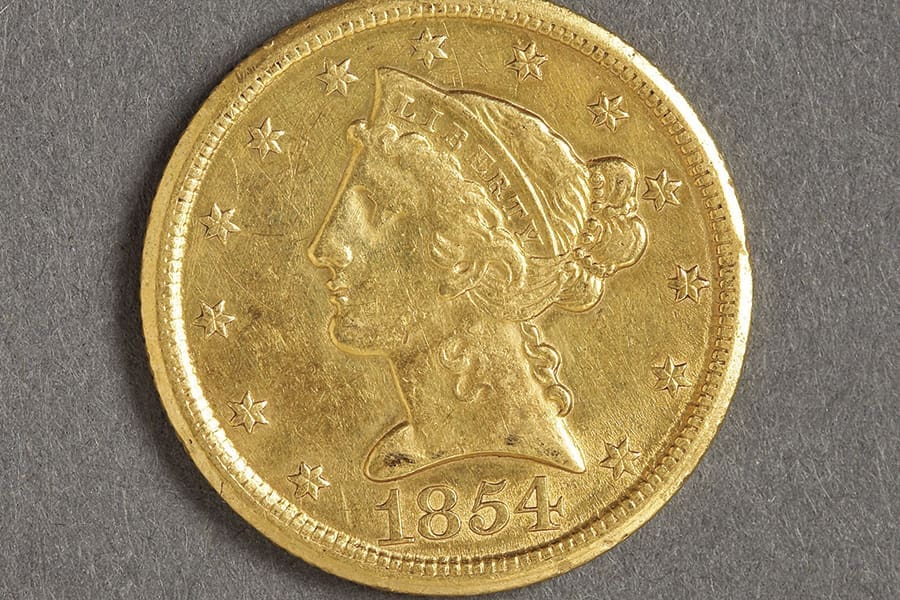
Beginning in 1838, the Georgia mint turned out $1, $2.50, $3 and $5 gold coins. During the decade of the 1840s Georgia’s production of gold oscillated. But an influx of Georgia miners returning from the gold fields of California caused a new surge at the Dahlonega Mint. Between 1838 and 1861, the north Georgia mint turned out $6 million in gold into U. S. coinage, stamped with a “D” to delineate where it was minted. (The Denver Mint’s “D” did not appear until 1906.)
The North Carolina and Dahlonega mints were relatively short-lived. Bechtler’s was shuttered in the late 1840s while the Georgia government mint continued operations until 1861, when the winds of war closed its doors.
Today the Bechtler mint site and his home are part of a new North Carolina Gold Trail & Bechtler Heritage Center. The Bechtler site is comprised of a small park with a short loop walking trail and information boards. In 1997 the Bechtler Mint site was listed on the National Register of Historic Places.
The main building of the Dahlonega Mint was fire destroyed in 1878. Price Memorial Building of North Georgia College & State University sits upon the remnants of the mine. Visitors can view the ruins of the mint through a glass panel. A historical marker tells of the site’s history.
The story above first appeared in our January / February 2023 issue.