Skip to content


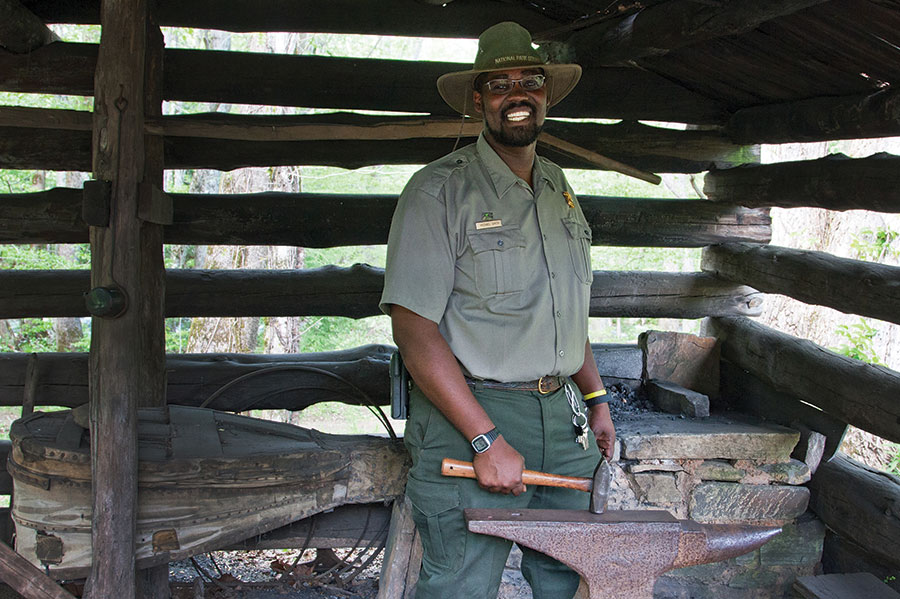
Interpretive park ranger Michael Smith loves chatting up the mountains he calls home.
Photo Above: Michael Smith: “It’s like being an elementary school teacher. I know a little bit about a lot of things in the park, but I don’t dive deep into any of those.”
Photo Courtesy of National Park Service.
Michael Smith was studying animal science at Alabama’s Tuskegee University—he’d been attached to critters ever since his dad gave him a pet hamster in a little purple box for his birthday—when he started to change his mind about being a veterinarian. It was there that he realized he couldn’t bear the thought of advising pet owners to put their aged, injured or seriously ill animals to sleep.

So when park rangers visited one of his classes to talk about jobs with the National Park Service, he knew exactly what he was meant to do.
“I was a Boy Scout,” says Smith, 37, an interpretive park ranger who celebrates his 10th anniversary with the Great Smoky Mountains National Park this year. “So I was kind of used to being outdoors and hiking trails and kayaking and canoeing. None of that was foreign to me.”
After a summer stint as a park guide in the GSMNP, where he manned the visitor center desk and led hikes in his green-and-gray uniform—“I really didn’t know much about the Smokies, to tell you the truth, but they had housing available”—he was invited to come back the next year. In 2011, he landed his first fulltime NPS position at the Selma to Montgomery National Historic Trail in White Hall, Alabama. In addition to interacting with the general public and school groups, he often helped out with maintenance, mowing the grass, trimming the shrubs, even assisting contractors when they installed exhibits in the visitor center.
“In Selma, it was a slow park. We only had about 7,000 visitors per year,” Smith recalls. “It was just a very rural kind of farmland, very open area.”
In 2015, he returned to the Smokies, a region that presented a stark contrast from flat Alabama and coastal Jacksonville, where he’d grown up.
“The mountains and the curves were something that I had to get used to, and the wildlife was another aspect. I was more comfortable around alligators and maybe even sharks, being from Florida. But here it was black bear or elk, large land critters versus the more water or amphibious type of wildlife.”
Two of his main responsibilities at the GSMNP are serving as coordinator of the Mountain Farm Museum next to the Oconaluftee Visitor Center in Cherokee and working as liaison to nonprofit associations that support Mingus Mill, the site of a historic, water-powered gristmill a half-mile away. Mingus is currently closed for major repairs.
At the Mountain Farm Museum, Smith oversees a barn, apple house, smokehouse, working blacksmith shop and other historic log buildings gathered from other parts of the Smokies and mostly built in the late 19th century. The on-site Davis House was constructed of American chestnut wood before a sweeping blight decimated the species nearly a century ago.
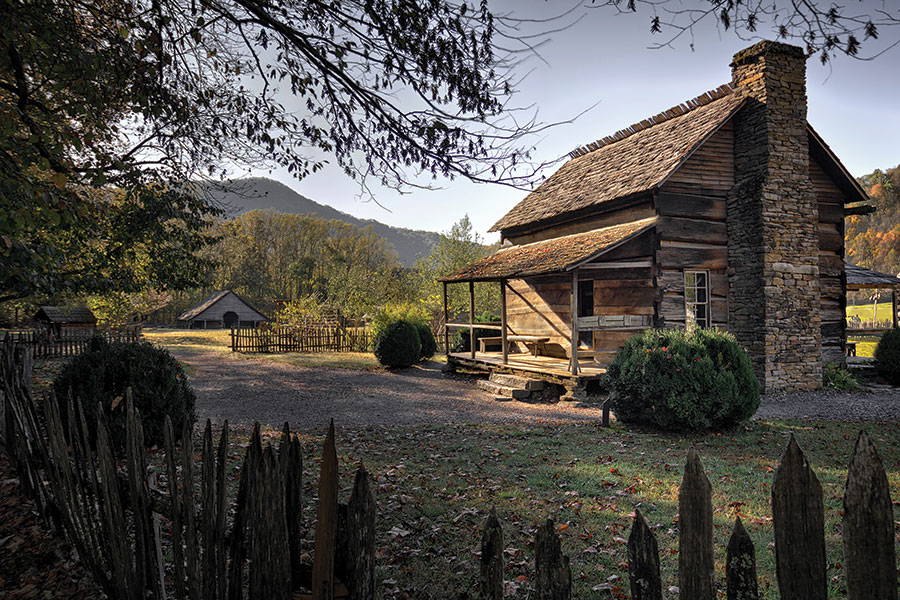
© National Park Service
He also cares for the museum site’s resident chickens and pigs, having never outgrown his love of animals, including his menagerie of “nontraditional pets” at home. “We have fish. We have a cat. We have a dog. We have a rabbit. We have a goat. We have a horse. We have a mule. And we have about nine or 10 chickens. The goat is the only one that really does [a chore] for us—weed and shrub control.”
Without question, interacting with park visitors has been a much better fit for his personality than delivering bad news to pet owners as a veterinarian, says the ultra-friendly Smith.
“Basically, I equate my job as an interpretive park ranger as like being an elementary school teacher. I know a little bit about a lot of things in the park, but I don’t dive deep into any of those. Normally, I’m just using that to tie in a bigger concept of why all of this is important and why we should protect it. I feel like building stewardship is a main part of my job.”
He enjoys talking to visitors so much, in fact, that he often has to mindfully control just how much. “I’m not afraid to talk to anybody. So I have to keep myself in check, so to speak.”
As an African American park ranger, Smith genuinely understands the need for diversity in a mostly-white profession.
“The national parks belong to everybody, so it’s important to have representation, in my opinion, of everybody that owns it. I think it’s important to start to understand some of the cultural differences.”
Being a role model is actually one of his favorite parts of the job. So is connecting with a diversity of guests.
“It’s important for young Black children to see a Black park ranger. I think it’s also important for young white children to see a Black park ranger because that can maybe change some of the stereotype, or some of the traditional thought, if a young white child has an awesome experience with a Black park ranger.
“I feel like there’s more that connects us than separates us.”
To young African Americans who are considering this type of career, Smith advises: Don’t be afraid to step out of your comfort zone. “At least one of two things could happen,” he says. “Number one, you will definitely know that’s an area that you’re not comfortable in. But you could also find a new comfort zone. So be open-minded and give it a try. If it doesn’t work, at least you know you tried.”
Looking back, Smith is grateful for the NPS spokesperson who opened his eyes to his future career in that Tuskegee University classroom years ago.
“Where the National Park Service really shines is in some of the tough moments like COVID,” Smith says. “When people were looking for places and spaces to be outside, the National Park Service was that space. There are over 400 sites throughout the National Park Service that protect and preserve the history, the culture, the natural wonder, the biodiversity of our country. I just try to share it with as many people as possible.”
Michael Smith’s Top 3 Things to Do in the Smokies
Mountain Farm Museum. “It’s about sharing the history and the culture of the area, like the African American experience in the park, or Cherokee stories. I do love the farm for that aspect.”
Roaring Fork Motor Trail in Gatlinburg. “It’s kind of overlooked a little bit. People drive around it, but getting out and walking to a log cabin or some of the waterfalls is just a really cool experience.”
The town of Cherokee, North Carolina. “There’s a Cherokee museum. There’s a drama that they do in the summertime in the evening, ‘Unto These Hills.’ There’s a botanical garden. There’s just a lot to see and do in Cherokee. You get an idea of how they stewarded the land before people moved into the area from other places.”
The story above first appeared in our January / February 2025 issue.