Skip to content


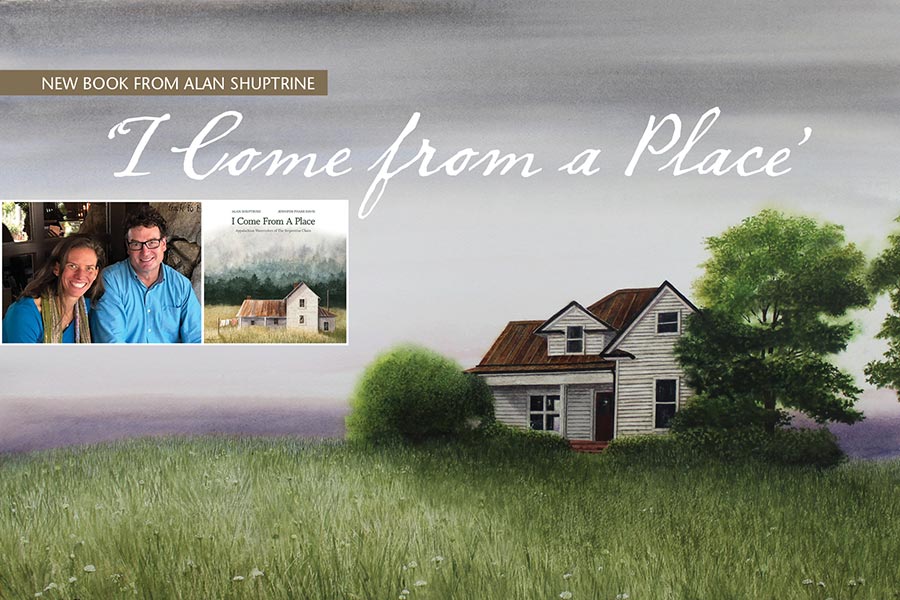
All his life, Lookout Mountain, Tennessee, watercolorist, gold leaf artist and gallery owner Alan Shuptrine had dreamed of that one big moment—that life-altering, turning-point moment like his artist father Hubert had enjoyed with the publication of the 1974 Pulitzer-nominated coffee table book, “Jericho: The South Beheld.”
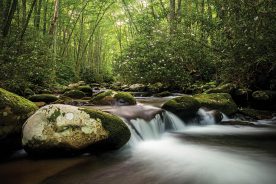
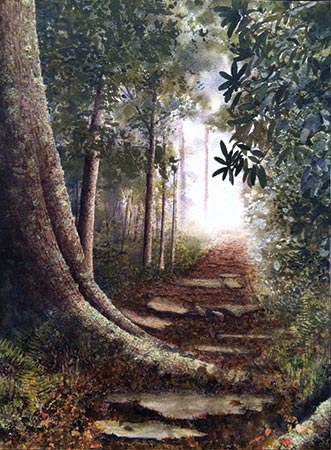
About six years ago, Shuptrine woke in the middle of the night, nudged his wife, Bonny, and announced, “I know what I want to do.” Before long, he was hiking parts of the Appalachian Trail with his trusty German shepherd, Captain, and painting what he saw along the route: a tattered homestead viewed through the peephole of a gnarled tree, late-day light bathing a forested path, a colorful quilt hung out to dry.
A self-described section hiker—unlike the AT adventurer who hikes from one end to the other, or the one who picks up or heads to where he left off the last time, Shuptrine skipped around different sites from north Georgia to Maine—he soon realized he needed to focus on more than just beautiful landscapes.

“In order to get different subject matter that applied to my theme, which was celebrating the traditions, the Celtic roots, of Appalachia, I would need to get down into the little towns and farms at the base of the mountains where the inhabitants are 95 percent English, Irish, Scottish and Welsh,” he says. “When [settlers] came to the coastline, they were uneasy. It didn’t feel like home. So they kept moving westward and when they got to the Appalachians, the terrain was similar to what they had been living in across the sea. Their offspring, after 250 years, are still alive and well in the Appalachians and practicing the same traditions.”
Shuptrine notes another, lesser-known connection between the Appalachian Mountains and Britain, which scientists say was physically linked to North America millions of years ago. The same seam of dark green serpentine that snakes beneath the trail also appears in the British Isles.

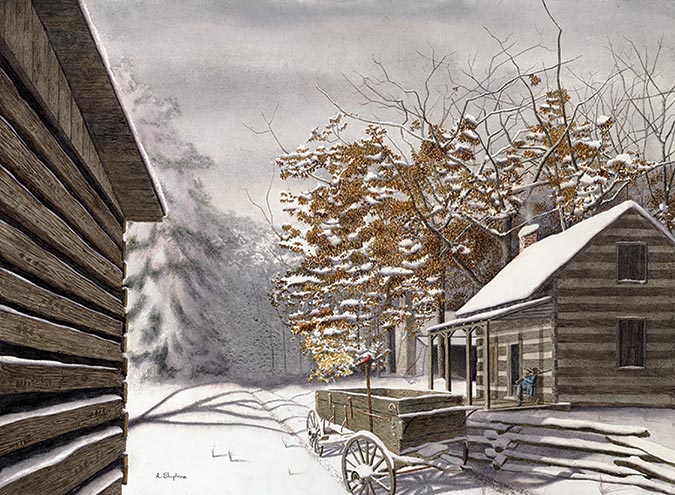
On his quest to find more Appalachian locals to capture on canvas, new subjects began to appear as if by magic: the elderly man rocking in his chair, a woman tatting on a front porch, a maker of old-fashioned sorghum molasses.
“One person led me to another,” Shuptrine recalls. “They would tell me about others like them, others with the X factor I was looking for.”
In painting both people and places, Shuptrine hopes to relay to his audience the serenity and sense of belonging he felt during his adventure.
“Maybe it’s a calmness or peaceful light or the warmth of the sun on a clapboard house or the smell of honeysuckle in the air or the fresh-cut hay in the field,” he says. “I’m trying to convey that emotion from them and use as many of the senses as possible. If they feel and see that, then that is my greatest reward.”
A more tangible payoff for Shuptrine, and the culmination of his decades-long dream, is “I Come From a Place,” a coffee table book that debuts in September after a two-year solo museum exhibition across the Southeast. Paired with prose written by bestselling author Jennifer Pharr Davis, who holds the female world record for fastest known time covering the 2,185-mile AT (40 days, 11hours, 20 minutes!), the volume features more than 80 of Shuptrine’s Appalachian-themed watercolors, from “Into the Clearing,” set in the woods of Tennessee’s Great Smoky Mountains, to “Falling,” which depicts an autumn scene in Hot Springs, North Carolina, near Asheville. It also portrays a sense of comfort, mountain heritage and home.
For Shuptrine, the experience has been groundbreaking in more ways than one. “I’ve gotten the satisfaction of being able to go see some of the vistas that I’ve seen, to talk to some of the people in the towns,” he says.
Another discovery: You need to pack light for the AT. “The Appalachian Trail teaches you what you need and what you can do without,” he says, laughing. “That’s not just physically, but mentally as well.”
The project also taught him a lot about himself as both an artist and a human being. “I’ve learned a lot about my own vulnerabilities, my own weaknesses. I’ve learned a lot about my painting skills and I’ve honed them,” he says. “It’s been so rewarding. … All my life, I’ve been waiting for this to come along.”
For more information or to order a limited-edition copy of Shuptrine’s new book, please go to alanshuptrine.com.
The story above appears in our July/August 2019 issue. For more, subscribe today or log in to the digital edition with your active digital subscription. Thank you for your support!