Skip to content

The story below is an excerpt from our January/February 2017 issue. For the rest of this story and more like it subscribe today, log in to read our digital edition or download our FREE iOS app. Thank you!
When a Midtown-Manhattan chef adds ramps to the dish she is cooking for Pope Benedict XVI, you can be sure that Appalachian cuisine has arrived. But of course the restaurants for the genuine, original taste of Appalachia are in places like Virginia and North Carolina. We celebrate two of them.
Within the same week, New York City celebrity chefs Lidia Bastianich and Mario Batali send out tweets heralding the springtime arrival of ramps in Manhattan. Within a few days, I get a call from a Brooklyn, New York, radio station asking me to explain the appeal of these wild mountain leeks and to discuss the philosophy of redeye gravy. The host remains enthralled as we move to sorghum syrup, soup beans, and chow-chow.

A radio station in Seattle follows suit, in need of information about the cushaw, the large, crooked-neck, striped squash that has been grown in America since long before Europeans came to these shores.
A few months earlier, an email arrived from the Smithsonian and the Zócalo Public Square project, asking me to write about the foodways of Appalachia in the context of “what it means to be an American.” The topic is a profound one, for the argument could easily be made that Appalachian cuisine is our country’s oldest.
Call it resurgence, renaissance, or long overdue respect, for whatever reason, Appalachian food now finds itself in the national spotlight. A decade ago, even seeing the word “Appalachian” on a restaurant menu was a rarity. Now, chefs use it liberally.
At his New York City restaurants, chef Mario Batali serves up ramp ravioli and spaghetti with ramps. He says ramps are the “perfect zing for spring.”
Chef Lidia Bastianich calls them “one of the fleeting pleasures of early spring.” Among her favorite ways to use them is in a spring risotto with ramps, asparagus and morel mushrooms, another Appalachian treasure. She buys ramps as soon as they appear in Manhattan markets and serves them on the elegant tables of her Midtown restaurant, Felidia. When Bastianich was asked to cook for Pope Benedict XVI during his visit to New York City, she prepared a spring pesto for the risotto, and it included a cup of ramp leaves.
From subsistence fare to the plate of the Pope, ramps have traveled an unusual path. Cherokees celebrated the coming of ramps because they were one of the first green plants to appear on the forest floor in the early spring. They believed that the pungency of the plants thinned down the blood and got it moving again, after a winter of relative inactivity.
In white cultures in the mountains, ramps were often viewed as a mark of shame. Coming to school with reeking ramp breath resulted in many children being sent home from school.
Today’s prestige and accompanying high prices for ramps are ironic indeed. I still recall the invitation I received to a $500-a-plate black tie dinner that took place in Chicago. At the top of the menu were ramps and morel mushrooms.
“Farm-to-table,” “sustainable,” “organic,” “locavore”—the hot-button food words of the day—describe practices that have been going on in Appalachia for generations. We just hadn’t labeled them.
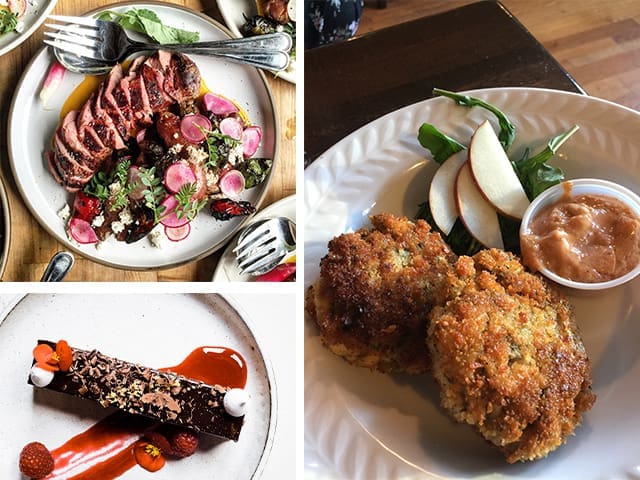
Of the many restaurants that now celebrate Appalachian cuisine, two especially stand out. One is rural, the other urban. One is country-store architecture, the other big-city bistro. The Harvest Table is only a few steps from the railroad tracks in the tiny hamlet of Meadowview, Virginia. There’s not much else around it. The Market Place occupies a spot on Wall Street in downtown Asheville, North Carolina, surrounded by restaurants offering the foods of Syria, the Himalayas, Southeast Asia, and Ethiopia.
… The story above is an excerpt from our January/February 2017 issue. For the rest of this story and more like it subscribe today, log in to read our digital edition or download our FREE iOS app. Thank you!