Curios: Disappearing Lakes of the Southern Appalachians

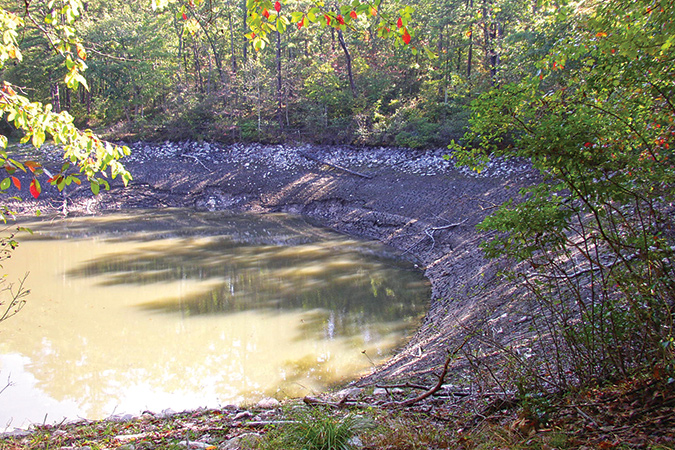
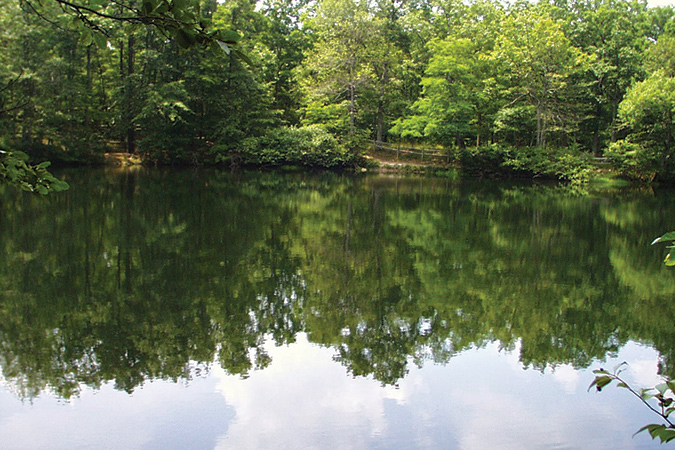
West Virginia’s Trout Pond, in Hardy County, was full in 2003 when the shot below was taken. Leakage out of what was until recently a blocked limestone sinkhole has reduced the pond to its current level, as seen above.

West Virginia’s Trout Pond, in Hardy County, was full in 2003 when the shot below was taken. Leakage out of what was until recently a blocked limestone sinkhole has reduced the pond to its current level, as seen above.

The three natural lakes of the region are endangered.

Well, “endangered” is not exactly true. Natural lakes have always been scarcer than partridge teeth in the southern mountains. “Lakes” in this region are overwhelmingly human-created reservoirs. Only three mountain lakes exist in the seven southern Appalachian states—and two have shrunk into ponds, while the third is hidden underground in a Tennessee cave.

West Virginia claims Trout Pond in Hardy County as its sole natural lake. The pond covers less than three acres of what has been discovered to be a blocked limestone sinkhole. Because of a shift in the rock bottom, Trout Pond has been shrinking between rains.
Native trout no longer swim in Trout Pond’s waters, although nearby manmade Rockcliff Lake is doing fine in the same Trout Pond Recreation Area of the George Washington & Jefferson National Forests. The larger, stream-fed lake is now the place folks go for swimming, boating, and fishing.

Southwest Virginia’s Mountain Lake, home of Mountain Lake Lodge, has also been pulling a disappearing act since 2008, leaving behind only cracked mud and a small pond. While the levels have been fluctuating for the past 13 years, the lake has never come back enough to make a paddling outing worthwhile for anything larger than a water bug.

Geologists theorize that the lake was formed by landslides filling a shallow gorge thousands of years ago. Landslides and shifting rocks, it turns out, make unreliable dams. They are pitted with gaps and holes that open and close without warning, allowing water to leach out. 

At Mountain Lake—as with Trout Pond—when surface water is abundant, the water remains high, and the wet sediment layers keep the leaks in the rock bottom in check. But droughts can worsen the effect of the leaching, drying up the sediments and creating more holes. Often it’s cyclical. Although there’s no record of Trout Pond emptying in the past, geological records indicate Mountain Lake has ebbed and filled for thousands of years.

The southern mountains’ other natural lake, Lost Sea in Sweetwater, Tennessee, is holding its own—with its “disppearing” attribute being simply that it’s underground. In fact new layers have been discovered by cave divers. While measured in acres rather than miles, it is one of the world’s largest underground lakes.


The story above first appeared in our January/ February 2022 issue.

You Might Also Like:

A Virginia Historical Marker stands at the entrance to Green Pastures.

Green Pastures’ picnic area was build by the Civilian Conservation Corps in the late 1930s.

Green Pastures Reborn

When it officially opened in 1940 — in the depths of the Jim Crow era — Green Pastures was likely the first U.S. Forest Service recreation area in the nation constructed for African Americans.
Chimney Tops Trail in Great Smoky Mountains National Park rewards a steep climb with exceptional mountain views.

Inset: Gatlinburg, Tennessee’s Chimneys Picnic Area sits beside the West Prong of the Little Pigeon RIver.

11 Picnics with a View

These bucket-list destinations are perfect spots to kick back, enjoy a delightful meal and take in the great outdoors.
Vernon and Toni Wright turn grains grown on their family farm into freshly distilled spirits.

Virginia Century Farm Home to New Distillery

For nearly 200 years, Vernon and Toni Wright’s family has raised corn, cattle and quarter horses at Hill High.
Spring wildflowers bloom early in the New River Gorge of West Virginia. From the photographer: “Bloodroot is one of the first to blossom, fittingly coming in around the first day of spring. The reddish sap that exudes from all parts of the plant — especially the root — when cut is what gives bloodroot its common name.”

Scenes of Spring: A Photo Essay

Our contributing photographers reveal the fresh sights and subtle joys of the season.
At Hayfields State Park in Highland County, Virginia, easy-to-moderate trails wind through quiet forests and past historic structures.

Greening the Blue Ridge Region

New Parks, Healthier Creeks, Solar Power, Protected Lands and More.
John Scrivani bags female flowers from atop a 40-plus-foot-tall chestnut.

The Good Steward

Veteran forester John Scrivani dedicated his career to restoring American chestnut trees — and helped lay the groundwork for the effort’s next generation.
The pond next to the visitor center entrance is easily accessible and a beautiful spot for a selfie or an afternoon of plein air painting.

How to Make a State Park

The opening of Virginia’s newest state park marked the culmination of a community dream carefully nurtured for more than a decade.
Daybreak at Elakala Falls in West Virginia’s Blackwater Falls State Park on a perfect winter morning.

Quiet Beauty of Mountain Winter: A Photo Essay

Our contributing photographers braved the chill to capture the calm of the cold months.
The original Academy burned in 1911.

Curios: When Lynchburg, Virginia, Was King

With the likes of Douglas Fairbanks, Duke Ellington and Louis Armstrong performing live, the little city with the highest per capita income in the U.S. was a national hotspot for entertainment.
Hendersonville, North Carolina, offers a walkable downtown.

Slow Travel in 7 States

It's perfect for the mountains!

CALENDAR OF EVENTS