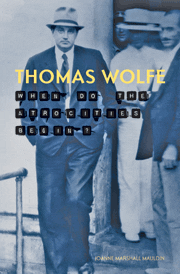
Thomas Wolfe: When Do the Atrocities Begin?

Independent scholar Joanne Marshall Mauldin examines in day-by-day detail the final two years of novelist Thomas Wolfe’s life, beginning with his return, in the summer of 1936, to his Asheville, N.C., hometown.

Independent scholar Joanne Marshall Mauldin examines in day-by-day detail the final two years of novelist Thomas Wolfe’s life, beginning with his return, in the summer of 1936, to his Asheville, N.C., hometown.

He and his editor Maxwell Perkins had mistakenly envisioned this as a period of writing and rest. But Wolfe, an outsized man with an inexhaustible hunger for food, alcohol and whatever pulsed with life, brought the whirlwind with him. He had not visited Asheville since the 1929 publication of “Look Homeward, Angel,” in which his thinly disguised portraits of townsfolk had created an uproar. His mountain sojourn found him partying with friends and hangers-on, and testifying at a murder trial in nearby Burnsville (he had been witness to an altercation between the principals a week before the murder took place), although he managed often to avoid his garrulous mother and the rest of his fractious family. How he got any writing done is a mystery not solved by this narrative.

Wolfe’s death, from tuberculosis meningitis on Sept. 15, 1938, a couple of weeks short of his 38th birthday, occurs about midway through the book, the rest of which is taken up with the posthumous publication of novels and short stories from the voluminous crates of manuscript he left behind. Neither Perkins, with whom he broke after his second novel, “Of Time and the River,” was published, nor his second editor – Edward Aswell – comes off well here. To Aswell, who had signed Wolfe less than a year before his death, fell the gargantuan task of organizing the million-word manuscript Wolfe had delivered just before embarking on a western trip during which he fell ill.

Mauldin thinks that both editors erred in shaping Wolfe’s work (although the portrait of his redoubtable agent Elizabeth Nowell is sympathetic and engaging). Her intended audience is not the reader with only a casual interest in Thomas Wolfe, but the aficionado (of which there are many), or the scholar seeking a precise record of the author’s final months and his posthumous publication history.

Thomas Wolfe: When Do the Atrocities Begin?,” Joanne Marshall Mauldin. 376 pp., softcover, $38. University of Tennessee Press, 2007. 800-621-2736, utpress.org.

You Might Also Like:

80b30614-90ad-11ef-bc8f-12163087a831-IMG_9083

Book Note: Rednecks

by Taylor Brown. St. Martin’s Press, 2024. 310 pp.
Ben Montgomery. Chicago Review Press. 2015. 266 pp.

Book Note: Grandma Gatewood’s Walk

by Ben Montgomery. Chicago Review Press. 2015. 266 pp.
Ron Rash. The Caretaker. Doubleday, 2023. 252pp.

Book Note: The Caretaker

by Ron Rash. Doubleday, 2023. 252pp.
Jeremy B. Jones. Bearwallow: A Personal History of a Mountain Homeland. (Blair, 2014). 253 pp.

Book Note – Bearwallow: A Personal History of a Mountain Homeland

by Jeremy B. Jones. (Blair, 2014). 253 pp.
Kami Ahrens, editor. The Foxfire Book of Appalachian Women: Stories of Landscape and Community in the Mountain South. (University of North Carolina Press, 2023). 268 pp.

Book Note – The Foxfire Book of Appalachian Women: Stories of Landscape and Community in the Mountain South

edited by Kami Ahrens. (University of North Carolina Press, 2023). 268 pp.
Long Man by Amy Greene. Knopf, 2014. 276 pp.

Book Note – Long Man

by Amy Greene. Knopf, 2014. 276 pp.
Family of Earth: A Southern Mountain Childhood by Wilma Dykeman. (University of North Carolina Press, 2016). 177 pp.

Book Note – Family of Earth: A Southern Mountain Childhood

The story behind Wilma Dykeman’s “Family of Earth” is almost as captivating as the book itself. Found in her belongings after her death in 2006, the 200-page manuscript is an account of her Depression-era childhood north of Asheville, North Carolina.
Mingo by W. Jeff Barnes. Little Star, 2021. 367pp.

Book Note: Mingo

Richmond, Virginia, attorney W. Jeff Barnes grew up in coal country, and his novel about the early 20th century efforts to unionize the coalfields gives names and faces to those who lived there.
A Killing in the Hills by Julia Keller. Minotaur Books, 2012. 364pp.

Book Note: A Killing in the Hills

Here’s the best thing about Julia Keller’s “A Killing in the Hills”: After you read it, there are seven more novels waiting in the series.
Demon Copperhead by Barbara Kingsolver. HarperCollins Publishers, 2022. 548 pp.

Book Note – Demon Copperhead

by Barbara Kingsolver. HarperCollins Publishers, 2022. 548 pp.

CALENDAR OF EVENTS