Skip to content


The National Committee for the New River is floating from Boone, N.C. to Gauley Bridge, W.Va., where the New joins the Gauley to form the Kanawha. Tim Thornton is paddling along and dropping a line whenever he can find a wireless connection. Thornton’s work on the river is made possible in part by a grant from The Arts Council of the Blue Ridge.
For most of us, the New River Expedition is just a nice way to see the river, meet some nice folks and get someone with more experience or more knowledge of this particular river to show us the best line through the rapids. But some folks are working while out here.

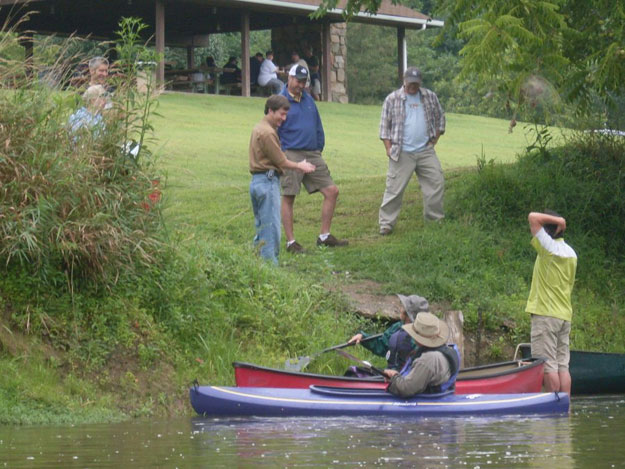
A few days ago, we stopped at Camp Dickenson. The camp was a farm of about 500 acres from more than 200 years. For the past 40, it’s been a United Methodist Church camp. Camp Dickenson is in a gentle bend of the river, but sometimes the water isn’t so gentle on the land. Camp director Micheal Snow said they’ve lost about five feet of river bank along one section of the camp this year alone.
The National Committee for the New River does a lot of work along the river’s edge, often replacing sharp, steep, mowed-to-the-water’s-edge banks with more natural boundaries between land and water filled with native plants that help hold the bank in place, which helps keep the river’s ecosystem healthy.
NCNR Executive Director George Santucci pulled his canoe into Camp Dickenson to offer advice about that sort of thing. Rob Farrell was there representing the Virginia Department of Forestry, the agency that will hold the easement if and when it’s written and recorded. John Eustis, executive director of the New River Land Trust was there, too. So was Bill Tanger, who works on all sorts of river issues and Lynn Crump of the Virginia Scenic Rivers Program. Crump is evaluating the New’s fitness for inclusion in the program, so she gave a perspective the potential easement’s effect on the river’s standing on that score card.
If the easement comes to be, it will keep the river bank from falling into the river, make the river healthier, preserve some open space and forest land, make a section of the New a little prettier and make some money for the camp. Conservation easements trade development rights for tax credits. If a landowner promises not to develop certain parts of the property in certain ways, the landowner gets tax credits based on the theoretical market value of the land as open space compared to its value as something else – condos, maybe.
If the landowner isn’t the kind of high roller who doesn’t owe enough taxes to make use of all those tax breaks those tax breaks can be sold to someone who can use them. Camp Dickenson is a church camp, so it doesn’t pay taxes. So its tax credits will go on the market. The money they raise may help fund some a new building or two out of sight of the river. Or it may become an endowment to see the camp through lean times. But most people floating by on the river won’t know any of that. They won’t see much more than some trees and bushes and a wooden cross down by the point when folks wade out in the river to have their sins ritually washed away.