July’s Mountain Wildflower: Oxeye Daisy

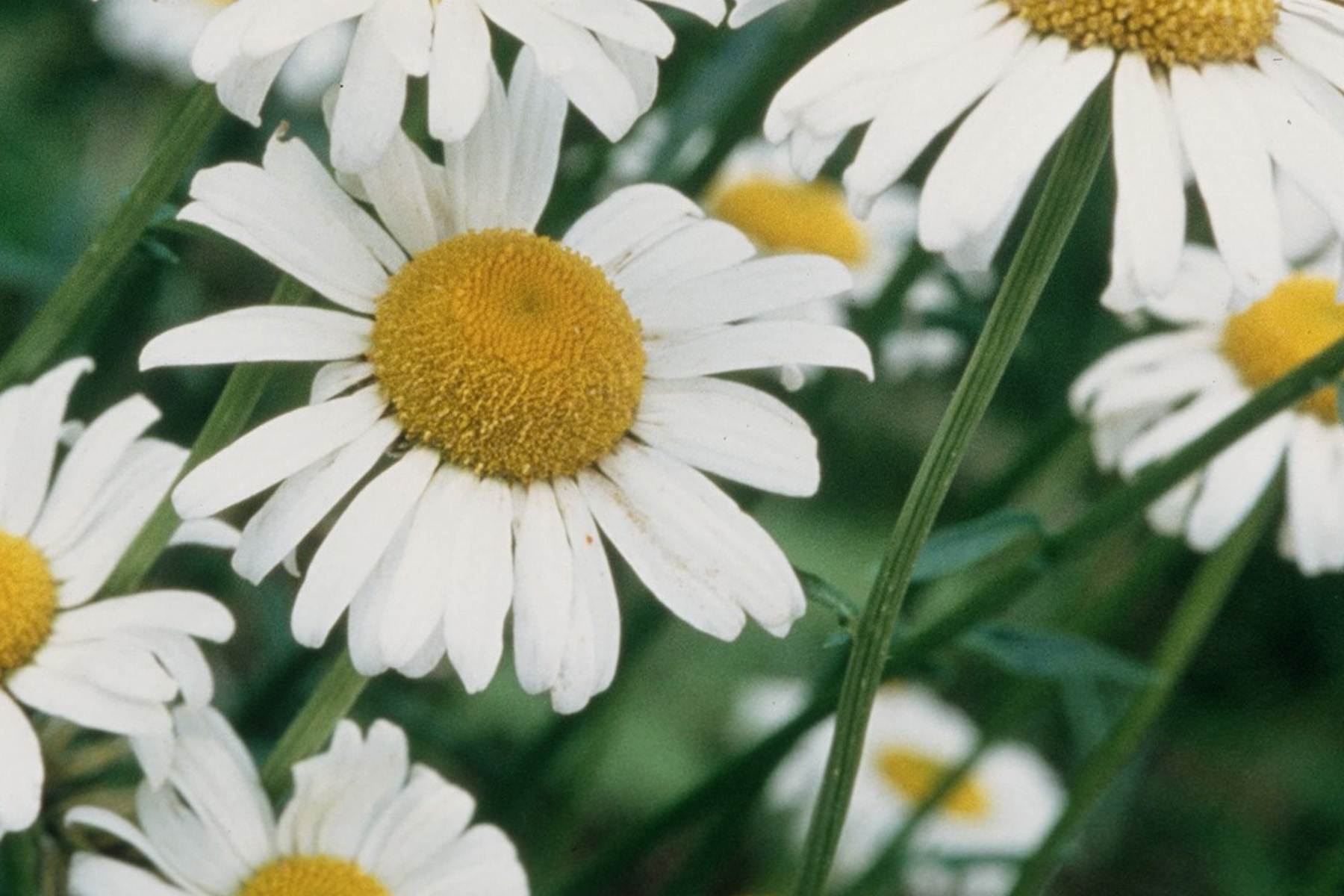
Oxeye Daisy. Credit Joe Cook and Monica Sheppard

The oxeye daisy is a member of the composite family, which American naturalist Roger Tory Peterson believed to be the most recent one to make its appearance on Earth. 

Photo Credit Joe Cook and Monica Sheppard

The oxeye daisy (Leucanthemum vulgare) did not exist in North America until the early settlers began arriving from Europe. Its seeds were probably imported when they were inadvertently included in shipments of crop seeds or in the fodder used to feed livestock on the long ocean voyages from the Old World. Once here, it did not take the plant long to spread across the land, often overtaking open fields and garden lands. It is now found throughout most of the United States and Canada.

The oxeye daisy is a member of the composite family, which American naturalist Roger Tory Peterson believed to be the most recent one to make its appearance on Earth. Despite its late development, it is now the largest of all of the families of flowering plants. The oxeye daisy is typical of most of its members, having rays of petals (Peterson referred to them as “strap-shaped flowers”) surrounding a center disk of small, tubular flowers. The rays are actually sterile flowers whose main purpose appears to be to serve as a landing pad and an attractant to the insects that will visit and pollinate the fertile, yellow, disk flowers.

By the way, the daisy almost always has an odd number of petals, so to get the desired result, be sure to start with the right phrase when you use the plant to find out if “she loves me, she loves me not.”

When looking to other sources for further information about oxeye daisy, you should be aware that some reference books list it as Chrysanthemum leucanthemum.

Flower Fast Facts

FLOWER: The inner, yellow, flattened or depressed, disk flowers are surrounded by 15-35 outer, white, ray petals.

LEAVES AND STEM: The narrow, sessile, dark green leaves are toothed or lobed and arranged alternately on a stem that rises 1-3 feet from the ground.

BLOOM SEASON: June-August


About This Series

“Mountain Wildflowers” features a wildflower from the Blue Ridge region each month from March to October. Leonard M. Adkins has written for Blue Ridge Country for more than two decades and is the author of 20 books about travel, hiking and nature. His Wildflowers of the Appalachian Trail, which received the prestigious National Outdoor Book Award, provides the photographs and some of the information he writes about in each “Mountain Wildflowers.” It and his other works may be obtained through his website.
You Might Also Like:

Mountain Laurel. Credit Leonard M. Adkins

June’s Mountain Wildflower: Mountain Laurel

If you are out in the fall, stop to examine the small capsules on the mountain laurel; these were once the plant’s flowers in May, June, and July.
Mayapple. Credit Joe Cook and Monica Sheppard

May’s Mountain Wildflower: Mayapple

Despite its name, the fruit, which looks more like a yellowish-green, egg-shaped berry than an apple, usually does not begin to develop until early to mid-summer.
Trout Lilly. Credit Joe Cook and Monica Sheppard

April’s Mountain Wildflower: Trout Lily

Like its western relative the glacier lily (Erythronium grandiflorum), trout lily (Erythronium americanum) is often found pushing its way through a blanket of snow in early spring.
e1b70596-05c8-11f1-92e0-1248ae80e59d-3-2026rueanemone--credit-Joe-Cook

March’s Mountain Wildflower: Rue Anemone

A member of the buttercup family and found in the open woodlands, rue anemone (Thalictrum thalictroides) has long, thin stems that tremble in the slightest of winds—prompting its other common name, windflower.
ec3b964c-5201-11f0-968d-1248ae80e59d-9-2025spottedjewelweed--credit-Joe-Cook-and-Monica-Sheppard

September’s Mountain Wildflower: Spotted Jewelweed

Seek out spotted jewelweed growing beside a stream or along a moist area and you will have a good chance of getting to watch one or more ruby-throated hummingbirds flit from flower to flower.
b278bbc8-5202-11f0-9ff6-1248ae80e59d-10-2025butter-and-eggs--credit-Joe-Cook

October’s Mountain Wildflower: Butter-and-Eggs

Originally a native of Asia, butter-and-eggs (Linaria vulgaris) was introduced into the United States by way of Europe and can now be found in temperate zones throughout the world.
aafec0b2-51fe-11f0-9b55-1248ae80e59d-8-2025turk_s-caplilly--credit-Joe-Cook

August’s Mountain Wildflower: Turk’s Cap Lily

Its species name of superbum means “superb” and is an acknowledgment of the plant’s glamour and charm.
6a4d3a0e-51fd-11f0-9a83-1248ae80e59d-7-2025columbine--credit-Joe-Cook-and-Monica-Sheppard

July’s Mountain Wildflower: Columbine

When the sun shines on columbine (Aquilegia Canadensis) flowers at just the right angle, they can take on the appearance of interestingly-shaped Japanese lanterns.
121fc91e-51f8-11f0-b6de-1248ae80e59d-6-2025catawbarhododendron--credt-Joe-Cook-and-Monica-Sheppard

June’s Mountain Wildflower: Catawba Rhododendron

Blooming in late May and into June, Catawba rhododendron (Rhododendron catawbiensis) has pink to deep purple clusters of flowers that are so lush and awe inspiring that they have attracted people from around the world.
ca6fd290-2753-11f0-8efc-12163087a831-website_5-2025smoothsolomon_sseal--credt-Joe-Cook-and-Monica-Sheppard_1_

May’s Mountain Wildflower: Smooth Solomon’s Seal

Because these plants cannot tolerate direct sunlight, you will not encounter the Solomon’s seals until the tree canopy has begun to leaf out.