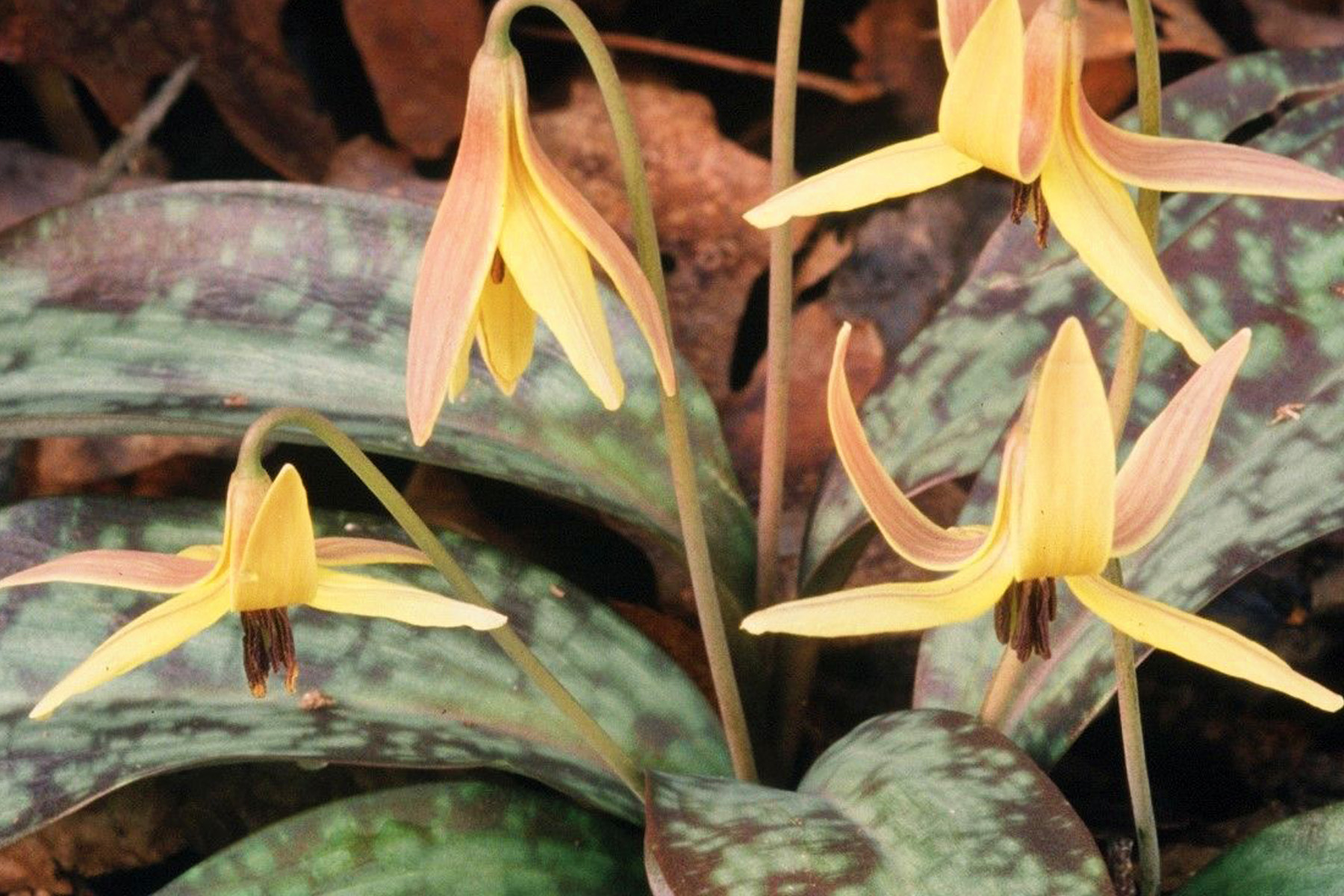
Like its western relative the glacier lily (Erythronium grandiflorum), trout lily (Erythronium americanum) is often found pushing its way through a blanket of snow in early spring.
Written by Leonard M. Adkins / Photo by Joe Cook and Monica Sheppard
Like its western relative the glacier lily (Erythronium grandiflorum), trout lily (Erythronium americanum) is often found pushing its way through a blanket of snow in early spring. It closes up each night to protect its inner parts from the cool air and chilly winds present at that time of year. As dawn’s sunlight creeps across the mountainsides, the petals and sepals begin to move, eventually curving backward to greet the day.

The plant originally received its common name from its leaves, which are speckled like the sides of a trout. Later on, people also liked to point out that it blooms during trout season. The leaves also provided another common name, fawn lily, because they stand straight up like the legs of a young deer and are spotted like a fawn’s flanks. The protruding stamens of the flower caused some to call it adder’s-tongue. Though not a true violet, the plant’s pointed white corm is responsible for the name dogtooth violet.
If you are having foot problems, you might be interested to know that Roman soldiers used the plant as a treatment for blisters and corns. In addition, if you ate something that disagreed with you, you should be aware that the leaves were boiled into a tea by American Indians to relieve stomach cramps.
Botanists have decided that another flower, also called trout lily, is a separate species (Erythronium umbilicatum)because it lacks the small, earlike appendages at the base of its petals, and the shape and orientation of its fruit are different from that of Erythronium americanum.
Flower Fast Facts
FLOWER: The nodding, 1.5-inch, yellow flower has six petals and sepals that bend in a graceful, backward curve.
LEAVES AND STEM: The 4- to 6-inch elliptical leaves are mottled purple-brown and grow near the base of the 6- to 9-inch stem.
BLOOM SEASON: March-May
About This Series
“Mountain Wildflowers” features a wildflower from the Blue Ridge region each month from March to October. Leonard M. Adkins has written for Blue Ridge Country for more than two decades and is the author of 20 books about travel, hiking and nature. His Wildflowers of the Appalachian Trail, which received the prestigious National Outdoor Book Award, provides the photographs and some of the information he writes about in each “Mountain Wildflowers.” It and his other works may be obtained through his website.