Skip to content


The story below is an excerpt from our Nov./Dec. 2015 issue. For the rest of this story and more like it subscribe today, view our digital edition or download our FREE iOS app!
Will the birds again fly south, or was a visit to the North Carolina mountains an aberration?
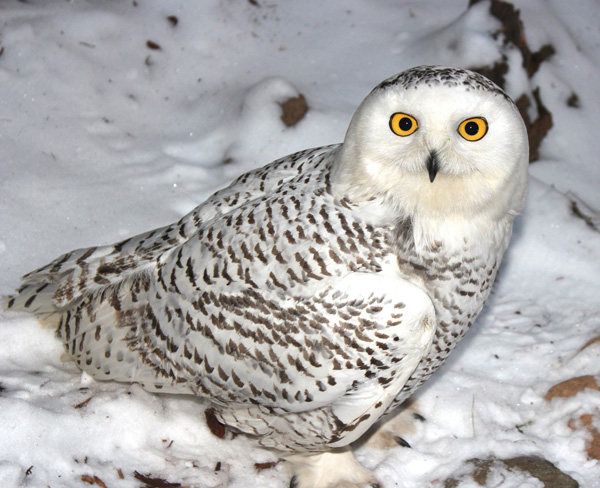
Wildlife rehabilitator Carlton Burke was checking his email on a Sunday afternoon in December 2013 when he opened a startling message: A snowy owl had been spotted near the small mountain town of Rosman, North Carolina, about 10 miles from Brevard. It was clear from the photo that, unlike other “sightings” of the Arctic avian, this one was real.

Burke and his wife Vicky, a nature artist, scrambled to pack their gear, drove from their Mills River home and found the bird flying normally. But Burke noticed that one time, when it landed on the ground, it stumbled a little, so he left his contact information with a neighborhood resident, just in case.
“Sure enough, the very next afternoon I got in and had a voice message from another neighbor about a quarter of a mile away from where we spotted the bird,” he says. “The bird was in his yard and could not fly.”
A veterinarian confirmed that the young owl weighed only half what it should and was suffering from some sort of infection but was otherwise in good shape. Burke began nursing Tundra back to health and started making plans to transport it back to the Canadian border. But the bird soon lost three of its eight talons, making it non-releasable in the wild, so Burke secured a permit from the U.S. Fish and Wildlife Service to include Tundra as part of his Carolina Mountain Naturalists program, which gives live animal and nature presentations at schools and other facilities.
So where did Tundra come from and how did he end up in the Blue Ridge?
According to wildlife experts, a handful of immature snowy owls always migrate a bit farther south than their natural Canadian-border range, usually because they haven’t developed the skills to hunt in the frozen snow. Even so, the nomads generally end up in only a few northern states, and a few of the cold-loving adults actually head north instead. But the winter that Tundra appeared in western North Carolina was colder than normal, triggering an “irruption,” or sharp increase, of snowy owls in spots where conditions resembled those in Canada. That season, a few were spotted as far south as coastal North Carolina, Jacksonville, Florida, and even Bermuda. One malnourished bird was found on a Kentucky roadside but didn’t survive. All were spotted in open areas, including pastures, dunes and airport runways.
“It could be that Tundra just wasn’t finding enough food or he had the urge to check out new areas,” says Burke. “But coming very far south is a long trip for a bird like that. That’s a long, long flight.”
Tundra, who now weighs a normal four pounds, is the first documented snowy owl in western North Carolina since 1892.
“It’s probably a once-in-a-lifetime thing,” Burke says. “It was an unprecedented, very exciting year.”
Last winter, a few stragglers ventured into the U.S., but the number paled in comparison to previous years. Bird watchers, some of whom drove from other states for a glimpse of Tundra when he was first sighted in Rosman, have been hoping the snowy owls will return. And Blue Ridge locals occasionally report what turn out to be barn owls, which look solid white underneath when they’re flying.
“People want to see something rare like that, but we have to take some of those sightings with a grain of salt,” says Burke. “But if it’s in the wintertime, there’s always a possibility.”