Blue Ridge Parkway: An Immigrant’s Story

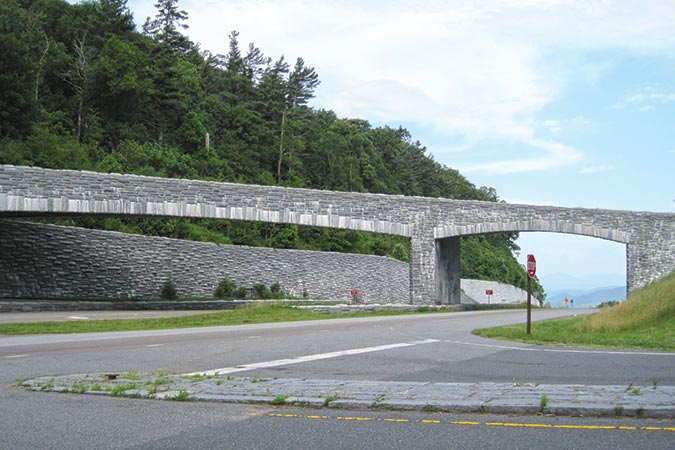
Of the U.S. 421 bridge near Boone, North Carolina, Frank Troitino said the rockwork was too uniform, and was not a parkway “old job. . . . not the way they taught us."

Here’s a story I never knew, until I started working on this article. It’s gleaned from a 2003 interview conducted by Philip “Ted” Coyle, with Frank Troitino, a nephew of the Spanish stonemason Joe Troitino, who was involved in building 75 percent of Blue Ridge Parkway stonework built between 1935 and 1969, his nephew estimated, and much of it thereafter, until his death shortly after the parkway was completed in 1987. 

Joe Troitino first came to the United States in 1914, at age 14; because he was too young to work, he faked his birth certificate. He and a friend returned to Spain briefly, and were barred from re-entry to the United States because the friend’s visa had expired. They went to Canada, where Joe’s U.S. visa also expired. When they tried to sneak into the country at Niagara Falls, they were arrested and jailed for six months before a Catholic priest was able to spring them. Thereafter, they worked in Vermont stone quarries and West Virginia coal mines, and as stonemasons, skills they had acquired in Spain. When they got word of a roadbuilding project through the mountains in Virginia and North Carolina, they applied for parkway stonemasonry jobs and got them. The friend died young, but Joe Troitino continued to do government contract work, not just on the parkway but in the Smokies and in Washington, D.C., into his 80s.

Frank Troitino, who also worked on the parkway as a stonemason, explained the fine points of early parkway stonemasonry to Coyle. Stone had to be quarried within 50 miles of where it would be used: that was a parkway requirement. Masons split the rock into blocks by hand to parkway specifications: blocks had to be a minimum of six inches tall  and could be one and a half, two or three times as long as tall, but no “big, enormous rock” anywhere. The masons took particular care, too, he said, that joints were uniform.

By the time the double-span U.S. 421 bridge and its extensive retaining walls—all rock faced—were constructed, blocks were machine-cut, and, he thought, minimum block height had been reduced to four inches. For that much rock work, block dimensions should have been larger. The uniformity of the rock work makes it look “more or less like a fireplace, not a real Blue Ridge Parkway old job.” People like it, he said, but it’s “not what they taught us.”
You Might Also Like:

A Virginia Historical Marker stands at the entrance to Green Pastures.

Green Pastures’ picnic area was build by the Civilian Conservation Corps in the late 1930s.

Green Pastures Reborn

When it officially opened in 1940 — in the depths of the Jim Crow era — Green Pastures was likely the first U.S. Forest Service recreation area in the nation constructed for African Americans.
Chimney Tops Trail in Great Smoky Mountains National Park rewards a steep climb with exceptional mountain views.

Inset: Gatlinburg, Tennessee’s Chimneys Picnic Area sits beside the West Prong of the Little Pigeon RIver.

11 Picnics with a View

These bucket-list destinations are perfect spots to kick back, enjoy a delightful meal and take in the great outdoors.
Vernon and Toni Wright turn grains grown on their family farm into freshly distilled spirits.

Virginia Century Farm Home to New Distillery

For nearly 200 years, Vernon and Toni Wright’s family has raised corn, cattle and quarter horses at Hill High.
Spring wildflowers bloom early in the New River Gorge of West Virginia. From the photographer: “Bloodroot is one of the first to blossom, fittingly coming in around the first day of spring. The reddish sap that exudes from all parts of the plant — especially the root — when cut is what gives bloodroot its common name.”

Scenes of Spring: A Photo Essay

Our contributing photographers reveal the fresh sights and subtle joys of the season.
At Hayfields State Park in Highland County, Virginia, easy-to-moderate trails wind through quiet forests and past historic structures.

Greening the Blue Ridge Region

New Parks, Healthier Creeks, Solar Power, Protected Lands and More.
John Scrivani bags female flowers from atop a 40-plus-foot-tall chestnut.

The Good Steward

Veteran forester John Scrivani dedicated his career to restoring American chestnut trees — and helped lay the groundwork for the effort’s next generation.
The pond next to the visitor center entrance is easily accessible and a beautiful spot for a selfie or an afternoon of plein air painting.

How to Make a State Park

The opening of Virginia’s newest state park marked the culmination of a community dream carefully nurtured for more than a decade.
Daybreak at Elakala Falls in West Virginia’s Blackwater Falls State Park on a perfect winter morning.

Quiet Beauty of Mountain Winter: A Photo Essay

Our contributing photographers braved the chill to capture the calm of the cold months.
The original Academy burned in 1911.

Curios: When Lynchburg, Virginia, Was King

With the likes of Douglas Fairbanks, Duke Ellington and Louis Armstrong performing live, the little city with the highest per capita income in the U.S. was a national hotspot for entertainment.
Hendersonville, North Carolina, offers a walkable downtown.

Slow Travel in 7 States

It's perfect for the mountains!

CALENDAR OF EVENTS