Skip to content


As the editors and staff of Blue Ridge Country have looked for the impossible—a way to express our sorrow and our hopes for those most affected by Hurricane Helene’s mountain-region destruction—we settle upon the writing of someone who loved her tiny piece of Western North Carolina perhaps as much as anyone has ever loved a piece of land. Elizabeth Hunter, who died in 2022 at age 75, lived for more than half her life in her adopted home of the Bandana community in Mitchell County, for which she wrote a book celebrating the county’s 150th anniversary. She wrote for us from our inaugural issue in 1988 until 2014 (and occasionally thereafter), and this piece is emblematic of not only writing that won her Gold Awards from the International Regional Magazine Association’s annual competitions year after year, but also of her Thoreau-like dedication to where she lived and how she lived. This is her column from the September/October 2001 issue. May we all come to reach her level of appreciation of where we live, whether climbing up from the rubble or lucky enough to have escaped that terrible challenge. She titled this column, “Celebrating 25 Years: Nearly half a life in one place enriches that life in ways unforseen.”
Photo Above: Elizabeth Hunter’s love for and dedication to the land was a hallmark of her life.
This September, I celebrate 25 years of living in this house, on this acre, in this place. On evenings like this, the third weekend in May, when I’m putting in my garden and we’ve had a half hour of rain in the driest spring any of us can remember, I feel greatly blessed. I’ve just taken a bath. I’ve washed away the grime of gardening, of mulching, of painstakingly transferring water from barrels under my gutter spouts to storage barrels in my front- and backyard gardens.

Like the world I look out on, I am moist now instead of parched. In my side yard, the indigo buntings and house finches are emptying a feeder I’ll have to refill in the morning. There is no wind. In the last week, the trees have darkened almost to the green of summer, like lights being dimmed. “To everything there is a season.” Yes. The season for trees occupying center stage is over now; they’ll be backdrop ‘til fall, when they’ll perform a flaring encore. The blackberries are in exuberant bloom, as are the multiflora roses (plenty of them!), purple rhododendron, yellow iris, Japanese iris, peonies and early roses. The first fireflies rise from the weeds. Five days ago, the season’s final frost whitened the grass in a low spot of pasture I drove by on my way to town. Blackberry Winter, too, a month ago—snow and biting wind.
I have been anticipating my silver anniversary of peaceful coexistence with a place I love—a small ridgetop cabin set in a clearing—for several years. That it coincides with a period in which I have contracted for more work-for-hire than I’ve allowed myself to take on for perhaps a decade is unfortunate, though I have good reason: I’m buying a car. Whenever I tell people I’m surfeited with work, their invariable response is, “That’s great!” I beg to differ, even if it’s wonderful work, which all of it is. Because I’m painfully aware of what I’m missing when I’m away from home—or at home, with my nose to the computer screen. Renting my brain—the way I think of work—cuts into my thinking time, my gardening time, my caterpillar-raising time, my walking-the-dogs time, my giving thanks-for-this-place-and-life time.
My chimney swifts returned on April 6—three of them (only three, of the two dozen or so that lived in my chimney before they left last October). That was six weeks ago, and I have not yet—not one single evening—lain on the deck and watched them wheel through the skies the way I did last spring and summer. I did see them, up there in the ragged gray clouds swooping and chittering, before it had even stopped raining this afternoon. So high as to be all but invisible, up where the lightening forked and flashed only a few minutes earlier, they cast caution to the winds. Their trajectories traced the great sweeping “thank you, thank you” that welled within me for full water barrels and a heady, almost forgotten fragrance of rain wet earth.
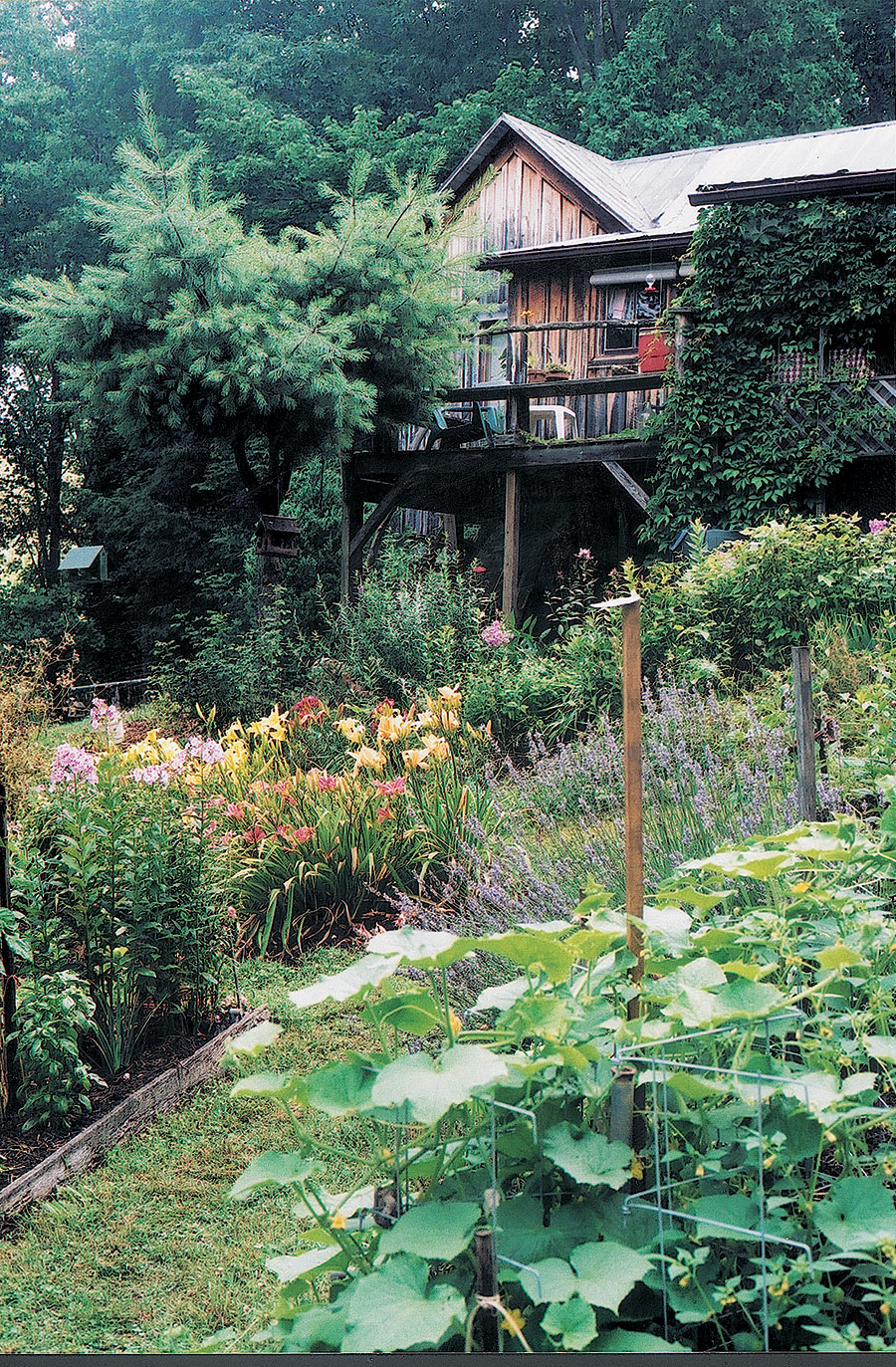
This is the kind of capital I value and hoard—not certificates of deposit but the accumulated earnings and interest that accrue in a life account from a bone-deep devotion to “knowing my place.” Cultivating calendula and cabbages, I’ve implanted a global positioning system (“if the Joe-pye weed is blooming it must be August; if the fledgling dowry and red-bellied woodpeckers are learning the route to the suet feeders, it’s got to be June.”) that charts my course. The wealth I aspire to is obtainable only by being here, quietly attending to and working within a small, intimately experienced corner of the world.
“I cannot but regard it as kindness in those who have the steering of me that, by the want of pecuniary wealth, I have been nailed down to this my native region so long and steadily, and made to study and love this spot of earth more and more.” Henry David Thoreau wrote in his journal on Nov. 12 1853, “What would signify in comparison a thin and diffused love and knowledge of the whole earth instead, got by wandering?”
I came across this passage several years ago, and have been thinking about it ever since. Although I’m a native New Englander, I’ve spent more than half my life in East Tennessee and Western North Carolina, most of it here. I recognize that as a kindness. My love for this spot of earth is thick as blood now, though it was “want of pecuniary wealth” that chose it for me. In two years of reading real estate listings, this place was the only one in my price range. Living here at first taught me to make do with what I had. Then it showed me that what I was making do with was all I really wanted. The life this place has given me has enriched me in ways I had no inkling of, the afternoon when I first parked my VW Bug between the two hemlocks that still flank my driveway.
I started this column a month ago; it’s mid June now. Time to look for turtles in the yard, especially MG 75, a venerable veteran with initials and a date carved on his back, whose story I told in this column five years ago. Every year but one since then, his paths and mine have crossed. He’s so old now that he’s losing the horny plates that cover his shell; he may not have survived the winter.
As for others I’ve written about here, the black snake who claims the tomato stakes in my garden shed defended them from me again this spring. The wrens—maybe the same pair whose nest the snake destroyed a year ago—successfully raised their first brood in a nest that neither he nor I discovered. (I did see a troupe of vociferously begging babies following their harried parents around, however, which is how I know this.) The wood thrush continues to sing.
And just yesterday, passing the terrarium in which I stored cocoons over the winter, I was amazed to discover an hours-old luna. (Two others had emerged May 17; I’d thought the remaining cocoons weren’t viable and was planning to throw them out.) By late afternoon, another pale green beauty had also emerged. Both had the skimpy bottle-brush antennae of females. Later, sweeping my library floor, I glanced up and saw a third luna, with a luxuriant antenna of a male, resting on the window screen. I knew then that, though I couldn’t smell it, the females were releasing the ambrosial pheromone that the satellite dish male antennae intercept and follow to their source. On the porch, I found a second male not far from the first. After dark, I let the females go. I wondered how their romances were progressing, hours later, when I awoke to thunder and rain.
My silver anniversary approaches. I still don’t know how I’m going to celebrate it, though the party in the yard is already in full swing. My power contribution thus far has been limited. Evenings, while I listen to Anthony Trollope and tapes teaching me to bird by ear, I’m painting the walls of several rooms white. When I finish the walls, I’ll paint the floors green. Before cold weather sets in, the husband of my friend will repair leaks in my front and back porches, and do some other work to shore up the place. With luck, I’ll find time to pick the raspberries, fending off the squash borers, and spend an evening or two on the deck watching the swifts before they depart for Peru in October. And, as day follows day, I’ll wonder at (and give thanks for) the kindness of those who have done the steering of me that they nailed me to this sweet and sustaining spot. That, I think, will be celebration enough.
To read more of Elizabeth Hunter’s writing for the magazine, go to blueridgecountry.com/elizabethhunter. To read entries from the journals that she kept for much of her time in Bandana, go to elizabethhunter.substack.com.
The story above first appeared in our January / February 2025 issue.