Skip to content


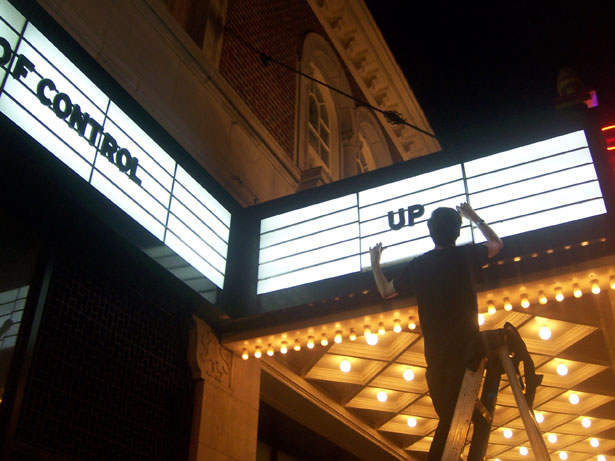
My husband and I rounded the corner from Pop’s Ice Cream last Saturday night to see Jason Garnett up on a ladder, replacing a fluorescent in the Grandin Theatre marquee. “One bulb was a ‘daylight’ bulb and the rest were ‘cool white,'” he explained later, and it was bugging him. “I was fixing it so they would all be uniformly the same.”
Some history: The Grandin was built in 1931 and first opened in 1932; it operated as a movie theater until the mid-1970s and then was home to (live stage company) Mill Mountain Theatre, then reopened as a movie theater and live music hall in the early 1980s. In the mid-’80s its new owner, Julie Hunsaker, brought in art house, indie and foreign films. The theater closed in 2001, but community support and a matching grant from the city allowed it to reopen, renovated, a year later.

Today, if my husband and I go anywhere else for a movie, it’s an extenuating circumstance – we’re out of town, or friends have invited us elsewhere. Cineplexes just don’t feel right anymore. We like the Grandin, where we can get a Stewart’s crème soda or a cup of hot tea with our popcorn and Raisinets. And the 15-person staff loves movies too – you can tell they’re not just there for the paycheck.
“Thursday nights we’ll watch the [incoming] movie with most of the staff,” says Jason, so they know and can answer questions about the new films. And, “you’ll always get a straight answer” if you ask them how a movie is. “We’re very honest.”
The Grandin has four screens with not-quite-soundproof walls between them (every now and then you’ll hear pyrotechnics or heavy music scoring from the next room over). The old balcony was separated years ago into two more small theatres, but the big auditorium still feels cavernous and old-fashioned enough. The Grandin shows a good amount of first-run stuff – we saw “Star Trek” there a couple weeks ago (aside: they did it right. It’s what Lucas should have done with episodes I through III of his Star Wars franchise and sadly didn’t) – but they also show what we come for (especially my husband, who is a longtime lover of good films) – independents, foreign and older films you can’t catch at the cineplexes. The Grandin showed “Farenheit 9/11” when no one else in Roanoke would. We saw “Citizen Kane” on the big screen there one Saturday morning, and “The Shining” one midnight. They show Bugs Bunny cartoons and they’ve started a quarterly open projector night where aspiring filmmakers can show their work.
We see Jason when we come in and out of movies and say hello, but haven’t really stopped to talk before – he’s always busy. This particular evening, once he climbed back down the ladder, he and Phil had a lengthy conversation on the sidewalk about their passions for movies, and I called him a few days later to talk more.
Jason might have film in his blood. His great-grandfather played drums in an orchestra for a silent movie theater in Charleston, W.Va., where he met Jason’s great-grandmother. His parents would take him and his younger brother and sister to the drive-in movie theater –the Trail Drive-In, in Cloverdale – “they’d put us in our pajamas,” and go to a double feature. The whole family would watch the first movie, and his parents would watch the second one while the kids slept in the back seat. “That’s my earliest movie memories.”
His mother raised them on history, and his father was mechanically inclined, so the combination of art, age and projectionist equipment are a perfect blend for Jason, who started at the Grandin as a night janitor, then as a projectionist, working his way up to general manager.
And it’s not just the theater experience that’s important to him and to the Grandin patrons, it’s the film experience, especially in an age when everything’s going digital.
“They both have their place,” he says – “…I’m not going to sit here and say I’m a film-only guy.” Digital allows many more people to make films who wouldn’t otherwise (he doesn’t make them really himself, except playing around some with a super 8 camera), and it saves theaters money and allows for certain special effects, but “digital is almost too perfect, too beautiful,” he says. With film, “you sort of fall in love with the imperfections… maybe a little scratch, or a jerkiness in the film.”
It’s harder and more expensive to get film prints, so the Grandin usually rents digital copies for their Saturday morning classic movie showings, ironically enough, which are underwritten by a retirement community in Roanoke. And royalties – Jason says as much as 75 percent goes back to movie studios – make showing any movie expensive. The mainstream movies bring in more audience, and the concessions help pay for the costs, and that makes it affordable to bring in the smaller, art-house movies too.
“It seems like every month I’ve heard about another theater closing down,” says Jason – though I think, and I hope, the Grandin has found a good balance, and a loyal community. “It’s a tough thing… I see in the future, 10, 20 years down the road, there’ll just be a few scattered around the country, fighting the good fight.”