Skip to content


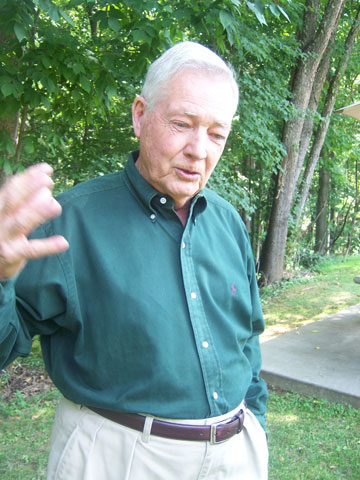
The first harbingers of fall: The students are coming back to school, packing cars and heading to Virginia Tech and Radford University and Roanoke College and Hollins, meeting roommates and buying textbooks. I miss being a student at this time of year, and next week I’ll get a little dose of it as I sit in on my first lecture class in… well, more than a decade.
That class will be Bud Robertson’s Civil War lecture, a class that usually enrolls about 300 students (yes, 300 college students clamoring to take a class in late 19th-century American history!). I’m not staying long enough to take a quiz or write a paper, just long enough to see how he and his students start the semester.

Bud Robertson – James I. Robertson, Jr. – has long been known beyond the Virginia Tech campus in many areas. For years his voice was familiar to public radio listeners as southwest Virginia’s voice of the Civil War, telling stories every week on WVTF‘s broadcasts (a series which ended in 2007), bringing soldiers’ letters and diaries to life, bringing home to the 21st century the day-to-day fears and losses and joys and lessons of those years back in the 1860s. Dr. Robertson has four degrees from three Virginia institutions, has written or edited more than 20 books and is executive director of the Virginia Center for Civil War Studies, established by Virginia Tech in 1999.
I sat down with him last Thursday at the Blue Ridge Public Television studios, doing a first interview in advance of our November/December issue. I talked with him and with producer Jim Hammerstrom; they are working together on a new documentary (the latest in a series of collaborations since 1996) in partnership with the Sesquicentennial of the Civil War, a three-hour film that’s also being produced in nine 20-minute segments designed for classroom teaching. They’ll be distributed to schools throughout the Commonwealth of Virginia later in the school year.
We talked about the logistical challenges of filming (battlefields with background highway noise, for instance) and the emotional challenges of filming – I was nearly in tears as Dr. Robertson described the bloodstain still left where a soldier had died in the balcony of a church. “That was a one-taker,” said Hammerstrom. I found it moving that after so many years of studying, writing, teaching and advising on the subject of the Civil War, the humanity and the tragedy of the war are still as close to his heart as ever.
“We didn’t lose just them,” said Dr. Robertson of the as many as 700,000 soldiers who died during those four years. “We lost all the things they could have done. We lost their children and their grandchildren… we just cannot measure what those guys could have given, had they lived.”
The project with Blue Ridge Public Television is wrapping up. It involved 20-something interviews, eight hours of aerial shooting from a helicopter, trips to Antietam, Harpers Ferry, Petersburg, Richmond, Appomattox, Annapolis, and hundreds and hundreds of hours of high-definition footage to edit. The Salem High School band in Salem, VA performed “Shenandoah” for the soundtrack – “You’re not going to make music today,” he told them, “so much as you’re making history.”
A preview of the documentary is online at Blue Ridge PBS, and I’ll blog next week from Bud Robertson’s classroom.
More links:
• Dr. Robertson’s author page on Amazon.com
• Dr. Robertson on the Virginia Foundation for the Humanities radio show “With Good Reason“
• The film “Gods and Generals,” for which Dr. Robertson served as chief historical consultant; the movie was based on his award-winning biography of Stonewall Jackson.