Skip to content


The presence of salt gave the tiny mountain town its name. The geology and hydrology since have resulted in a surprising present-day existence.
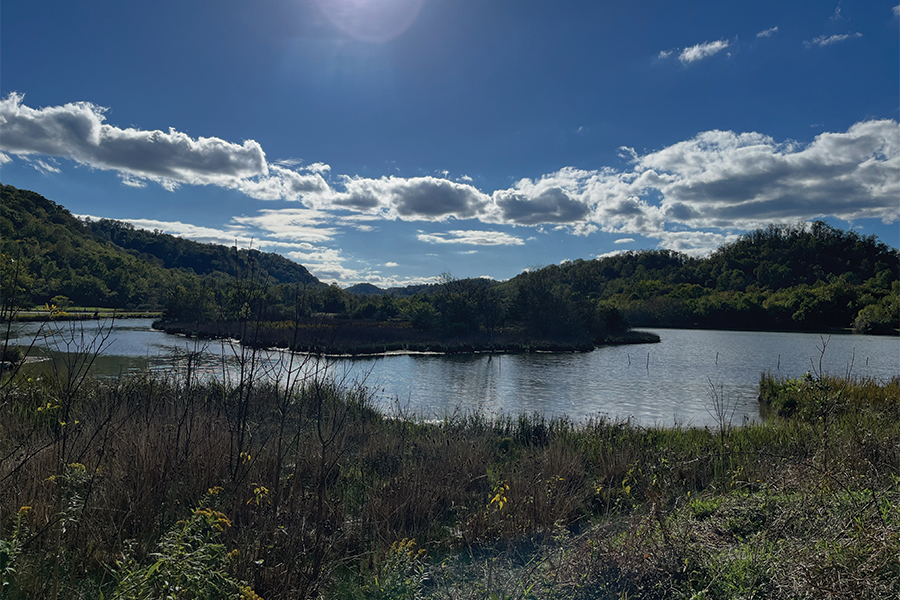
Photo Above: This body of water is what remains today from Lake Totten of centuries past. Courtesy of David Golliher.
Tiny Saltvillle, Virginia, boasts a history worthy of a much bigger town.

Today, the remains and rebirth of that past present a geologic and hydrological puzzle involving everything from 1700s lakefront property to a slightly salty mountain marsh lining manmade ponds to some of the finest cattle-grazing lands anywhere.
The southwest Virginia town earned its name from rich salt deposits beneath a scenic valley once covered by a swampy natural lake.
“Lake Totten was an early natural one, not salty, but with brine springs,” says retired biologist Doug Ogle, who taught at nearby Virginia Highlands Community College in Abingdon. The springs are the thing. From Seven Springs to Hot Springs, they’re all on the same fault.”
Scientists theorize the ancient Lake Totten formed from the natural damming of a watercourse with a cut-off channel, which may explain why so many cobblestones have shown up in the Salt Valley of southwest Virginia, says Janice Orr, a retired teacher who manages the Museum of the Middle Appalachians in Saltville.
“Saltville is kind of a bowl,” says Monica Hoel, an avid birder and a Virginia Master Naturalist from nearby Emory.
This bountiful bowl with a bounty at the bottom — layer upon layer of salt deposits lying beneath the surface — must have been shaped by Mother Nature to hold Lake Totten, named for a prominent Saltville family.
In the 1700s, early Salt Valley settlers lived on waterfront property at Lake Totten, leaving behind at least one letter, saying how they could walk across the swampy water in what is now Smyth County, Virginia.
“Lake Totten was drained in the middle of the 19th Century to create pasture,” says Ogle. “The then-dry lake bottom was extremely nutrient-rich from sediments and became a showplace for cattle raising.”
Saltville cows were shipped as far as the United Kingdom, according to Ogle, until this same lakebed was tapped to drill salt wells a few years later — beneath the bowl.
“As the salt layers were extracted, the pasture began subsiding — until the current recreated ponds were formed,” says Ogle.
Those ponds are now the new Saltville lake in the same basin as Lake Totten. These man made “well fields” span a few dozen acres with barely brackish water, ringed by a rare inland saline marsh containing saltwater-loving plants.
“They should not be called ‘salt ponds,’ as they are freshwater and have been becoming more so since the brine wells ceased operations in the 1960s,” Ogle says. “They will support freshwater fish.”
Ogle figures what’s fresh is next. Salt was on the surface here only in early brine springs and through the process of using wells, he says. “Surface salt concentration was temporary and no longer exists. The salt-tolerant plants are disappearing.”
This part of the original lakebed is now Saltville’s Well Fields Recreation Area. “It’s like Disneyland for birds,” Hoel says. “You pretty much get an amazing surprise every time you go over there.”
Egrets, geese, gulls and ducks might be seen among the 200 kinds of birds reported here, including “this insane array of warblers that will either pass through or stay there in the summertime,” Hoel says. “That whole area there is considered unique to the mountains.”
The story above first appeared in our January / February 2026 issue.