How does an out-of-the-way mountain town—pretty much left for dead a few decades back—make a comeback? It’s a long story that finally comes down to this: creativity and courage.
It’s a familiar story: company towns dependent on a single industry shriveling and, sometimes, disappearing when factories close up shop.
Mining in Appalachia. Textiles in South Carolina. Steel in the Rust Belt. Railroad shops across the East.

Traveling the Blue Ridge, I’ve seen plenty of these left-behind towns, their main streets lined with empty storefronts. But I’ve also seen small towns that have beat the odds, reinventing themselves with creativity, passion, and a lot of hard work. I call them Phoenix Towns, the ones that rose from the ashes of what was into the blue-sky possibilities of something new. It’s time to tell the stories of these towns—they’ll open your eyes, pique your curiosity, and make you want to see for yourself what hope and tenacity can do in these mountains.
If you lived in Clifton Forge, Virginia in the late 1940s, odds are that the Chesapeake & Ohio Railway paid your bills. Two thousand of the city’s 5,800 residents worked for the C&O. More than a hundred passenger, coal, and freight trains rolled daily through Clifton Forge. In the shops, steam engines were tuned up and then went on their way. But with the advent of the more durable diesel locomotives in the 1950s, the Yards grew ominously quiet as workers were transferred or laid off.
What do you do with a railroad town when the trains stop running?

In Clifton Forge—which reverted to town status in 2001 after a 40-percent population loss—the answer is, well, artful.
“Art has been around this place for a very long time,” longtime resident and artist Bari Ballou says. “When we talked about bringing life back to Clifton Forge, it was the incredible artistic energy in the Alleghany Highlands we kept coming back to.”
The result was the Alleghany Highlands Arts and Crafts Center, which opened in 1984 with a gallery, a shop selling juried fine art and crafts, and art classes. Over the past 34 years, the AHACC has hung 445 exhibits that have attracted over 300,000 visitors. Exhibits like the Fischer Collection of German Expressionist art, which left the AHACC Gallery to travel to its permanent home in Richmond’s Virginia Museum of Fine Arts. An early exhibit of Sally Mann photographs. Work by nationally recognized painter Joni Pienkowski. And work by centenarian railroader Allan Hickman, whose paintings of the steam trains he used to work on are so real you’d swear you hear wheels on track.
Executive Director Nancy Newhard says it was the solid business plan and large volunteer workforce that brought her to the Center in 1989. That, and the understanding that the Center could show “not only what was, but what could be.”
With the longstanding success of the Arts Center as model, other arts are flourishing in this small railroad town. At the two-building Clifton Forge School of the Arts, you can work with stained glass, learn blacksmithing, throw pots, paint and sculpt and carve, learn to play the violin and the piano, practice yoga and meditation. There are concerts and craft fairs, bluegrass jams and a brass ensemble.
Like the Arts Center, the School of the Arts began as with a savvy, committed group of volunteers who believed a dying railroad town could be something different. They learned the ropes, found and renovated the space, and didn’t give up. In his book “TOWN INC,” Andrew Davis calls these traits the Law of the Town Visionary: Optimism, Imagination, Tenacity.
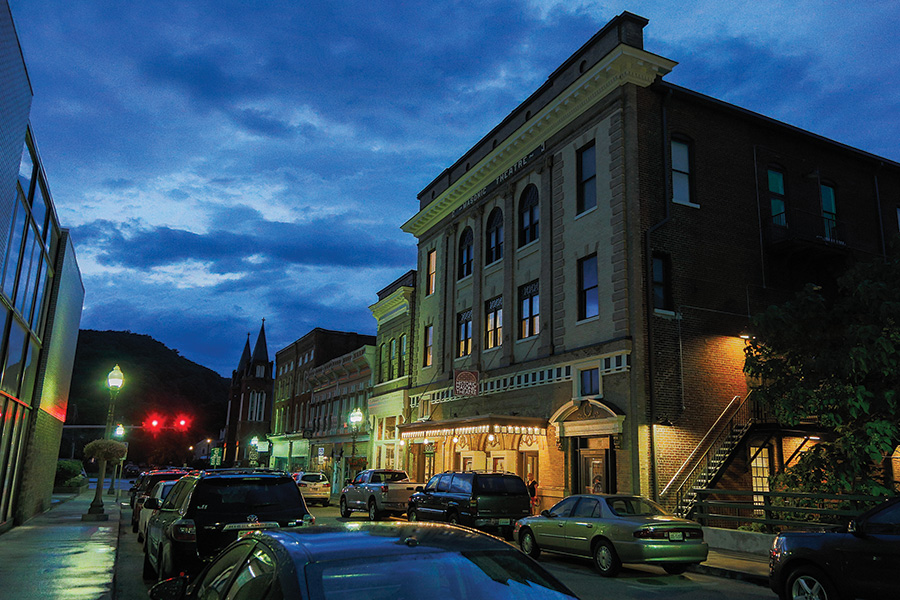
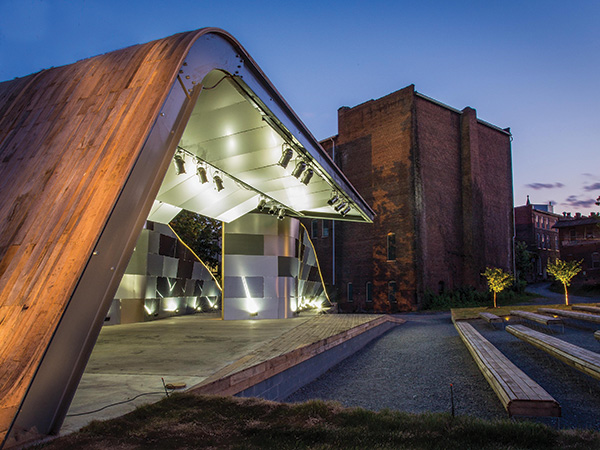
Exactly what the late John Hillert brought when he and his wife Gayle moved to Clifton Forge. He looked at the deteriorating, four-floor Masonic Theatre in 2007 and knew that the building could again be an elegant gathering place, drawing together both local audiences and visitors from across the country. After nine years of planning, fundraising and hard work, the restored Historic Masonic Theatre re-opened its doors in 2016. The Masonic Amphitheatre, designed and built in partnership with the Virginia Tech Architecture School, sits nearby. Together, the theater and amphitheater have welcomed more than a quarter million patrons over the past few years.
“We heard again and again, “It’s a good idea, but it will never happen,’” Gayle Hillert says. “And then people began to believe.”
Optimism. Imagination. Tenacity. The phoenix rising from the ashes. A hard-luck western Virginia railroad town becomes a center for the arts, and new businesses come to Main Street: a photography and metalwork gallery, a quilting shop, antique shops and an upscale consignment shop. A friendly tavern that welcomes all ages, and a craft brewery. A six-storefront hardware store selling everything from hammers to Himalayan salt lamps.
And the railroad? Its presence continues in the Alleghany Highlands, where you can ride 15 miles of converted railroad bed on the Jackson River Scenic Trail, with kayaking and canoe livery in the offing. Where the C&O Historical Society has its international headquarters and archives, and the C&O Heritage Center invites you to tour vintage steam engines and rail cars from the past. Where Houff Corporation has moved to the Clifton Forge railyards, bringing new life to rail-truck transport.
People who have lost heart, believing that new things are possible—that’s the definition of hope. That’s Clifton Forge, Virginia.
Want More?
The story above is the first entry in a brand new column—Our Blue Ridge Towns—and appears in our Sept./Oct. 2018 issue. To get future editions of the column, and more from the current and future issues, subscribe today or log in to the digital edition with your active digital subscription.