Skip to content


The story below is an excerpt from our May/June 2017 issue. For the rest of this story and more like it subscribe today, log in to read our digital edition or download our FREE iOS app. Thank you!
Fads came and went fast in the 1960s. The nationwide explosion of paper fashion was centered at one manufacturing plant in Asheville, North Carolina. The owners, who still live in Asheville, were temporarily and completely overwhelmed, and became nationally famous during their own “15 minutes.”
For the Complete Mars Paper Dress Story and More . . .

This piece is excerpted and adapted from Marla Hardee Milling’s new book, “Legends, Secrets and Mysteries of Asheville,” due on June 26 from The History Press. The book contains 12 chapters of fascinating stories from in and around Asheville. For information or a copy visit arcadiapublishing.com.
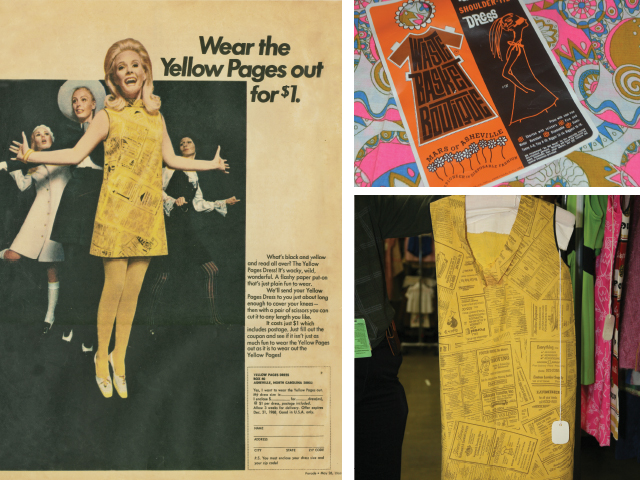
The high point of the brief 1960s fad of paper dresses may have been the week after an October, 1968 edition of Parade magazine, which carried a full-page ad featuring a model wearing a paper dress and bright-yellow tights.
The headline read, “Wear the Yellow Pages Out for $1.” The ad copy carried out the tease: What’s black and yellow and read all over? The Yellow Pages Dress! It’s wacky, wild, wonderful. A flashy paper put-on that’s just plain fun to wear. We’ll send your Yellow Pages Dress to you just about long enough to cover your knees—then with a pair of scissors you can cut it to any length you like.
Customers cut out the coupon, filled in their address and then mailed it with their dollar (postage included) to a P.O. box in Asheville, North Carolina.
Two days after the ad ran, Mars Hosiery of Asheville received about 5,000 envelopes.
“The next day, we received 25,000,” says Bob Bayer, co-owner of the company with his wife Audrey (“Audie”). “The next day, 50,000. We were overwhelmed with [just] two secretaries.”
They hired a local firm—Daniel’s Graphics—to provide fulfillment services.
With the sudden, overwhelming demand for paper dresses came sudden, unexpected fame. The Bayers appeared on the TV shows “To Tell the Truth” and “What’s My Line?” and saw their company and products featured on “CBS Evening News,” on the front page of the Wall Street Journal and in many other publications, including the London Times, The New York Times, Business Week and Forbes.
They were also amazed at a spread that Vogue magazine created featuring their products.
“They started out with a full-page photo showing a model wearing one of our paper jumpsuits,” says Audie.
“When you opened it up, there were three or four pages about the company and the dresses.” Bob adds, “For Audie, who was a liberal arts major, to get this level of recognition as a designer was incredible.”
The national profile for the Asheville-produced paper dresses also involved New York-based retailer Abraham & Strauss Department Stores, precursor to today’s Macy’s. A & S created a separate department in all their stores called Waste Basket Boutique for the dresses and related disposable clothing
The apparent overnight success of Mars actually ran quite a bit deeper. Audie is the daughter of Morry Bard, who opened Mars Hosiery Manufacturing in West Asheville in the 1940s.The plant produced women’s hosiery with seams running up the back, and then became the first company in the United States to produce pantyhose. Audie left Asheville as a teen to attend Cornell University, and she met her soul mate, Bob, in her second week at college. They eventually married and returned to Asheville. Her father needed an engineer, which was Bob’s chosen field, and they decided to see what contribution they could make to the family business.
Bob witnessed the declining profit margin in the hosiery business and turned his attention to disposable goods. He first focused on making disposable undershorts for army soldiers to wear in Vietnam.
“We made a lot of samples and sent them into the field, but the material was not as sophisticated as it is now,” Bob says. “It caused a lot of chafing and would also cause little pieces of paper to fall down a guy’s legs. Our real goal was to get into the medical market, but we knew the only way we’d get in would be to create a buzz through fashion. We started experimenting with paper dresses.”
A brief foray into the market by national paper company Scott (see sidebar) provided Mars with its opening.
“We jumped right in,” says Audie. “We were ready. The Scott thing was the impetus for us to carry on. We were at the right place at the right time and young enough to take a chance.”
Audie had studied English at Cornell, but with the company’s new direction, she stretched her creative skills by designing the dresses—everything from choosing the paper prints to deciding on style and size along with the paper packaging.
“There was a wallpaper printing company in Appleton, Wisconsin, and they sent us books of their discontinued designs,” says Audie. “I had so much fun going through the pages and choosing prints to make A-shape dresses. Many were pop and mod; some were pretty wild.”
Once the designs were selected, they were printed on their material and then shipped to Asheville for production. Hundreds of employees worked to cut and assemble the dresses.
The dresses were packaged in plastic bags with a front cardboard insert decorated with their logo: a paper doll dress cutout with the words “Waste Basket Boutique” running across it. Above the dress was a circle cutout, where the doll’s head would be, to display the dress print. Beneath the dress read, “Mars of Asheville” above a row of daisies. Under the flowers, read, “The Pioneer in Disposable Fashion.” The other side identified the style of garment along with the size guide: Teeny (4–6), Tiny (8–10), Bigger (12–14) and Biggest (16–18). It also provided instructions—press with cool iron, shorten with scissors; fire and water resistant—along with a “Do Not Wash” warning.