Skip to content


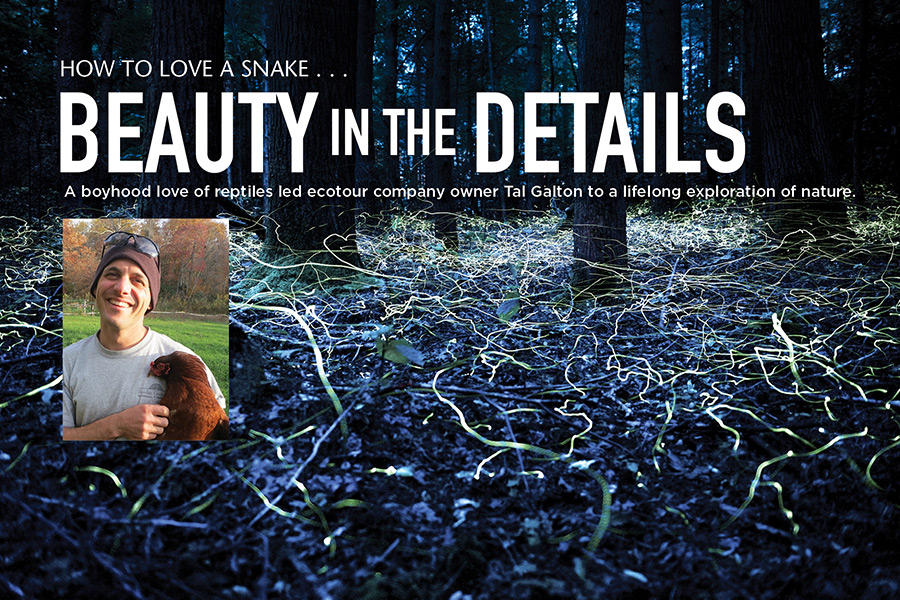
A boyhood love of reptiles led ecotour company owner Tal Galton to a lifelong exploration of nature.
Growing up in the San Francisco Bay Area, Tal Galton couldn’t get enough of the outdoors, especially if snakes were involved. “Some people are frightened by them, but I got a little adrenaline rush from seeing them,” says Galton, 45, who moved to North Carolina 23 years ago and now operates Snakeroot Ecotours in Celo, a small land trust community in the shadow of the Black Mountains in the western part of the state.

As a kid, Galton (his first name is pronounced “tall”) wanted to be either a baseball player or a herpetologist but ultimately majored in history at Haverford College outside Philadelphia, where he ran cross-country and track. He also spent a year studying at the University of Sussex in southern England, exploring Scotland and Ireland, and connecting with cousins he’d never met before.
“I was definitely a little disappointed by the wilds of England and Europe,” he says. “Those places have been so densely populated for so many years that they don’t really have the same kind of park systems and wilderness areas and extensive forests that we still have.”
After college, Galton set out on what would become a lifelong, unorthodox teaching career, not in history but in hands-on life sciences, starting as youth programs manager at the Museum of Life and Science in Durham, North Carolina, where he and his wife, Jessica, moved in 1996 to be near her family and raise their own.
In the summers, Galton oversaw crews of teenagers doing trail work in the Yosemite Youth Conservation Corps and did a stint as a naturalist in a state park in South Dakota. Later, he led students on trips to Cumberland Island and the Everglades.
Despite his generally introverted nature and a need to recharge alone, he says, “I really like working with teenagers, junior high all the way up to college. At that age, they still have lots of energy and lots of curiosity. I think that we, as a society, don’t give kids of that age enough responsibilities. They really are capable of doing a lot more than what we ask of them a lot of times as far as taking care of themselves and doing the real work to give back to their communities.”
In 1999, Galton and his family moved to the Burnsville, North Carolina, area for his new job as a trip leader, teacher, farm manager and administrator at the private Arthur Morgan School, named after the man who founded Celo on the South Toe River in 1937.
A self-described “modern-day homesteader,” Galton and wife Jessica designed their own timber-frame home from the wood of local trees. After sawing the logs and chiseling the edges to fit together, they hosted a community house-raising.
“As a big group of people, we sort of lifted it all up into place,” he recalls. “After that followed three years of hard work finishing it all up.”
Often referred to as a commune—Galton begs to differ because the residents are autonomous, with individual dwellings and jobs—Celo is home to about 50 families and a handful of businesses, as well as a summer camp and a health center. A number of residents are farmers or artists who share the land, help each other with projects, and collectively maintain the 1,100-acre property.
“That kind of community—we’ve lost a lot of that in our society,” says Galton, who raises vegetables and chickens. “So it’s a way for people to try to rebuild that [sense of camaraderie].”
As part of his work at the school, he’s led a number of weeklong backpacking trips through the woods near Celo.
“It’s a way for students to really get a feel for the place and also work together as a group to overcome the natural hardships of living outdoors for several days at a time,” he says. “It’s kind of a bonding experience.”
For the past four years, Galton has also served as labor coordinator for the Arete Project, a college summer program in which students work with “both their hands and their heads” in classrooms and outside.
In the spring of 2016, Galton funneled his years of experience as a nature guide into his own venture, Snakeroot Ecotours. The name holds multiple meanings, he says, including a reference to the reptilian “root” of his interest in nature as well as a prolific native plant called snakeroot. Growing more philosophical, Galton goes on to explain a psychological phenomenon that causes humans to love—or fear—nature.
“For instance, people love going to waterfalls. To our ancestors, it meant fresh water. To us, it’s beautiful. Our minds are programmed in really ancient ways to look at these things and have a deep sort of affiliation or appreciation of them.
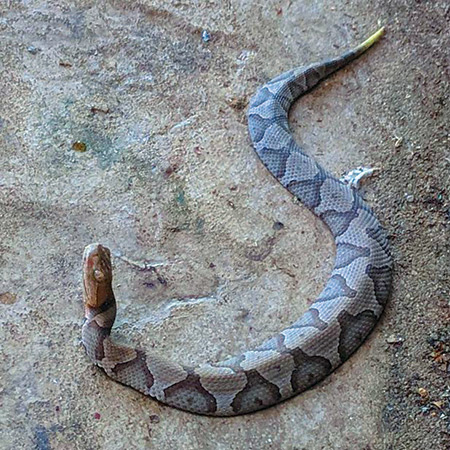
“We’re also fearful of things like spiders and snakes,” he adds. “The idea is that our really refined sense of vision may have come from our ability to detect snakes. I think that also sort of ties into what I teach: how to observe things in nature and how to see things that most people just don’t actually see. Most people walk through the woods and they just see a bunch of greenery. A lot of what I do on my nature hikes is to point out those little tiny details. … We have dozens of different kinds of trees with different leaf shapes and plants with different flowers. Once you notice them, you see how special they are.”
In the fall, Galton offers half-day and full-day guided tours ranging from Foxfire Night Walks, which allow guests to see glow-in-the-dark mushrooms and experience the forest under the light of the moon, to customized Creek Adventures leading to hidden waterfalls and secret swimming holes. (The Ghost Firefly tours are by far the most popular in summer.) Hikers, from 7-year-olds to senior citizens, typically trek two to five miles to different sites depending on fitness level.
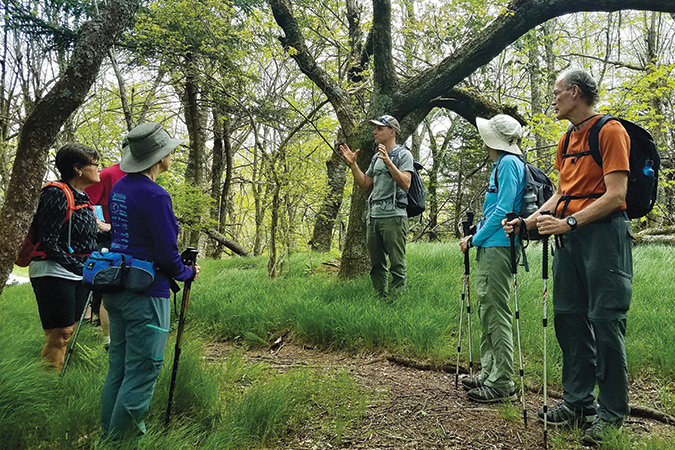
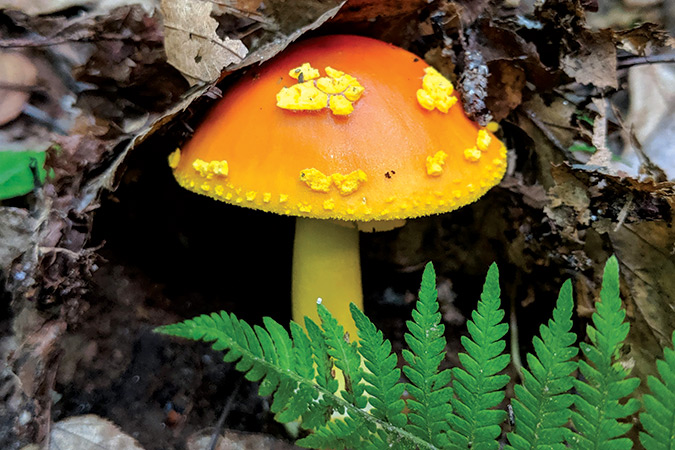
After all these years, Galton still feels most at home outdoors, hiking alone or with his family, running trails, gardening, photographing unusual plants, and foraging for mushrooms. Because he so seldom crosses paths with a snake on his regular tours, he sometimes takes summer camp groups to spots where he knows they’ll find a few orange-banded ringneck snakes.
“I’ve never met anybody who’s really been afraid of a ringneck snake,” he says, “because they’re just so tiny and pretty and totally harmless.”
TAL GALTON’S 3 FAVORITE THINGS TO SHOW TOUR GUESTS:
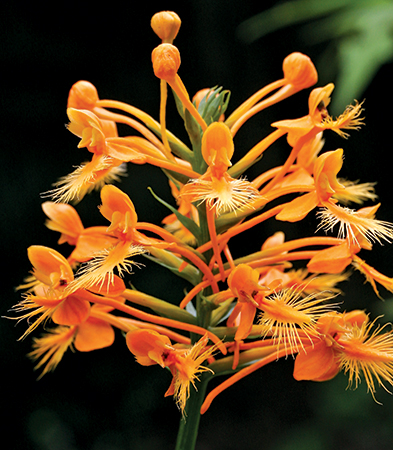
WILD ORCHIDS. “Many people will just walk along and never notice them because most of them are not very showy. The showiest ones are kind of the rarest ones, like the lady slippers, whereas we do have all these other little orchids like twayblades and green wood orchids that are not uncommon but really hard to see unless you know what you’re looking for.”
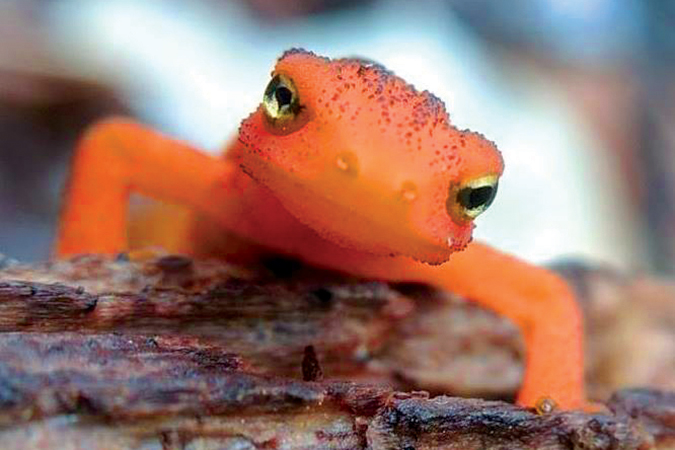
NEWTS. Efts—adolescent Eastern red-spotted newts—are probably the most “charismatic animals we’re likely to see on the trail. They come out when it’s wet, especially. It’s actually really nice to be out in the rain sometimes because certain things like these efts come out onto the trail.”
BIRD SONGS. “People don’t pay attention to them unless they know what to listen for. I knew very few bird songs up until a few years ago, and I’ve actually learned them mostly from clients of mine who have come on my flower walks. My ears are being opened to a whole world out there.”
The story above is from our September/October 2019 issue.