Skip to content


When it officially opened in 1940 — in the depths of the Jim Crow era — Green Pastures was likely the first U.S. Forest Service recreation area in the nation constructed for African Americans.
Photo Above: A Virginia Historical Marker stands at the entrance to Green Pastures. Green Pastures’ picnic area was built by the Civilian Conservation Corps in the late 1930s. Photo Courtesy of Joan Vannorsdall.
In the 1980s, when my children were preschoolers, Green Pastures (then called Longdale Recreation Area) was where we swam — along with a lot of minnows and water snakes and, when we were really lucky, an otter making its way from the dam across the small lake. Despite the weedy sand and the countless flies and mosquitoes, it was quiet and beautiful on that rock-walled beach. Sometimes we’d even see deer on the side of the steep mountain across the lake, watching and waiting for us to leave.

I wonder now how it could be that I had no idea what that place had been, when it was called Green Pastures — a park built for African Americans who were denied access to nearby, whites-only Douthat State Park. It was:
- created at the insistence of the Clifton Forge chapter of the National Association for the Advancement of Colored People (NAACP), spearheaded by Reverend Hugo Austin of the town’s First Baptist Church
- a place where Blacks could safely gather, eat, swim, play games and baptize their children
- where, on some Sundays, there would be 1,000 people by the lake and on the playing fields, from as far away as Washington, D.C., and eastern Virginia.
This is a story overlooked too long, but thanks to a grant from Virginia Tech’s Monuments Across Appalachian Virginia (MAAV) project, it’s a story being well-told now with strength and beauty.

Alleghany County, Virginia, was no different from the rest of the country in the 1930s. Times were hard, with the Great Depression deepening and jobs scarce. In addition, “Jim Crow laws and segregation were in full swing,” says applied historian Dr. Josh Howard. “Plessy v. Ferguson had upheld the federal laws passed in the 1890s, and in 1902, the Virginia constitution literally wrote racial segregation into the code of the Commonwealth.”
Creating the “separate but equal” doctrine meant that as long as African Americans had access to the same things as white citizens, it was legal to bar them from white facilities: restrooms and restaurants, schools and water fountains, train cars and front-of-the-bus seats. It quickly became clear that while separate establishments might exist for Black citizens, they were in no way equal in quality or number. So the NAACP began advocating for better on all fronts.
It was, in fact, the Clifton Forge NAACP that took up the cause of creating a recreation area for African American citizens when nearby Douthat State Park opened in 1936. Built over nine years by 600 Civilian Conservation Corps workers, Douthat offered visitors a 50-acre lake and a far-reaching network of trails, picnic areas, a guest lodge and hand-built cabins — all available only to whites.
Reverend Hugo Austin and members of the NAACP believed that needed to change — that Black citizens in western Virginia needed and deserved a place to be in nature, together and safe. So they sprang into action, approaching the U.S. Forest Service to request that a park similar to Douthat be built for African American use.
Reverend Austin’s niece, Ettrula Clark Moore, shares what daily life looked like for Black Virginians during segregation:
Even if we had the money, or the desire, we couldn’t go to Douthat. We couldn’t even go to the City Park. The whole community was segregated. We had our own stores—a cleaning business, taxi stand, pool hall, barber shop, beauty shop. It was a thriving community—almost a self-sufficient community. Everything was segregated: if we went to the theatre, we had to sit in the balcony.
When you’re growing up, you know things weren’t as they should be…you know that. But we had visionaries—like my uncle—who came along and changed that. My uncle…and members of the NAACP were bold people who wanted to step out and get a place for us to go.

—From the “What’s Your Story?” oral history series, Volume 3
Howard — who grew up just down the road from the park — describes the resulting decision to build Green Pastures like this: “Fearing the challenges to segregated recreation areas might be met with escalating protest — namely headline-grabbing lawsuits — the [U.S.] Forest Service agreed to build a recreation area explicitly and exclusively for African American use.”
Howard’s interpretation of the park’s approval is reinforced by a letter written by U.S. Forest Service Supervisor John McNair dated April 12, 1938:
Unless a suitable recreational area is provided for the colored race, we may expect the color[ed] people to continue to try to use the existing developments for the white people. … It is recommended that we proceed at once with the construction of the proposed Forest Camp in order that some type of recreational facility may be provided for the color[ed] race during the coming season.
The Longdale Furnace area in eastern Alleghany County was chosen as the site for the park, with the U.S. Forest Service estimating that more than 35,000 African Americans lived within 100 miles. The Civilian Conservation Corps’ Dolly Ann Camp got underway building the dam, beach, picnic shelter, bathroom facilities and trails. Black residents from all over western Virginia began coming to Green Pastures well before the work was completed.
The official opening on June 15, 1940, was attended by hundreds. Here’s what Reverend Hugo Austin said:

Because of the determination, endurance and zeal of the NAACP, our goal has been
successful. On this grand occasion, we celebrate the opening of this beautiful outdoor space. We leave it to you and to future generations to enjoy these green pastures.
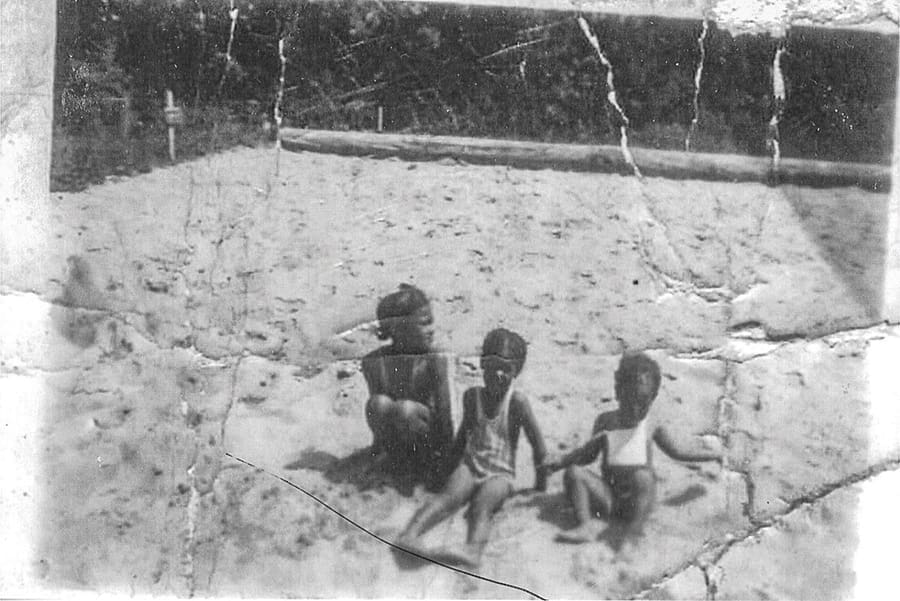
And enjoy it they did. The stories are legion: baseball games (the home plate is still embedded in the grassy field), horseshoe pitching, picnic tables laden with food, rope swings over the lake, wildflowers and berries, and trails through the woods.
And baptisms. “Few Black churches had the immersion baptismal fonts,” remembered the late Dr. Calvin McClinton. “So they’d come to the lake for baptisms. Can you imagine the scene? The kids lined up on the beach in their white robes, the minister in the water. Each child would go individually for full immersion. People singing the old hymns on the shore.”

Even though the U.S. Forest Service officially desegregatred all of its parks across America in 1950, Green Pastures remained known as a place for African American recreation. “At its peak in the early 1950s, the park attracted in excess of 1,800 visitors a day, often forcing the Forest Service to close the park out of public health concerns,” wrote Howard in the introduction to the Green Pastures oral history collection.
“Sure, you saw some white folks out there in the sixties and seventies. But it was mostly Blacks,” says Clifton Forge native Gregory Key. “It was like a big family reunion out there. It was a place you could go and always see a friend. I always felt safe there.”
In 1964, the U.S. Forest Service changed the name of Green Pastures to Longdale Recreation Area in an effort to make clear that the park was no longer a segregated site. One Forest Service supervisor put it like this: “All of us … feel that the name ‘Green Pastures’ should be changed. The reason is mainly one of psychology. All of the local country knows the area originally was built for the negro. They still look at it in that light.”
Despite ambitious plans to build campsites at the park in the late 1960s, funding and maintenance diminished. The park fell into disrepair, and in 2017, the U.S. Forest Service locked the gates.
But the children and grandchildren of those who’d worked so hard to create the park weren’t going to just let it disappear. Spearheaded in 2018 by the late Dr. Calvin McClinton and a group of committed volunteers, the Friends of Green Pastures began lobbying and fundraising to save the park.
Steve Nicely, whose late mother, Dorothy Helms Nicely, grew up just outside the gates of the park, took on the large job of its mowing and maintenance. “Soon as I got off the bus, we’d go to the woods, my granddaddy and me,” says Steve. “He watched over the recreation area.”
His mother’s memories of the building of the park were shared with those working to save it in a letter. It ended like this:
We have missed the Park being what it once was and would like to see it come alive again.
In the spring of 2019, a local citizen wrote a letter to Gov. Ralph Northam, sending it with a copy of the Green Pastures oral history book:
We take as truth your commitment to bridge the racial divide in Virginia, in this time of separation and distrust. We invite you to come to Alleghany County to witness this unique and endangered piece of Virginia African American history.
Stand by the lake.
Share a picnic in the 80-year-old, hand-hewn picnic shelter.
Walk with us.
Governor Northam, please join with us to save the historic Green Pastures/Longdale area.
And come to Green Pastures he did. On September 24, 2021, Gov. Northam stood with local leaders and U.S. Forest Service and state park officials to authorize a Shared Stewardship agreement. The 30-year lease agreement established shared state-federal oversight of Green Pastures, which would be operated as a satellite of nearby Douthat State Park.
“Green Pastures is both a reminder of our painful past and a symbol of our future and the good that we can all accomplish when we work together,” Northam said. With that, the name Green Pastures was restored.
With the inauguration of Northam’s Republican successor a few months later, the funding promised to rejuvenate the recreation area began to soften and change direction. While the state park staff faithfully opened the seasonal gates, the lake sat overgrown and still at the foot of the mountain, the picnic shelter continued to deteriorate and trails disappeared beneath scrub growth and poison ivy. Things went silent.
That’s when the Monuments Across Appalachian Virginia (MAAV) grant opportunity came across the desk of Clifton Forge Town Manager Chuck Unroe in late 2023.

Funded by the Mellon Foundation and overseen by the College of Liberal Arts and Human Sciences at Virginia Tech, the MAAV project set out to create a wide range of monuments across Virginia to honor those whose stories have been overlooked and undertold. Clifton Forge received $217,000 to do just that — to once again bring Green Pastures back to center and tell its story well.
Working closely with skilled leadership from Virginia Tech and Douthat State Park — and drawing on the knowledge and skills of area residents whose lives have been impacted by the park — the MAAV grant group and town staff oversaw a major renovation at the Green Pastures’ center, which included:
- structural stabilization of the beloved picnic shelter
- the clearing of the CCC-constructed dam
- construction of picnic tables overlooking the lake
- the placement of memorial benches for those who advocated for and supported Green Pastures over its 85 years
- the creation of an interpretive walking trail, with seven historical markers sharing the Green Pastures story
- the clearing of overgrown picnic areas and walking paths
- the writing and production of an illustrated children’s book, complete with Green Pastures nature activities and recipes.
On the 85th anniversary of its official opening — June 15, 2025 — more than 300 people gathered once again to celebrate Green Pastures. They came from all over the region to remember what it meant to gather safely in the mountains, share food and songs and stories, and celebrate the restoration of an important piece of history. State park workers demonstrated Civilian Conservation Corps tools and construction. Bishop Isaiah Freeman III performed “The Green Pastures Song,” written especially for the occasion. The Soul Rhythm Line Dancers did their steps in front of an appreciative crowd. Reverend Hugo Austin’s niece read part of the children’s book she’d helped write, a smile never leaving her face.
We talked about what had been done, and what was left to be done. Joy rose like mist off the lake.
And all true: That afternoon, an otter swam diagonally across the lake, its rippled path spreading rays of sunlight behind it.
The circle was unbroken, the story ongoing and the words of Reverend Hugo Austin spoken 85 years earlier came back loud and clear:
We leave it to you and to future generations to enjoy these green pastures.
Why Green Pastures?
Two explanations have been put forward for how Green Pastures was named. In 1936, a movie titled “The Green Pastures” was released. It was a box-office success and one of only six feature films of its era with an all-Black cast. The story goes that the film ran in some theaters for over a year.
Then there’s Psalm 23, redolent with images present at the park — still waters, paths of righteousness, souls restored, green growth, tables prepared, goodness and mercy:

The Lord is my shepherd; I shall not want.
He maketh me to lie down in green pastures, he leadeth me beside the still waters.
He restoreth my soul: he leadeth me in the paths of righteousness for his name’s sake.
Yea, though I walk through the valley of the shadow of death, I will fear no evil: for thou art with me; thy rod and thy staff they comfort me.
Thou preparest a table before me in the presence of mine enemies: thou anointest my head with oil; my cup runneth over.
Surely goodness and mercy shall follow me all the days of my life: and I will dwell in the house of the Lord for ever.
What would Pastor Hugo Austin hear most clearly? I’m pretty certain Psalm 23 was the language of his heart and his strength as he pressed for a place to come to for his people.
The Stories They Told
“The park is still in our hearts, and I would love to see it restored to its glory days. To teach the kids today how to appreciate the earth, the green pastures and how to rest and relax.” —Reverend Roslyn Clark Thomas
“There were nights when we would put out sleeping bags on tables in the shelter and watch the moonlight on the lake, which was so beautiful…” —Barbara Higgins
“I loved the stone picnic shelter. My father was part of the Dolly Ann CCC Camp that built it. The training he got working in the park gave him skills he used throughout his life. The last time I visited the park was [in] August 2017 with Dr. McClinton. It was emotional — difficult to see how run-down things had gotten. My father would be so happy about the effort to rebuild Green Pastures.” —Eutha Patricia Davis-Ross

“Back then, we all had gardens. We’d bring sliced cucumbers, and beets, and cabbage, and tomatoes, and green beans. We’d hold each other’s babies. … In the 1980s, it would break our hearts to see [the park] overgrown. The sand had grass in it. I grew up there. My ten kids grew up there. But my grandchildren went to Douthat. I’m glad I’ve got [memories] of Green Pastures. I’m just waiting to take my great- and great-great grandchildren there.” —Lillie Thomas Hughes
“My brothers would catch frogs and our father would fry up those frog legs — delicious! We’d capture snapping turtles and our father would fix them for us to eat — [also] delicious! Camping at Green Pastures made me feel rich; it was our vacation.” —Maxine Ross Lee
“[The park] was dedicated as Green Pastures as a place for the Black community. When they integrated, the name was changed. When you change a name, you lose an identity. … When I was a child, I thought it was so very large. When I go back, I see how small it was. But this small area, we could call our own.” —Ettrula Clark Moore
—from “Green Pastures at Longdale: Family, Memory, Renewal” “What’s Your Story?” series, Volume 3
The story above first appeared in our March / April 2026 issue.