Skip to content

Since we last explored the Brown Mountain Lights (March/April 1995), new scientific research teams were formed, the Burke County Tourism Authority offered sold-out symposia, the lights were featured in a National Geographic show, Brown Mountain received a bonafide overlook and sign, and there’s a new book and a new song. Writer of the original piece, Linda Shockley, has the updates.
The spectacular Pisgah National Forest of western North Carolina spans 500,000 acres of wild, lush woodland, rising over 5,000 feet high and dipping into deep gorges. Known as the birthplace of forestry in America, the ruggedness of its terrain kept large swaths of the hardwood forest safe from the industrial logging suffered by other nearby areas. The Pigsah offers waterfalls, whitewater rivers and hundreds of miles of hiking trails, all with remarkable views.
These southern mountains also offer legends and lore that have fascinated generations of locals, tourists, scientists, authors and filmmakers. The mystery of the Brown Mountain Lights is one of the most captivating legends. They have mystified, haunted and inspired scientific research and cultural inquiry. They’ve been the focus of books and films, songs and even an episode of the “X-Files” hit TV show.

Surveyors as early as the 1770s noted “some kind of luminous vapor.” A 1913 Charlotte Observer article mentioned members of the Morganton Fishing Club who saw the lights. Subsequent Observer articles explored other explanations, including the lights from passing locomotives, and the fire and smoke from moonshine stills.
The lights have been investigated by the U.S. Weather Service and twice by the U.S. Geological Survey. Results from the 1922 geological survey offered 11 proposed explanations for the lights, including Will-o’-the-wisps, phosphorus, Andes light, chemical reactions and radium emanations. (Read the report: pubs.usgs.gov/circ/1971/0646/report.pdf)
Could the flickering lights, as often speculated, be foxfire (an eerie, phosphorescent light related to fungus and decaying wood, insects and animals), or burning marsh grasses? Are they moon dogs (moonlight shining on haze) or St. Elmo’s Fire (electrical discharges from sharp objects during a thunderstorm)? Are they beings from outer space? Are the visions the result of too much moonshine, bottled or otherwise?
Local legends offer love, loss and calamity aplenty. Maybe the lights are Cherokee maidens or warriors searching the mountains by lantern light for fallen lovers. Or perhaps the lights are the souls of murder victims, like the long-suffering Belinda and her child, or Revolutionary war soldiers searching with torches for lost family.
North Carolina native Ed Phillips, director of the Burke County Tourism Authority, grew up listening to tales about the lights and has witnessed them himself.
“The lights are one of North Carolina’s top legends, its most popular paranormal legend,” he says. “When I became director of tourism, I developed a couple symposia in 2012 where experts talked about what the lights might be, what they aren’t and what we don’t know.”
Phillips continues: “There was lots of eyewitness testimony, including from historians, researchers and two retired U.S. Forest Service law enforcement officers who had worked on Brown Mountain and in the Linville Gorge for most of their careers. After they retired, they started telling stories about what they saw. To this day, it makes the hair on the back of my neck stand up.”
Phillips describes symposia attendees as locals fascinated by the lights, researchers and scientists, tourists and “people in dark glasses who wouldn’t give their names.”
Recognizing the local interest, as well as the draw for visitors, in 2011 the lights spawned a bonafide Brown Mountain overlook off of Highway 181, 20 miles north of Morganton. It’s a partially paved and graveled parking lot, with picnic tables and informational signs about Brown Mountain and the Linville Gorge.
“There’s no way for us to count how many people visit,” Phillips says, “but I’ve been told that in nice weather and on Friday and Saturday nights, you’ll find a dozen cars or trucks parked up there, sometimes more. It’s a festive atmosphere as people watch for the lights.”
Daniel B. Caton is professor of physics and astronomy, and director of observatories, at Appalachian State University. As a scientist, he’s a skeptic by training, and remains focused on inquiry and evidence. He and fellow scientists and students formed a Brown Mountain Lights research group in 2012 following Ed Phillips’ symposium at the Morganton City Hall, to investigate the physics of the lights. (Read more on his site: dancaton.physics.appstate.edu/BML/index.htm)
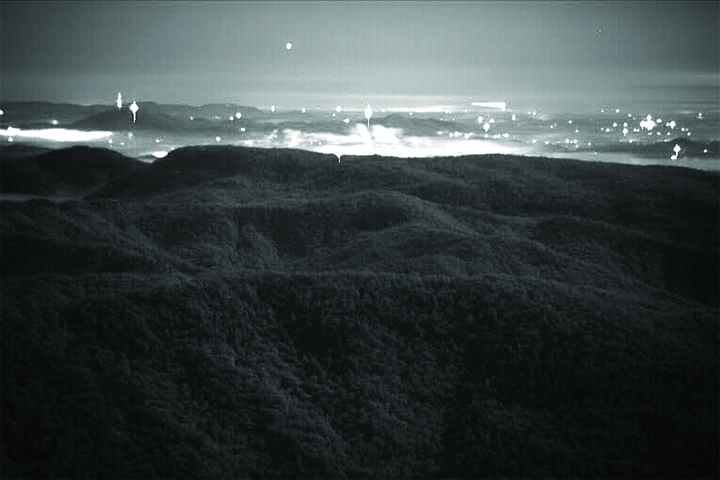
The group—called WCLEAR, short for Western-Carolina Lights Experimental Advanced Researchers— uses stationary cameras in two locations. One overlooks Highway 181 onto Brown Mountain from the Jonas Ridge area. The other is south of the valley, facing north up the Linville Gorge. Both are located at private residences that have provided permission to install the cameras and use the owners’ broadband to collect data.
These are infrared-sensitive night, low-light-level cameras that take sequences of images all night, from dusk to dawn. The next morning, Caton downloads the footage, builds them into videos and posts them on YouTube.
While Caton and his team have ruled out many causes, ball lighting—an unexplained atmospheric electrical phenomenon—remains a possibility, a wild card. “
It’s not well understood,” Caton says. “Suppose nature has a way of making ball lightning preferentially in the gorge? Great, we’ve got a natural lab that knows how to make it, but it’s difficult to capture it. It would be much easier to study the lights if we could predict them.
“The bottom line is that most people are completely unfamiliar with the night scape. They’re indoors watching TV or working on their computers, and they’re probably living in a light-polluted environment. So when they get outdoors in a dark location, they are clueless about natural and manmade lights. I estimate that 95 percent or more of the sightings are people who seek the lights, see some kind of light and leave thinking they’ve seen the Brown Mountain Lights.”
He cites a few examples: “I’ve seen people get excited by a flashing cellphone tower light or the lights of Lenoir, a city in Caldwell County. Really, we’ve had airplanes and flashing tower lights for a century. CSX trains travel regularly through the gorge and there are 27 miles of ATV trails.”
The lights have been the focus of numerous books. Author Ed Speer, a native of Marion, North Carolina, turned an early fascination with rocks and minerals of the Blue Ridge Mountains into a global career in exploration geology. For his most recent book, “The Brown Mountain Lights, History, Science and Human Nature Explain an Appalachian Mystery” (McFarland Books, 2017), Speer used his training in science to explore a childhood enigma with fresh eyes. Over three years, he worked with a team of experts—including scientists and outdoor enthusiasts—camping out regularly and employing staged light tests at Wiseman’s View and the Highway 181 overlook.
“The team was convinced we could identify a new, unexplained sequence of light,” Speer says, “But we were mistaken. We simply couldn’t find a light we couldn’t explain. I concluded that 98 percent of all mistaken or baffling lights are manmade lights: town and city lights, and moving planes, trains and helicopters. A very small percentage of people are seeing a naturally occurring light. One example is the eerie blue ghost firefly, which is out only at certain times of the summer, at certain hours and at certain temperatures. And then there are the pranksters playing ‘Brown Mountain Lights.’ So, most of the mystery lights aren’t really mysteries to someone with the time and experience to investigate them.”
Joshua Warren, expert on the paranormal, grew up in the mountains near Asheville, and saw the lights firsthand as a child. He hosts a syndicated weekly paranormal program, “Speaking of Strange,” and founded the Asheville Mystery Museum. He also has a research center in Puerto Rico, where he studies the Bermuda Triangle.
Warren likens the area around the Linville Gorge to a mini-Bermuda Triangle, mentioning the first English settlement on the Carolina coast—The Lost Colony—that inexplicably disappeared.
“You draw that line out East and you’ll come pretty close to hitting the Island of Bermuda, which is the top point of the so-called Bermuda Triangle. The three points of the Triangle are Puerto Rico, Miami and the Island of Bermuda.”
“I feel like Brown Mountain and that whole Linville area are certainly part of this alignment,” Warren says. “People at Brown Mountain have had so many odd experiences that go way beyond telling stories around a campfire. As a serious researcher, I’ve interviewed lots of people, taken lots of measurements and written reports. I’ve been featured on the National Geographic channel, and my team and I captured footage that was studied at the Princeton Optics Lab. They couldn’t explain what we captured.
“Brown Mountain is a special place. Ultimately, we have these odd, eerily beautiful lights upon which everyone projects their ideas. You have the physicists and astronomers with theories, geologists and chemists with theories, and the UFO people who think this area is the landing ground for the mother ship or the place where the saucers go to recharge their batteries.”
Warren adds: “Brown Mountain is a blank slate upon which so many different kinds people can enthusiastically project their own impressions or their own ideas about what might be happening. It breeds a lot of creativity: songs, novels, research, a TV shows. It sparks people’s imagination.
“We know there’s a tangible, objective, measurable, phenomenon occurring there. Whatever it is, it’s something that deeply affects people when they experience it and opens their minds to all the mysterious possibilities here on Earth.”