Sentence for Causing a Trainwreck: Tonsils and Adenoids Removed

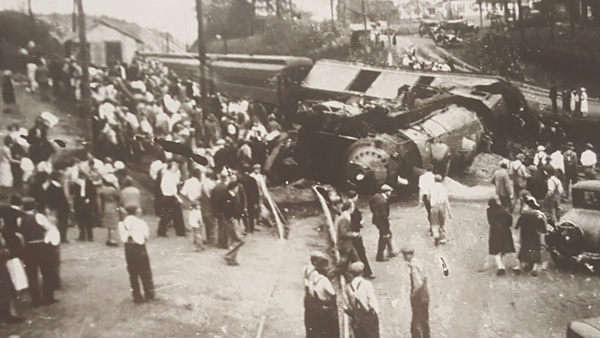
The 1931 derailment in Drexel, North Carolina was cause by a few rocks placed on the tracks.

The story below is an excerpt from our January/February 2018 issue. For the rest of this story and more like it subscribe today, log in to read our digital edition or download our FREE iOS app. Thank you!


A 6-year-old in Burke County, North Carolina in 1931 may not have realized what an enlightened punishment he received for a derailment that injured four, ripped up some 100 yards of track and cost about $15,000 to repair.


The tragedy of a train derailment on April 23, 1931 in Drexel, North Carolina was not as bad as it might have been: four injured but no one killed, and some 100 yards of track ripped out of the ground.

What compounded the aftermath of the incident was that the wreck had been caused by a 6-year-old boy.

The investigation determined that Charlie Whitener, Jr., had put rocks on the railroad tracks. Charlie lived with his mother, who worked at night and was not able to properly attend to her son. His father was serving a jail sentence and was thus not in the home.

At about 4:15 in the afternoon of April 23, Charlie placed the rocks and hid behind a fence to get ready to watch as the train, traveling nearly 60 mph, approached. The conductor failed to see the rocks and the train derailed and overturned.

Whitener confessed and was quoted in the local paper: “It was a lot of fun seeing the cars pile up and the steam coming out. I laughed about it, just like I did when I wrecked my toy train.”

Four people were taken to the hospital with injuries, but no one was killed. It was estimated that repair costs would be $15,000.

The sheriff’s investigation found another child witness who had seen Charlie place the rocks.

Spokespeople from the railroad concluded that Charlie was responsible, but they did not want to prosecute him. They wanted only to keep him away from the railroad, as his mother’s home sat on a bank right by the tracks.

Charlie went before Juvenile Court Judge Bowers with a social worker. The social worker informed the judge that Charlie needed his tonsils and adenoids removed. With the approval of three railroad representatives, Charlie’s mother and his grandfather, the judge included the removals as part of Charlie’s sentencing. In addition, Charlie would live with his grandfather, a well-respected farmer, until his father was out of jail.

Charlie would then go from hanging out on the railroad tracks to learning farming skills from his grandfather.


… The story above is an excerpt from our January/February 2018 issue. For the rest of this story and more like it subscribe today, log in to read our digital edition or download our FREE iOS app. Thank you!

You Might Also Like:

A bee clings to the center of a sunflower at Mill Springs Farm, located just up the road from historic downtown Jonesborough, Tennessee. From the photographer: “The farm grows a yearly crop of a variety of sunflowers. The bees love them!” Photo by Jay Huron

Among The Blooms: A Photo Essay

Our contributing photographers wandered the mountains in late spring and early summer to capture critters big and small frolicking, nibbling, and buzzing about.
Hikers willing to take on a moderate climb are rewarded with incredible panoramas from the summit of Marys Rock.

An Insider’s Guide to Shenandoah National Park

This year is a landmark one for this treasured piece of mountain land in Virginia: the 100th anniversary of Congress authorizing its establishment and the 90th anniversary of its dedication.
A happy 8-year-old Eula Mae standing in front of her father, Woodrow, in this Golding family photo taken in 1952.

My Beloved Scenic

Before it became America’s Favorite Drive, the Blue Ridge Parkway was a farm family’s front yard, playground, and memory lane.
Elizabethton, Tennessee, USA, - May 15, 2021: Reenactment at Sycamore Shoals State Historic Park of the Siege of Fort Watauga in 1776.

Revolutionary Roundup

On July 4, 1776, a new nation was born. In honor of this historic day, we explore the forts, battlefields, museums, trails, and more that trace the Patriots’ journey to freedom in the Blue Ridge Mountains.
2025 Festivals and Events

2026 Festivals & Events Guide

From the Virginias and the Carolinas to Georgia, Tennessee, and Kentucky, our annual compendium is the perfect travel companion.
A Virginia Historical Marker stands at the entrance to Green Pastures.

Green Pastures’ picnic area was build by the Civilian Conservation Corps in the late 1930s.

Green Pastures Reborn

When it officially opened in 1940 — in the depths of the Jim Crow era — Green Pastures was likely the first U.S. Forest Service recreation area in the nation constructed for African Americans.
Chimney Tops Trail in Great Smoky Mountains National Park rewards a steep climb with exceptional mountain views.

Inset: Gatlinburg, Tennessee’s Chimneys Picnic Area sits beside the West Prong of the Little Pigeon RIver.

11 Picnics with a View

These bucket-list destinations are perfect spots to kick back, enjoy a delightful meal and take in the great outdoors.
Vernon and Toni Wright turn grains grown on their family farm into freshly distilled spirits.

Virginia Century Farm Home to New Distillery

For nearly 200 years, Vernon and Toni Wright’s family has raised corn, cattle and quarter horses at Hill High.
Spring wildflowers bloom early in the New River Gorge of West Virginia. From the photographer: “Bloodroot is one of the first to blossom, fittingly coming in around the first day of spring. The reddish sap that exudes from all parts of the plant — especially the root — when cut is what gives bloodroot its common name.”

Scenes of Spring: A Photo Essay

Our contributing photographers reveal the fresh sights and subtle joys of the season.

CALENDAR OF EVENTS