Skip to content


The story below is an excerpt from our March/April 2015 issue. For the rest of this story and more like it subscribe today, view our digital edition or download our FREE iOS app!
A Spanish fort in the Blue Ridge foothills, built in 1567, was likely the first European settlement in the inland u.s. and if the Spaniards – seeking safe transport of gold – had known of gold lurking in the rivers nearby, would the course of world history have been changed?
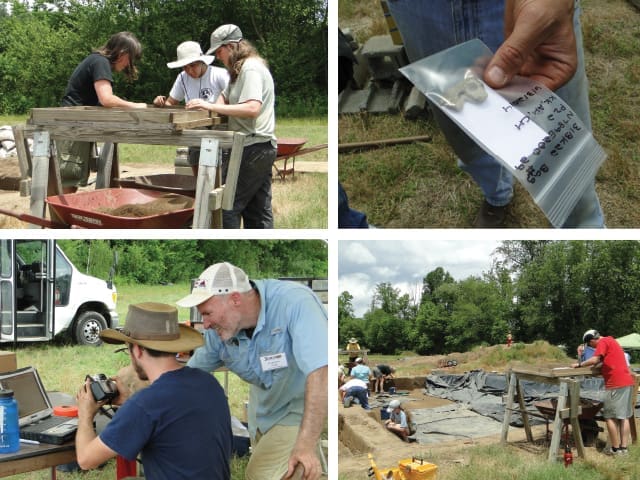
In a 15-acre field outside of Morganton, North Carolina, the story of our nation’s history is being rewritten. Every shovel of dirt that is painstakingly removed and sifted from the site reveals surprising insights into how the Southeast was explored and founded. If you think you know the facts of our country’s early exploration, come to Burke County and be prepared to change your mind.

Evidence of early Spanish colonization in western North Carolina is being unearthed in an archaeological dig that began in 1986. After decades of research and testing, proof exists that a Spanish fort in the area, known as Fort San Juan, is now considered to be the earliest known European settlement in the interior of the United States (that is, aside from coastal areas such as St. Augustine, Florida.).
Pre-dating North Carolina’s “Lost Colony” by 20 years and Jamestown, Va., by 40 years, Fort San Juan was built in 1567 by Spaniard Juan Pardo and an army of 125 men. The Spanish were seeking to expand their empire of land and wealth throughout the Southeast, starting in present-day Florida and marching north. Hernando de Soto had first journeyed from Florida through North Carolina on the way to the Mississippi River in 1540.
“We know with the kind of certainty that is rare for archaeology of Native American sites that this was the Native American town of Joara where Juan Pardo arrived in December 1566,” says Tulane University archaeologist Dr. Chris Rodning. “It is recorded in the written accounts of the Pardo expedition that he established a town named Cuenca and Fort San Juan adjacent to the town of Joara.”
Pardo was on a mission to secure a safe route to transport gold and silver from Mexico to the Atlantic Ocean where it could be shipped back to Spain, without the danger of pirates encountered by sailing through the Caribbean. He devised a road supported by six forts between eastern Tennessee and modern-day Parris Island, S.C.
An early co-existence between the Catawba tribe and the Spaniards seems to be evident, but conditions quickly turned sour, as a Native American tribe burned all six of the forts by the spring of 1568 and killed all but one of the soldiers. Fort San Juan was the first fort to have been built, lasting 18 months, and the only fort that has been excavated.
Fort San Juan is located on a private piece of property now known as the Berry Site, named after landowners Pat and James Berry. The Smithsonian documented a large earthen mound on the property in the late 1800s, well before it was bulldozed in the 1960s, signaling the likely existence of Native American artifacts. According to Rodning, “the Berry Site represents one of the largest Native American towns from the greater Southern Appalachians between 1400-1600.”
When archaeologist Dr. David Moore first came to the site in 1986, he quickly found plenty of remains, with one puzzling European artifact. Nearly a decade later, archaeologist Dr. Robin Beck, the Berrys’ nephew, also found European relics on the site, encouraging Moore and Beck to believe that this could be the site of the long-lost Fort San Juan.