Cyrus McCormick’s Reaper: The Ag Industrial Revolution Began in Virginia’s Shenandoah Valley

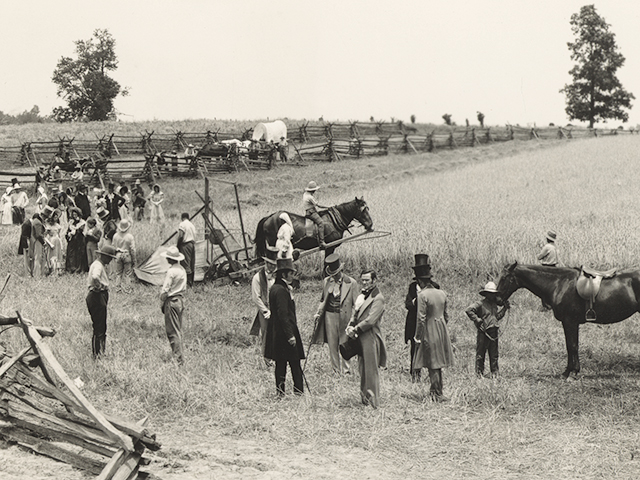
This production still is from the 1937 Fox Hearst film “Romance of the Reaper,” which was produced by International Harvester to celebrate the McCormick reaper’s centennial. The scene is a re-creation of the first reaper test.

The story below is an excerpt from our Sept./Oct. 2014 issue. For the rest of this story and more like it subscribe today, view our digital edition or download our FREE iOS app!

The rolling hills and valleys of western Virginia today feel far removed from large-scale industrial agriculture.

But in the mid-19th century the region contributed heavily to feeding the still-new United States of America, serving as the highest grain-producing region in one of the highest grain-producing states.

And, the Valley of Virginia produced in that era a man who would forever leave a mark on American agriculture and business in general: Cyrus McCormick.

His invention of the reaper dramatically changed food production around the world. It represented the first major advance in grain-harvesting technology since the scythe came along to supplement the sickle. Farmers have only a small window – 10 days or so – in which to harvest their grain for the year. With a sickle, a person could harvest about half an acre of grain in a day. In one of his first field exhibitions of the reaper, McCormick harvested six acres in an afternoon.

“It is not an exaggeration to say that the invention of the reaper there in 1831 was the beginning of the agricultural industrial revolution,” says Jay Gilliam, who lives near Walnut Grove in Raphine, Virginia, and who has researched McCormick. “It changed the world in many many ways.”

McCormick did much more than invent a farm tool. He revolutionized agriculture worldwide, drove the growth of the U.S. as a world power, contributed to the emergence of Chicago as a major city, pioneered business practices that today are standard protocol, and influenced the outcome of the Civil War.

He was born in 1809, the year the presidency passed from Thomas Jefferson to James Madison, from one Virginian to another. McCormick’s family came from the Irish province of Ulster, joining the great wave of Scots Irish landing at Philadelphia and then traveling down the Great Wagon Road to the Valley of Virginia and points south.

“All these people were streaming into the valley bringing culture with them, and that includes agriculture,” says Kenneth Koons, history professor at Virginia Military Institute. “Their agriculture is what we call general mixed farming. They grew lots of different crops and kept on their farms lots of different livestock…The idea is that they’re trying to be self-sufficient, if not at the individual household level, then at least at the neighborhood level.”

Cyrus came in the fourth generation of American McCormicks. His father Robert invented things too, tinkering constantly in his blacksmith’s shop. In fact Robert conducted a fair bit of work on his own mechanical reaper before giving up and turning it over in 1831 to Cyrus and Jo Anderson, a slave who was brought up as his companion. Cyrus McCormick successfully demonstrated the new version later that year.


The story above is an excerpt from our Sept./Oct. 2014 issue. For the rest of this story and more like it subscribe today, view our digital edition or download our FREE iOS app!

You Might Also Like:

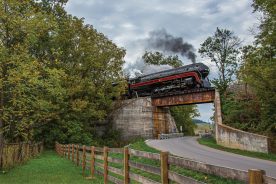
Built in Roanoke, Virginia, in the 1950s, the “Queen of Steam” remains one of the nation’s most celebrated steam locomotives.

The Queen Still Reigns

More than 70 years after she first took to the rails, the legendary Norfolk & Western Class J No. 611 continues to inspire both passengers and the volunteers who keep her running.
In West Virginia, the rugged trails of Dolly Sods Wilderness lead to sweeping overlooks and untamed mountain scenery.

Blue Ridge Base Camp Towns

More than outposts for gearing up, these seven mountain communities are destinations in their own right, pairing easy access to some of the region’s best outdoor adventures with walkable downtowns, local flavor, and much more.
Interior designer Maisie Leach and her pup Stella Bea traded Roanoke’s bustling Grandin Village for a slower pace of life in Eagle Rock

Refuge in the Woods

A log cabin in Eagle Rock, Virginia, is the latest project for Maisie Leach of Hermione Interiors—and her most personal.
Author Tim Carmichael’s grandmother, Granny Woman Stella Gosnell Norton, served her Madison County, North Carolina, community as a trusted healer and caregiver.

The Heart of the Hills

Long before modern healthcare reached many Appalachian communities, Granny Women became trusted healers and caregivers, delivering babies, treating illness and injury, and preserving generations of healing knowledge.
Sherwood Anderson and printer Howard White outside the Marion news office, in one of the last photos taken of Anderson.

Finding Home in the Mountains

In 1926, renowned writer Sherwood Anderson moved from center stage in Chicago to the mountains of far Southwest Virginia. Why?
Carly Pearson smiles at the summit of McAfee Knob in Virginia

Trailblazer

Former wildland firefighter Carly Pearson became an accidental advocate for people with disabilities.
The hotel’s rooftop terrace, affectionately known as The Perch, offers exceptional mountain views.

Walking in the Footsteps of an American First Lady

The owners of Wytheville’s Bolling Wilson Hotel and Graze on Main make sure the town never forgets her legacy.
Roanoke, Virginia, USA downtown skyline at dawn

2026 Happiest Mountain Towns

Ten years after this poll’s inaugural launch, we once again turned to our knowledgeable readers for their picks. The results? A brand-new collection of 71 exceptional Blue Ridge communities that excel at bringing big smiles to the faces of both residents and visitors.
Kayaks on Toccoa River Below the Falls

7 Fabulous Float-to-Stays

Paddling trips on scenic rivers to great mountain towns make for perfect summer getaways.
Blooming rosebay rhododendrons frame a lovely, fast-moving cascade along the Oconaluftee River in Great Smoky Mountains National Park near Cherokee, North Carolina. Photo by Robert Stephens

Currents & Cascades: A Photo Essay

Our contributing photographers followed the flow of summer.