Skip to content


Connie Deegan helps Johnson City, Tennessee, residents appreciate nature in all its forms
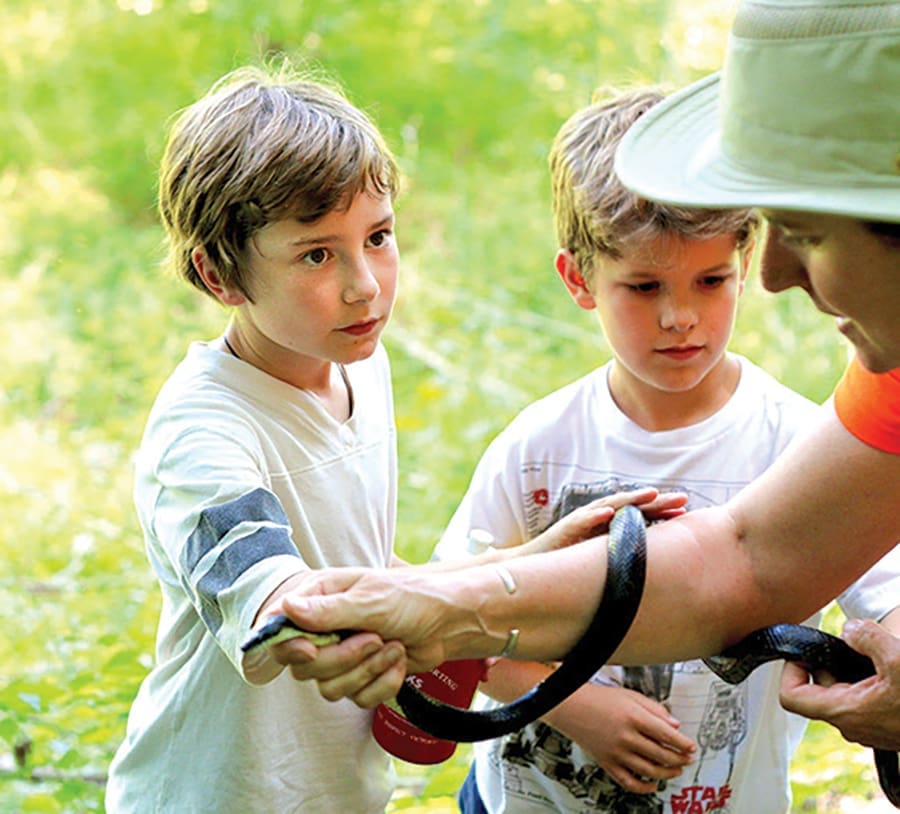
Photo Above: Connie Deegan on her love of snakes: “I just find them beautiful and important and fascinating.”
Photos Courtesy of Connie Deegan.
In a new neighborhood, with few friends to play with, young Connie Deegan entertained herself by luring toads in her backyard with discarded fruit pits, peels and cores that attracted the insects they thrived on. One day while looking for them, Deegan flipped over a rock and discovered two snakes.

“I never thought I’d be lucky enough to find a snake, ever, and there they were,” she recalls. “I tried to catch them. I missed one. I caught one. Ever since that day, that’s just been the animal for me.”
Even now, says Deegan, 66, “I’m always looking for snakes and, if I see a snake, I catch it if I can. And then I just let it go. I’ve always done that, and I bet you 50 bucks I always will.”
Unmistakably in her element at the Johnson City Parks and Recreation Department, it’s hard to believe this enthusiastic, high-energy naturalist once lacked the confidence to pursue a career in her field. She now designs programs focused on native critters (including snakes, of course), leads summer camps and maintains four of the city’s parks.
Born in Jamestown, New York, Deegan frequently moved due to her dad’s corporate transfers. An outdoorsy kid, she often entertained herself with “insect zoos” of roly-polies, spiders and earthworms in empty, ventilated Skippy peanut butter jars.
“I always paid attention to the little things,” she says. “When many people walk through the woods, for example, they look straight ahead. I always looked down.”
Most of all, she kept an eye out for snakes. “I just find them beautiful and important and fascinating. I ended up championing an animal that a lot of people know little about and misunderstand.”
After majoring in natural resources and education in college, Deegan spent two years traveling with a short list of goals that included making an offshore sailboat delivery and living in Ireland. After that, she assisted in her sister’s stained-glass business in Colorado before moving back to Connecticut to start a similar venture, crafting large panels for homeowners, churches and restorations. It was there that she landed her first job as a naturalist, curating a small nature center where she taught classes, cared for the resident animals and led summer camps.
When her husband passed away, leaving her to provide for a young child in one of the most expensive parts of Connecticut, she started researching other options. On a road trip with her daughter, the two fell in love with Johnson City, Tennessee. It was beautiful, with many outdoor opportunities, a solid school system and a university in case Deegan wanted to earn another degree.
Soon after they moved to Northeast Tennessee in 2007, the recession hit and there were no jobs to be found, not in her naturalist field nor any other.
“I would sit at red lights and I’d read the writing on the truck next to me, and it would say ‘tree service,’ and I’d be like, ‘I could do that.’” Desperate for work, Deegan answered phones for a local bank and conducted fieldwork for TVA before the agency laid off its contractors and she was forced to reinvent herself once again.

A turning point came at the Johnson City Senior Center. “I brought in programs that nobody else had ever brought into the senior center before, cool stuff, instead of how not to fall down, snake stuff. We would go on really cool field trips.”
The lone naturalist at Johnson City Parks and Rec had no plans to leave—Deegan had already asked—but when a medical condition sidelined him in 2010, the department needed a replacement in a hurry. The summer nature camps were already filled and ready to go, with no one to run them. “It was an open slate, and I just took it and ran with it,” Deegan says. “I just got busy.”
Fourteen years later, she enjoys the job more than ever. “I love teaching because I love the topic. I love the variability, and I love being outside. It’s weird, but the older I get, the more and more I like trail work.”
Creating and conducting programs for schools, organizations and the general public energizes Deegan. “I say yes, really, to everybody,” she admits. “I don’t care if it’s the Salvation Army or the Boy Scouts or Garden Club.”
Sharing what she knows about snakes is one of Deegan’s top priorities. “I don’t know how many snakes I have saved from being chopped in half, just from having people go to my lectures and learning a little bit about them. Human beings are weird. We like animals that remind us of us. We like animals with eyeballs in the front. We like furry things. We kind of tolerate feathery things. We don’t like scaly things. We don’t like slimy things. We allow ourselves to constantly hate certain animals: sharks and bats and snakes and spiders. And because of that, we harm them all the time, and we have to stop it.”

The Parks and Rec summer camps are currently in full swing through mid-July at Winged Deer Park, with guest speakers ranging from Native American spokespersons and firefighters to professors who lead geological hikes and gardening experts who talk about edible plants. Despite her adventurous nature—Deegan hikes, rides her motorcycle just about everywhere and teaches classes for the Motorcycle Safety Foundation—she knows how to keep young, hyped-up campers in line. “I always tell them, ‘When a big person is talking, you guys better zip it.’ I’m a disciplinarian … and I think the parents appreciate that.”
Deegan is also responsible for any park maintenance that requires the expertise of a naturalist. One of her favorite sites is Jacob’s Nature Park—part wetland, part meadow, part hardwood forest—at Sinking Creek. She and her team have restored the wild, 28-acre park to its original, centuries-old state and turned it into a birding hotspot. She has also re-signed the entire 725-acre Buffalo Mountain Park with a QR map code and has guided her fair share of lost hikers, by phone, out of the woods.
When she does retire—and it won’t be anytime soon, Deegan asserts—she’ll hike the Appalachian Trail from its genesis at Springer Mountain, Georgia, to her own origins in New York state before motorcycling the country with friends.
“I like being busy,” she says. “I almost get nuts if I have a Saturday with nothing planned. I want to pack it in, and I’m totally invested when I’m doing something.
“I have to feel like what I do is important,” Deegan adds. “I’m never going to be president of the world, and I know I’m never going to do a TED Talk. But if I can capture a kid’s interest, or even big people, and make them slightly alter some of the things they do, even in their yard, and it will benefit wildlife, then that matters to me.”
Connie Deegan’s 3 NE Tennessee Faves

Anywhere on the Appalachian Trail. “I’m a member of a couple of hiking groups, so anyplace on the AT, and certainly anyplace on the AT I have yet to go to.”
Watauga Lake. “It’s just beautiful. It’s part of the TVA system, but it’s one of the two northernmost lakes.”
The view from home. “I have a beautiful, beautiful view from my house. I live in a pretty rural area and I sit on my porch every single night. I don’t care if it’s winter or summer or pouring. I’ve got a slight downhill and then, off in the distance, bam! There’s Holston Mountain.”
The story above first appeared in our July / August 2024 issue.