Skip to content


The story below is an excerpt from our March/April 2016 issue. For the rest of this story and more like it subscribe today, log in to read our digital edition or download our FREE iOS app. Thank you!
As the director of gardens and grounds at Charlottesville, Virginia’s Monticello, the historic home of Thomas Jefferson, acclaimed horticulturalist Gabrielle Rausse is charged with the task of maintaining one of America’s oldest and most historically cherished heirloom seed banks, the Thomas Jefferson Center for Historical Plants.
While the TJCHP was officially founded in 1987 and tasked with completing the restoration of Monticello’s gardens—which include an eight-acre plot of vegetable and fruit gardens as well as an 18-acre ornamental forest—the seedbank was originally the brainchild of Mr. Jefferson himself. It began as a way to maintain European and old-world varieties for the United States.

“Jefferson set lofty goals for his gardens,” says Graham Smith, a writer specializing in 18th and early-19th-century horticulture. “Monticello’s south-facing expanse was a living laboratory for a lifelong tinkerer and almost obsessive record keeper.”
After kicking off his gardening project in 1770, over the next half a century the father of the Constitution found time to meticulously document the many trials and errors that led to the successful cultivation of around 300 varieties of more than 90 different vegetables alone. His “garden” included exotics like sesame, chickpeas, sea kale, salsify, and a diverse range of other now commonly available staples like tomatoes and eggplant which were, in the late 18th century, basically unheard of. Meanwhile, in an adjacent orchard, Jefferson raised 130 varieties of fruit trees, including peaches, apples, figs and cherries. Not to mention a veritable hoard of herbs and flowers.
During Jefferson’s political career, the seedbank’s operations were expanded to include specimens gleaned from forays into the interior of the continent. The most prominent of these missions was that of Lewis and Clark. History books rarely give much treatment to the legendary explorers’ training to preserve and bring back samples of seed varieties from plants used or cultivated by the indigenous populations they encountered on the way to the Pacific.
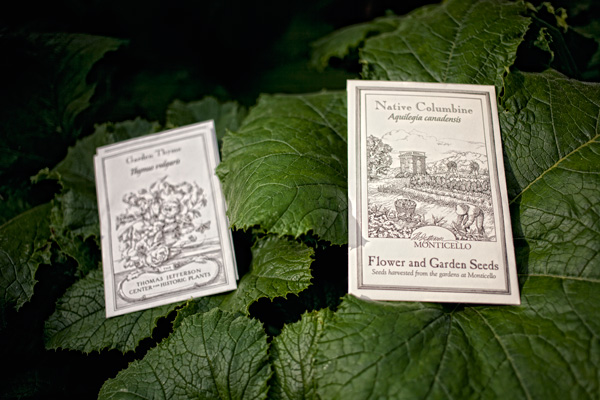
In fact, in Rausse’s workshop, there are umpteen jars and packages dating back from that very expedition.
“Lewis and Clark sent over 100 [dried botanical] specimens to [President Jefferson] in the spring of 1805, and brought back many, many more in 1807,” says Rausse, showing off some Jefferson-labeled seed packets. “It gives me pleasure to think of [Jefferson] as being inwardly more excited by the expedition’s plant discoveries—” as in those of gardening significance—“than political matters.”
Today, the TJCHP seeks to maintain the spirit of Jefferson’s botanical zeal, offering weekly classes and educational tours of the gardens and grounds, in additon to conducting research and publishing an acclaimed botanical review, the Twinleaf Journal.
To learn more about the Thomas Jefferson Center for Historical Plants, plan a visit, sign up for classes, or read Rausse’s gardening blog, visit monticello.org.