Skip to content

Are you thinking about getting a dog? Did you just get one? Whether you buy or adopt a new pet, what you do the first two weeks you are together makes a huge difference in how quickly the dog settles into your home.
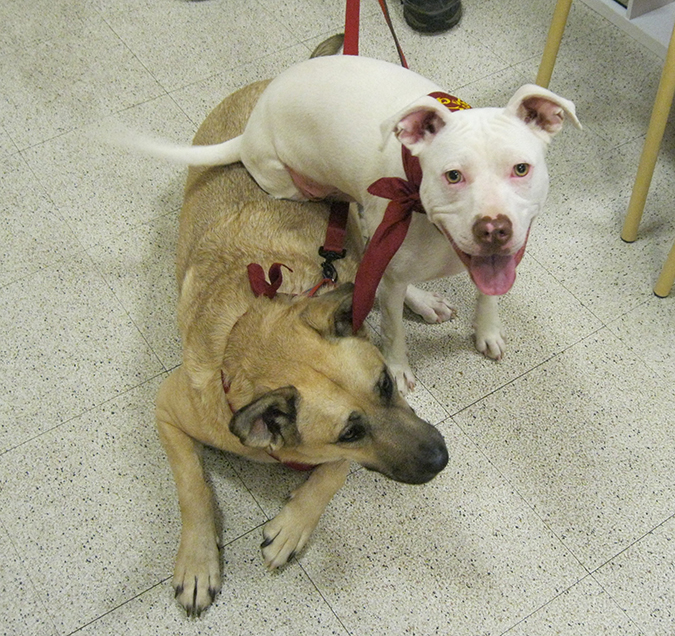
Photo Above: Two of Molly Dugger Brennan’s rescue dogs, Squirrel and Biscuit
This two-week period is often referred to as the “two-week shutdown.” Some call it the honeymoon. I think it’s more accurate to call it Freshman Orientation. Your new dog has to learn all about the new campus, the rules, the food, the expectations, the professors, and the other students, both human and animal. It’s a lot to absorb and understand.

Your new dog has been through loads of upheaval recently: new surroundings, routines, leaving mama or enduring the chaos of a shelter, humans, new animals, different water, and food. That’s a ton of stress. He has no idea if you’re just another temporary stop or his forever home, even if it is a lovely one here in the southern Appalachians. He needs time and guidance to understand what’s happening and how he fits into it.
I know that when you get a new pet you are excited to cuddle him, show him off to all your friends, have play dates with friends’ dogs, and take him everywhere with you. I understand, I really do. However, it is kinder – and more successful in the long run — to let the dog adjust to you on his own time, and that’s usually two weeks. It can be more or it can be less depending on the dog’s personality and past experiences, but two weeks is a good rule of thumb.
First of all, don’t give your new dog access to every room in your house. Too much freedom can easily overwhelm him. Introduce him to just the essential areas such as the kitchen, the family room, one bedroom, and the yard. I recommend that you have a crate set up for him before you bring him into your home. He needs a safe place he can retreat to when he feels overwhelmed. A crate with an old towel or blanket thrown over it is perfect. I am a big fan of crate training because it is useful for housebreaking, provides a comfy den for resting, and keeps the dog safe when you can’t supervise him.
Secondly, set up a simple and consistent routine from the start. Regular meal times, regular potty breaks, regular bed times, all help your new dog settle into your home. Bedlam begets bad behavior. Help your new pet be the dog you want them to be by establishing rules and boundaries from Day One.
Thirdly, avoid excessive stimulation. Long walks in the neighborhood, going to the dog park, or even visiting friends and their pets is just too much at this point in your relationship. Limiting outdoor activity to your own yard is just fine. Your dog needs slow introductions to his new world more than he needs exercise right now.
Fourthly, set your new dog up for success. That means you’ve dog-proofed your home before you bring him home. By that I mean you’ve taped loose electrical wires to the baseboard. You’ve put everything you cherish away that could get chewed, peed on, or broken. You’ve put household cleaners and other toxins out of reach. You moved houseplants out of the dog’s area. You have a selection of approved chew toys at the ready. Most importantly, you’ve briefed the children on how to interact with a dog. Running, squealing, and grabbing or even hugging the dog is all very threatening when the dog has no idea who this person is and what’s going on. Tell your kids that they must be gentle until the dog understands that it’s all just play and no harm will come of it.
It is also important to think through how your dog will fit into your home and family because during the first two weeks, it is better for your budding relationship if there are no harsh corrections or complicated training sessions. You must show the dog through your actions that you are calm and capable. This will lessen his anxiety over the newness of it all and build his confidence in his place in your family, his new pack.
If you adopted a dog from a shelter or rescue group, bless your heart. You are giving a new home to a discarded angel. You have done a good thing. Sometimes because of something in their past, they may have hot buttons such as leashes, rolled up magazines, brooms, hands or feet, or certain sounds. If you discover a button, you can desensitize your dog to the issue by throwing treats in front of them when the triggering item is present. It will take longer than the two-week period, but it will improve and it will be worth the effort.
Every dog is different. There will be some that will jump right into your life with enthusiasm. Sometimes a younger dog adapts more quickly than an older dog, but just as often an older dog settles in perfectly, grateful for a warm bed and good food. Shy or reactive dogs need extra guidance, but then so do dogs who are outgoing and stable but whose situations have drastically changed, like going from being an outside dog to an apartment dweller. Any new dog will go through an adjustment period. It’s up to you to help them get through it and be the best dog they can be. Teach your dog by using the Freshman Orientation period that you are the one to look to for guidance. Your reward? They’ll love you forever and that’s as good as it gets.
About the writer: Molly Dugger Brennan, APDT (mollythedogtrainer.com) adores dogs to the extent that her Harrisonburg, Virginia-based training is “so much fun it doesn’t feel like work.” Her classes include Puppy, Beginner (five months to any age), Intermediate, Advanced, Trick, Private lessons and Therapy Dog. She also certifies therapy dog teams for the Alliance of Therapy Dogs.