June’s Mountain Wildflower: Wild Geranium

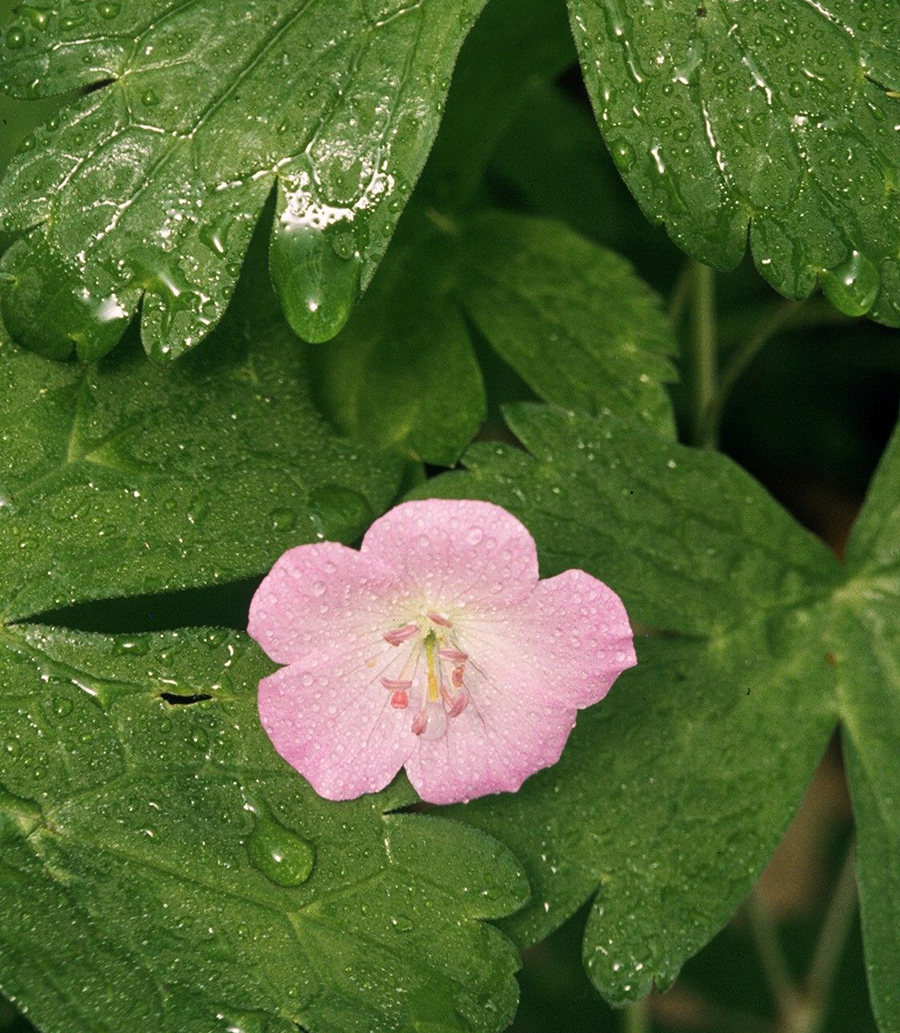
The ingenuities of nature are seemingly infinite. Take a close look at the petals of a wild geranium flower and you will see dark blue lines leading from the outer edge to the center of the blossom. If you were a bee with its ability to see ultraviolet light, the lines would be more pronounced and act like guides, directing you to land on the plant’s reproductive parts, deposit the pollen you picked up from the previous plant you visited, and help insure the propagation of the species.

(Incidentally, while the pollen of most plants is an orange-yellow, that of the wild geranium is a brilliant blue. Researchers are not sure if this is also a mechanism to attract bees.)

After the pink and purplish petals of the Wild Geranium drop off, an elongated ovary becomes part of the seed pod—which resembles a bird’s head with a long beak rising up from the stem. In fact, hundreds of years ago, inhabitants of the Old World named the plant Cranesbill, and even the word geranium comes from the Greek geranos, which means “crane.” As the seeds ripen and enlarge, they cause the pod to curl and become ever tighter. Eventually the pressure becomes too much and the pod bursts, sending the seeds out in all directions. Some observers say the seeds are catapulted more than thirty feet away!

Flower Fast Facts

FLOWER: The pink to purplish, upright, round-petaled flowers have five pointed sepals, ten stamens, and one pistil. They grow in loose clusters of two to five.

LEAVES AND STEM: The grayish leaves have coarsely-toothed lobes and grow oppositely on a stem of one to two feet in height. They may become covered with white dots as they age.

BLOOM SEASON: April to June


About This Series

“Mountain Wildflowers” features a wildflower from the Blue Ridge region each month from March to October. Leonard M. Adkins has written for Blue Ridge Country for more than two decades and is the author of 20 books about travel, hiking and nature. His Wildflowers of the Appalachian Trail, which received the prestigious National Outdoor Book Award, provides the photographs and some of the information he writes about in each “Mountain Wildflowers.” It and his other works may be obtained through his website.

You Might Also Like:

e1b70596-05c8-11f1-92e0-1248ae80e59d-3-2026rueanemone--credit-Joe-Cook

March’s Mountain Wildflower: Rue Anemone

A member of the buttercup family and found in the open woodlands, rue anemone (Thalictrum thalictroides) has long, thin stems that tremble in the slightest of winds—prompting its other common name, windflower.
Pokeweed growing in Floyd County, Virginia.

January’s Wild Edible: Pokeweed

Pokeweed is one of the wild plants that is most associated with the Blue Ridge Region.
A purple-spored puffball growing in a field in Botetourt County, VA.

December’s Wild Edible: Purple-Spored Puffball

The purple-spored typically grows in this region’s fields, often appearing from October through December and into early January.
d289022c-696f-11f0-a179-1248ae80e59d-CGZ_0845-011

Ride the Rails, Explore Rockbridge County: Make a Weekend of the 611 in Goshen!

This fall, one of America’s most iconic steam locomotives is making tracks and memories.
The compound, lancelike leaflets of the bitternut are a good identifier.

November’s Wild Edible: Bitternut Hickory

Frankly, this native species to the Blue Ridge mountains comes by its name honestly.
Mullein growing in Ingram's backyard.

October’s Wild Edible: Mullein

Earlier, this year, a lone mullein plant appeared along the fence that encloses my garden, which made me curious about this plant.
An indigo milk cap growing in Botetourt County, Virginia.

September’s Wild Edible: Indigo Milk Caps

When young, indigo milk caps are one of the most stunningly beautiful mushrooms in the Blue Ridge Mountains.
ec3b964c-5201-11f0-968d-1248ae80e59d-9-2025spottedjewelweed--credit-Joe-Cook-and-Monica-Sheppard

September’s Mountain Wildflower: Spotted Jewelweed

Seek out spotted jewelweed growing beside a stream or along a moist area and you will have a good chance of getting to watch one or more ruby-throated hummingbirds flit from flower to flower.
A black staining polypore growing in Botetourt County, VA.

August’s Wild Edible: Black-Staining Polypore

The black-staining polypore is certainly one of the more fascinating wild edible mushrooms.
Northern Dewberry growing in Botetourt County, Virginia.

July’s Wild Edible: Northern Dewberry

For several reasons, the northern dewberry is often overlooked as a summer berry in the Blue Ridge.

CALENDAR OF EVENTS