Skip to content

EDITOR’S NOTE: This story originally appeared in our November/December 1993 issue. It is being presented again here as part of our 30th Anniversary celebration.
” … although Raggedy Ann and Raggedy Andy loved all the other dolls in the nursery very much, still at times they like to leave the nursery and walk down through the deep, deep woods filled with fairies ‘n’ everything, because there they found strange adventure …”
–The Paper Dragon: A Raggedy Ann Story, Johnny Gruelle, 1926

Crossing the log threshold of The Last Great Company is like stepping into the pages of a storybook. Fragrant woodsmoke and tinkly ragtime music beckon visitors inside, where shelves and cases bulge with old-timey merchandise-everything from draftstoppers to toy bags to tee shirts, piled in neat, bright stacks. Walls are hung chockablock with hand-watercolored proverbs and patents. Dozens of nostalgic gadgets and New-Age keepsakes compete for the few remaining nooks and crannies.
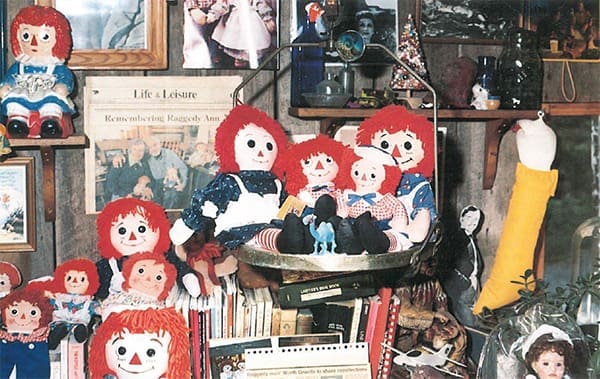
But the real storybook presence here is the scores of bright-eyed, yarn-haired dolls that spill out over the edges of wooden shelves and tables; floppy ragamuffins who have endeared themselves to generations of children worldwide-America’s favorite folk dolls, Raggedy Ann and Andy.
At the center of this Cashiers. N.C. outpost sits The Last Great Company’s amiable owner-proprietor, Kim Gruelle. For Kim, The Last Great Company is more than just a gift shop or stop-off for travelers headed deep into the mountains. It is the true, spiritual home of Raggedy Ann and Andy. In this, the most magical of mercantiles, Kim has made it his business-and his pleasure for the past 12 years, to watch over and perpetuate the gentle legacy created more than 75 years ago by his grandfather, Johnny Gruelle.
A prolific writer, gifted illustrator, and skilled playthings designer, Johnny Gruelle is best known as the creator of Raggedy Ann and Andy. He also possessed a keen understanding of folklore, a near-mystical affinity with magic, and a spiritual love for nature and the great outdoors. Johnny particularly loved the forest, and drew much of his creative inspiration from long walks in the woods. When he began writing about his whimsical Raggedys during the teens and twenties, he was determined to give them an enchanted playground; a special, far-off wooded place all their own. Eventually. Gruelle dubbed this mystical, mythical locale the Deep Deep Woods.
Here, in an imaginary, pastoral wonderland full of fairies and gnomes, the lively Raggedys could race through trees, from thicket to thicket, munch to their hearts’ content on cookies that grew on bushes and drink from bottomless soda water springs.
Like his grandfather, Kim Gruelle is an artist-businessman drawn to the wonder and magic of the forest. Western North Carolina (where his family had vacationed for years) seemed the perfect spot for an enchanted, off-the-beaten-path Raggedy outpost, where Kim would sell only the best and most authentic Raggedy merchandise.
Kim and his parents, Worth and Sue (who live just up the road) work hard at seeing that marketing concerns don’t overshadow the Raggedys’ true spirit. According to Kim, that spirit has at its center a very important value: unconditional love.
“It’s a natural thing,” notes Kim, “that the traditional images and spirits of Raggedy Ann.and Andy have persisted. Traditional values never become passe when you love unconditionally.” Certainly. Kim’s mountain mercantile embodies that true spirit created so many years ago by his grandfather. From the wooden Raggedy cutouts waving hello on the front porch, to the smoke wafting out of a crooked little chimney, to the babbling brooks and lush Carolina woods that lay just beyond the doorstep, The Last Great Company is a “real-for-sure” Blue Ridge version of the places Johnny Gruelle wrote about and illustrated- a welcoming, Deep Deep Woods kind of place where the best and most magical of adventures still seem possible.
The Last Great Company, located just off of Route 64 in the community of Cashiers, North Carolina, is open Tuesday through Saturday from June through October. Hours: 10 a.m.-5 p.m.
For mail order information, write The Last Great Company, Route 2. Box 245. Cashiers, NC 28717.