Skip to content


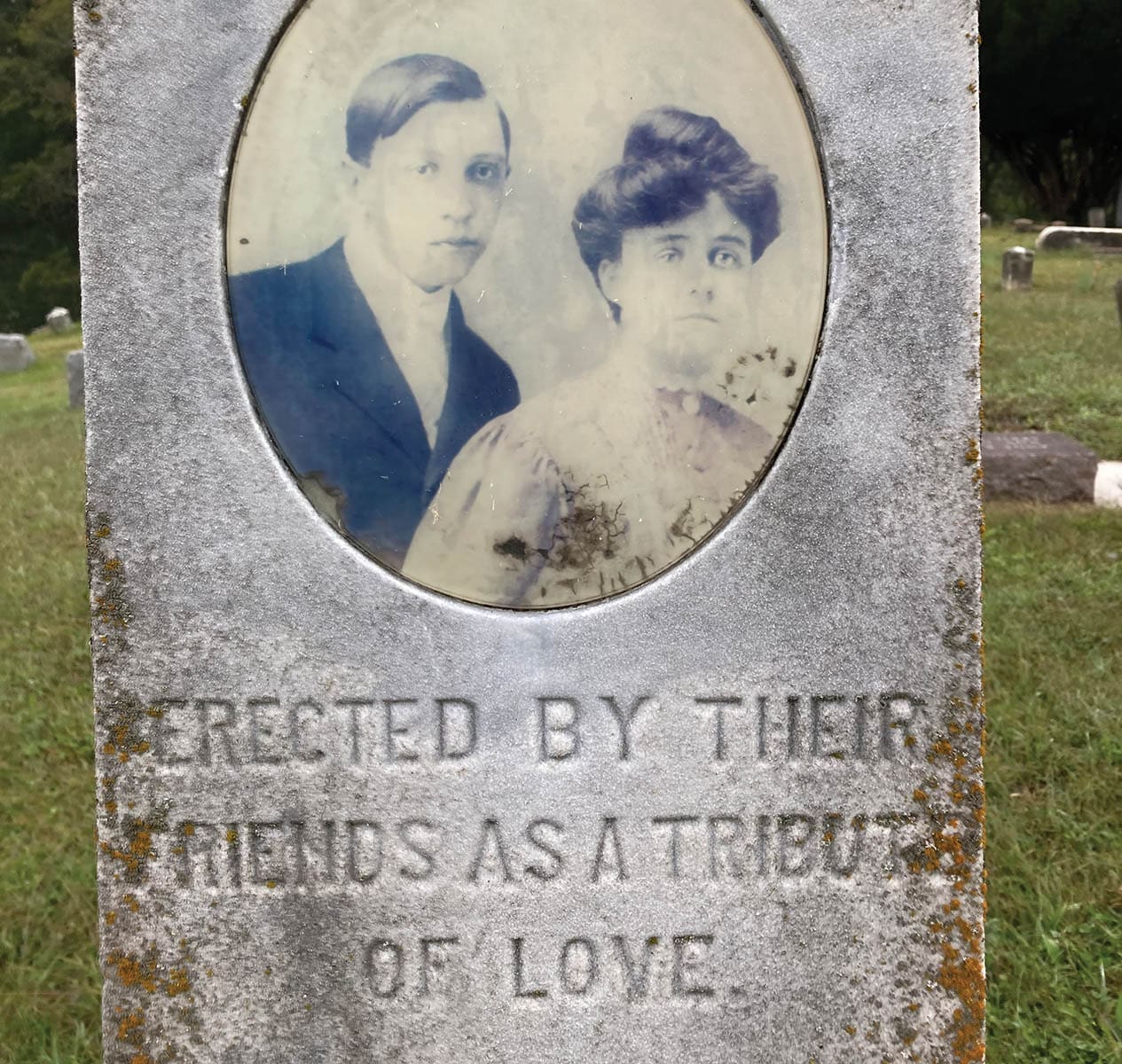
The Shakespearean tragedy of Stuart Gay and Mabel Pendleton is still remembered in the small railroad town of Clifton Forge.
Text and Photos by Joan Vannorsdall
Photo above: Portrait of Stuart Gay and Mabel Pendleton centered on the front of their shared tombstone.

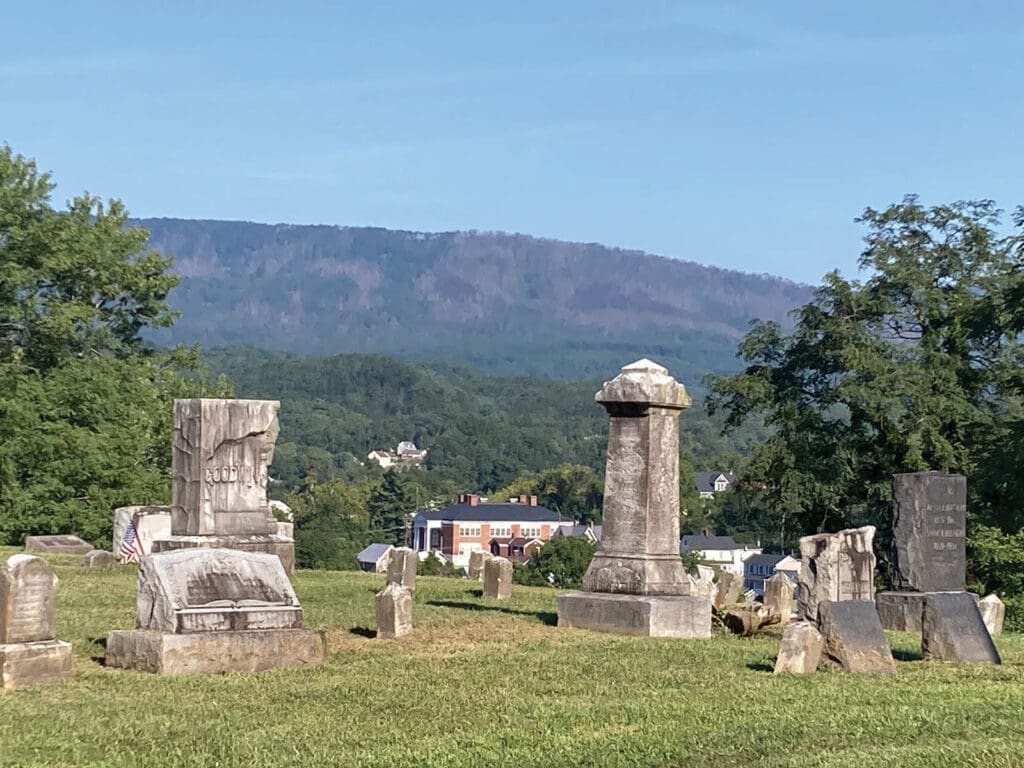
Crown Hill Cemetery is a quiet and beautiful place to wander. The 163-year-old burial ground sits high above Main Street in Clifton Forge, Virginia, overlooking once-stately houses and old brick school buildings, church spires, and the rail tracks running along the Jackson River. And embracing it all, the blue-hazed mountains.
Some of the oldest graves here are marked with small, tilted stones, the inscriptions weather-worn. Aside some, an iron Southern Cross of Honor commemorates a Confederate soldier’s resting place. Family plots are neatly arrayed with artificial flowers and flags, and the cemetery’s grass is always neatly mowed and trimmed.
At the crest of the cemetery hill, just to the right of the high-flying American flag, is a monument with a large, inset photograph of a young woman and man with this inscription:
“Erected by their friends as a tribute of love.”
On one side of the monument:
She was the sunshine of our home.
Mabel Lucile
Daughter of J.H. and Mattie W. Pendleton
May 9, 1889
April 18, 1907
And on the other:
His memory is blessed
Charles Stuart
Son of C.S. and Katie M. Gay
May 23, 1888
April 18, 1907
Seventeen-year-old Mabel, and Stuart, just a few weeks shy of 19, died on the same day and were buried in the same grave. How, I wondered…and why? Who were these two young people, whose portrait has watched over this town for more than a century? And what, in the spring of 1907, captured the nation’s attention so deeply that their story was written up in big-city newspapers up and down the East Coast?
And so I set out to find the answers.
Like most long-ago stories that get told again and again, this one has a lot of versions, with shifting details and human conjecture. But weaving all of them together is love. Young love. Communal love. And star-crossed love.
If you want to know anything about the history of this small railroad town, Elizabeth Hicks Corron’s 1970 book, The History of Clifton Forge, Virginia: Scenic, Busy, Friendly,is a good starting place. Here’s how Corron begins the Pendleton-Gay story:
One of the saddest tragedies to ever happen in this community occurred in April 1906 [sic]. Two young lovers, Stuart Gay and his sweetheart Miss Mabel Pendleton, both under age, eloped to Washington to get married, but they were intercepted by a police officer in Staunton. The officer had acted on a telegram sent by one of the girl’s relatives and brought the couple back to this city.
The question of who sent the police to stop the train—and why—was recounted in several ways. In a retrospective Washington Post story from April 1982, reporter Jack Elsen claimed it was “their parents.” The 1907 New York Times story pointed to “the girl’s parents.”
But most accounts suggest that it was Mabel Pendleton’s sister, Mrs. W. H. Hocker, who asked police to intercept the two lovers before they married, citing their youth as the reason for stopping the elopement.

Of note is that the boy’s father, Captain C.S. Gay, was reported in the Newport News Daily Press as regretful: “He recognized the uselessness of trying to stop the marriage and would not take any part in it, for he felt satisfied that the couple would eventually marry, and there was nothing to gain by throwing obstacles in their way.”
It may be telling that young Mabel did not reside in Clifton Forge—she lived 75 miles north in Waynesboro. She’d come back home to visit with her widowed mother and sister…and, most certainly, Stuart Gay.
Whoever reached out to the police to stop the young lovers, we’ll never know. But we do know that Pendleton and Gay left Clifton Forge on April 17, 1907, heading north to Washington, D.C., on the evening C&O #3 train, unaware that notices had been telegraphed to every stop between Clifton Forge and Washington, asking police to thwart the elopement and send them home.
And that is exactly what happened. An officer met them at the Staunton train station and “held these unfortunate persons until the arrival of the No. 2,” heading back to Clifton Forge.
A reporter for the Newport News Daily Press wondered why the couple returned at all, given that they were sent back to Clifton Forge without an officer accompanying them. “They could have left the train at Goshen and boarded No. 4 and in this way passed Staunton without fear of molestation, but young and timid they possibly did not think of this.” (April 21, 1907)
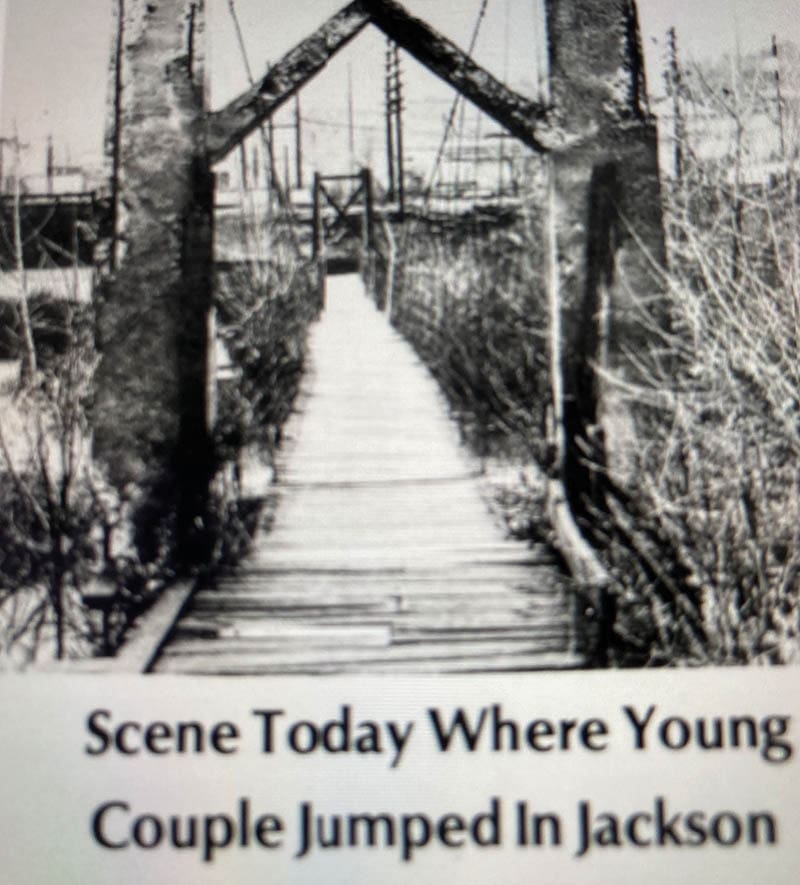
Clifton Forge Police Chief W. T. Hornbarger reported that when he entered the coach, the two young lovers sat laughing and talking. He walked them to what was known as “the wire bridge,” spanning the Jackson River at the bottom of Bridge Street: “Chief Hornbarger kept his eye on them long enough to see that they made a start for home and when he saw them start up the steps to the bridge landing he felt satisfied that they would go home and he therefore paid no further attention to them.” (The Daily Review, April 18, 1907)
And here is where it happened. Shortly after starting across the swinging bridge, Mabel Pendleton jumped over the wire rail into the river 60 feet below. And Stuart Gay, “in his heavy clothing, promptly followed in an effort to rescue his sweetheart, but both were drowned…”
(Elizabeth Corron).
It’s hard not to wonder what drew Mabel Pendleton into the cold water below. Certainly, having grown up walking that bridge so high above the shallow river, she knew she wouldn’t survive her jump. And did she know that her fiancé would follow—had they pledged that to one another on the trip back to Clifton Forge? Was this act her final statement of defiance, in a time when women had little authority over their own lives?
But after 119 years, the why of Mabel’s leap is long gone. Both of the young lovers died, taking their secrets with them.
It took townspeople two days to find Mabel’s body, three days to find Stuart’s.
The accounts of the search are detailed in the Clifton Forge newspaper, The Daily Review. The April 20, 1907, edition headlined the recovery of Pendleton’s body, reporting that there was a “smile on the face of [the] drowned girl.”
And also this curiosity:
The theory advanced by some that if a garment of a drowned person is thrown into the water it will go where the body lay and sink was tried and a shirt waist of the young lady was used for this purpose. The waist floated down the river and went to the bottom of the river where the body was found, but it did not furnish the clue to the discovery.
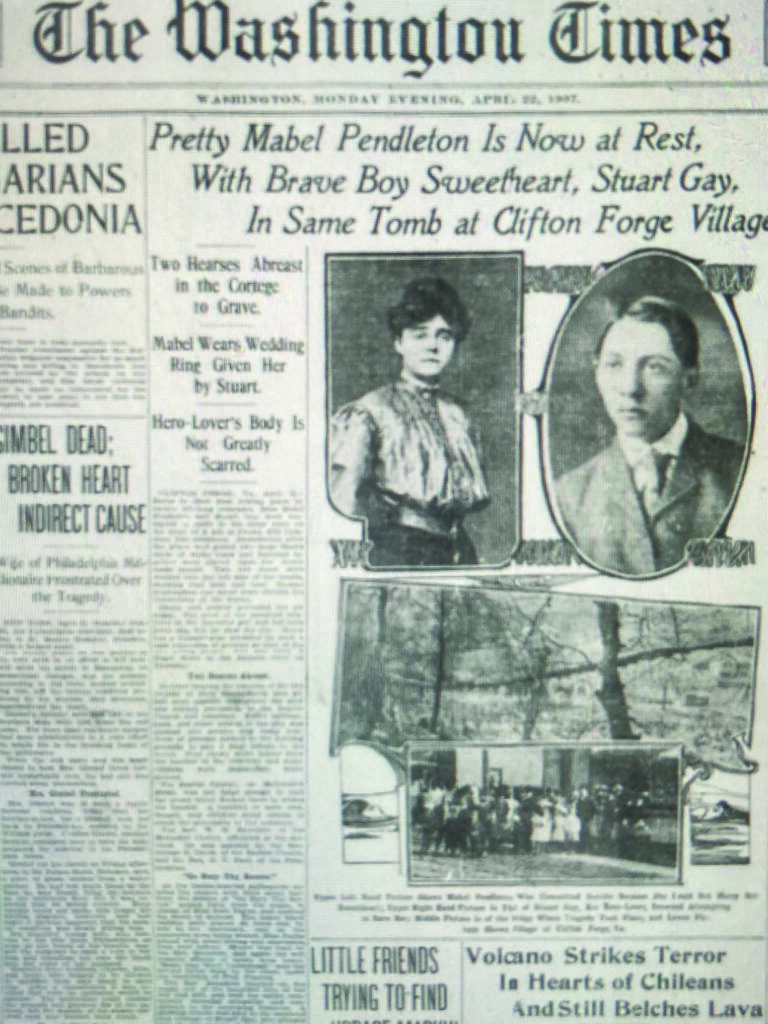
Gay’s body was discovered the following day. As reported in The Washington Times on April 22, 1907, “The fates decreed that his body should be found in the river at a point directly in front of Mr. Shomo’s house, in which the remains of the girl lay, waiting for him to be found in order that they might make life’s last journey together.”
And that is exactly what happened. After the bodies were prepared for burial, visitors were allowed to view them. “All day long a steady stream of humanity poured across the dangerous swinging bridge from which the two leaped, one to suicide and the other to rescue. The crowd became so dense that the bridge sagged down so low it was believed a collapse was inevitable.”
And this: “So many persons flocked into the room where the bodies lay that the floors began to crack and the relatives allowed only fifteen to go in at one time…”
A joint funeral was held at the Clifton Forge Baptist Church, officiated by the Methodist minister. The funeral was recounted in great detail by a reporter for The Washington Times, headlined as follows:
“Pretty Mabel Pendleton is Now at Rest With Brave Boy Sweetheart, Stuart Gay, In Same Tomb at Clifton Forge Village.”
“Two Hearses Abreast in the Cortege to Grave”
“Mabel Wears Wedding Ring Given Her by Stuart.”
“Hero-Lover’s Body Is Not Greatly Scarred.”
Descriptions of Mabel were detailed:
She looked lifelike and natural, and her skin was soft and pink. Arrayed in a snowy shroud made by friends, she lay in the casket as if sleeping. The long, black lashes swept down over her plump, delicately colored cheeks. Her lips were contracted into a smile, and two large, loose coils of black hair rested on her forehead….On the ring finger of her left hand, she wore a heavy plain old circlet, her wedding ring given to her by Stuart while they were on the train going to Washington to wed. From her throat hung a gold locket, in which was pasted a picture of the youthful lover.
Gay’s description in the funeral account centered on his injuries and heroism:
Stuart’s face was slightly discolored by the three-day stay in the water. There were a few scratches and gashes on the cheeks, but the features were unmarred. He was garbed in a suit of sober black, and wore a white necktie, which was invariably his dress when with his fiancé.
A glowing tribute was paid to the manhood and courage of Gay, who plunged into the icy waters of the Jackson, unmindful of his own danger, and possessed by the single thought of bringing the girl of his choice to safety.
And then the two identical caskets were taken to Crown Hill Cemetery for burial:
Every carriage, hack, and vehicle in the city was pressed into service and many hundreds of persons walked to the burial grounds to pay a final tribute to the lovers. Four snowy white horses drew the hearses to the cemetery and many children wore immaculate white dresses. Borne to their final resting place by twelve life-long comrades, Mabel Pendleton and Stuart Gay were consigned to earth in the same tomb…and immediately after the grave was sealed two large hearts made of white roses and fastened together were placed upon the newly made mound. Two red roses were worked into the left side of the hearts, showing that both had bled. Human interception can never more disturb the communion of the lovers.
Corron’s summary statement of the visitation and funeral is beautifully descriptive of her community and its response to the tragedy of Stuart Gay and Mabel Pendleton: “The whole city wept and was stunned by this disaster. Similar tragedies may happen in other cities, but in a small community where there are no strangers, every casualty or event becomes personal.”
She added one final note to her account of the tragedy: “The initials of the sweethearts and the date, March 1905, are still carved on the bricks of Foster’s store on the River Street side.”
I’ve gone searching for those initials and the date, walking the length of the River Street alley and the side of the building that once housed Foster’s store (still painted with a huge advertisement: “Fosters: Where the woman who knows buys her clothes”). But it seems the inscription is long gone, erased by time or repair.
I’d like to think that someone with better eyes than mine might find the lovers’ initials some day…and it’s a Clifton Forge history treasure hunt to decipher the many deep-cut inscriptions on the Foster’s store wall, some dating back over a century.
Then walk a little more, on down to the Jackson River. There, you can sit on the north bank beneath the locked-up swinging bridge, with its missing planks and drooping wires and the countless stories carried by those who walked it.
None of them is more memorable than the Romeo-and-Juliet tragedy of Stuart Gay and Mabel Pendleton.
For never was a story of more woe Than this of Juliet and her Romeo.
—William Shakespeare
Romeo and Juliet
(V:iii:309-310)
What Makes a Sad Story Romeo-and-Juliet Tragic?
William Shakespeare wrote a dozen tragedies, and Romeo and Juliet stands apart from most of them. In his traditional tragedies (think Othello and Hamlet), the tragic hero suffers from hubris, or overwhelming pride and arrogance. The result is usually a downfall of the hero’s power or position—often fatal. Shakespearean tragedies often center on hunger for political power, “ancient grudges,” and, always, that inevitable downfall.
But Romeo and Juliet stars very young main characters. They fall in love quickly and deeply, and the resulting decisions are impulsive. The larger concerns of state, war, and country are irrelevant to them: it’s love they hunger for. Love—on their own timeline and terms. And without the “wisdom” of age, they act impetuously…and fatally.
Like Romeo and Juliet, Stuart and Mabel share the tragic flaws of youth and deep desire. And their fates, sadly, are the same, as they die for love.
Romeo and Juliet, Stuart and Mabel. They belong together.
A Century Later, A Town Remembers
After posting a request for any memories of Stuart and Mabel on the “I Love Clifton Forge” Facebook page, I was surprised at how many people knew about the long-past local tragedy.
A number of people shared that their grandmothers had shared the story with them.
One respondent asked an acquaintance this: “Aren’t you related to the lady who jumped off the bridge? Do I remember you saying you have her shoes?”
And here’s the response: “Yes…my mother was related to Mabel Pendleton. My mother had their grave restored many years ago. I have a copy of the article in the local paper and there’s a picture of my mom with the actual shoes Mabel was wearing when they found their bodies.”
Another local resident told me this when we connected at a meeting, saying she’d seen my post: “My grandma always said that her father was one of the searchers who found Mabel’s body.” (When I found his name, George Broughman, in an early 20th-century newspaper account, she was thrilled.)
Of all the local memories of this tragic story, the most poetic came from long-time local historian, Johnny the Barber:
“They had fire in their hearts, and smoke in their eyes.”
The story above first appeared in our May/June 2026 issue.