Skip to content


The story below is an excerpt from our May/June 2015 issue. For the rest of this story and more like it subscribe today, view our digital edition or download our FREE iOS app!
Along the new river gorge national river, volunteers spend a week in the woods looking for markers of those who came before us.
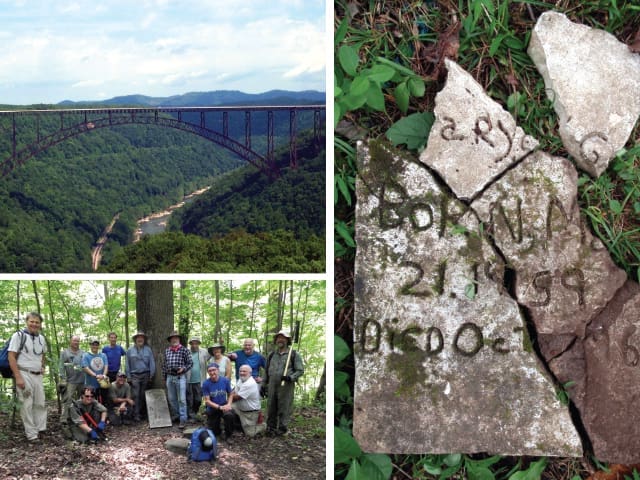
I stand on a terrace of forested and wild land a mile from the rocky, rutted dirt road where we parked our vehicles. The loud rush of West Virginia’s New River, 100 yards away, echoes through the trees, pounding and pummeling itself over rocks, pushing between the steep and unforgiving sides of the gorge.

A group of Sierra Club members from across the country has converged here, for a week of service in the New River Gorge National River Park. On this day, trekking back into the work location, we climb over and under fallen trees and logs and scramble up and down steep, slippery, overgrown slopes. Finally, we come to a place where the land flattened and formed an elevated shelf above the river.
New River Gorge National River Park Ranger Frank Sellers briefs us before we trek in.
“It’s a bit of a hike back in there, and we may have to peck around a little to find the gravestone,” he says. I smile at the thought of us “pecking around,” the woods like a flock of chickens. Instead of hunting for bugs and worms, we will hunt for the final resting place of someone’s long-lost ancestor.
We are there as a part of the Volunteers in the Parks program. A part of the National Parks goal is to protect and respect any and all cemeteries on parklands.
While many are familiar with the gorge’s world-class whitewater rafting or the longest steel arch bridge in the Western Hemisphere, the gorge has another story to tell – the disappearing remnants of a boom time when coal and logging were kings along the river. With the arrival of the Chesapeake and Ohio (C&O) Railroad in 1873, came thousands of workers, including miners, lumberjacks, migrating blacks and many European immigrants. At one time, about 50 small coal towns were scattered along the gorge. Once vibrant and humming engines that sustained the industrial revolution, most are by now largely reclaimed by Mother Nature.
After almost a century of limitless mining and logging, the boom went bust. Just as people had flocked into the gorge to find work, they now abandoned the dying area. They left behind ghost towns and cemeteries filled with friends and family members.
“Many people across the country probably have ancestors buried here along the gorge and don’t even know it,” says Sellers.
In the heart of the New River Gorge National River are the remains of one of those ghost towns. Thurmond, the chief railroad center on the C & O Railway mainline by the early 1900s, had the largest revenue on the C & O. It served some 75,000 passengers a year and moved 4 million tons of freight. The town was a bustling economic center with stores, saloons, hotels and boarding houses constantly overflowing. By the 1970s, Thurmond was little more than a ghost town.
Once we arrive at our work location, we fan out and began searching for a gravestone he’d found almost a year earlier.
We scour the area until we hear Sellers shout of “Here it is,” echo through the trees. We rush to converge on the spot. The headstone stands erect but leaning slightly. Its top was chiseled in a graceful curve; the center carved out with a name that has been worn down by the wind, rain and snow of decades. A scuffing away of leaves revealed a footstone as well.
An unspoken ripple of emotion runs through the group as we look upon this long-lost gravestone with reverence. Who was buried here? What was the age at death? What was the cause of death?
Once the area is cleaned up, Sellers plugs the coordinates into his GPS so the site can be found again.
“We find more cemeteries every year,” he says. “We’ve identified about 70 cemeteries in the park. We often use the old CSX railroad maps and town maps to find cemeteries in the park.”