Skip to content


If your garden space is limited, don’t despair. Take advantage of veggies’ upward mobility. Not everything can be trained up a string or a pole, but space-hogging squash and cukes, as well as tomatoes, beans and peas, can be encouraged to grow vertically. With food costs skyrocketing, you can bring your grocery bill down by planting climbers next to an existing fence. Or fill your back yard with creative, low-cost garden structures. You can reap a bountiful reward even in space scarcely larger than a shoebox.
When I was a beginning gardener, gadgetry advertised in garden catalogues beguiled me. I sent away for bean towers and collapsible pea fences; I bought stakes and tomato cages. I still use the stakes, cages and pea fence (often for other crops than peas), but I finally gave away my bean towers after they’d cluttered up my garden shed for years. They weren’t tall or adaptable enough to work in the space I had. Take my advice. Hoard your hard-earned cash and build your own garden structures.

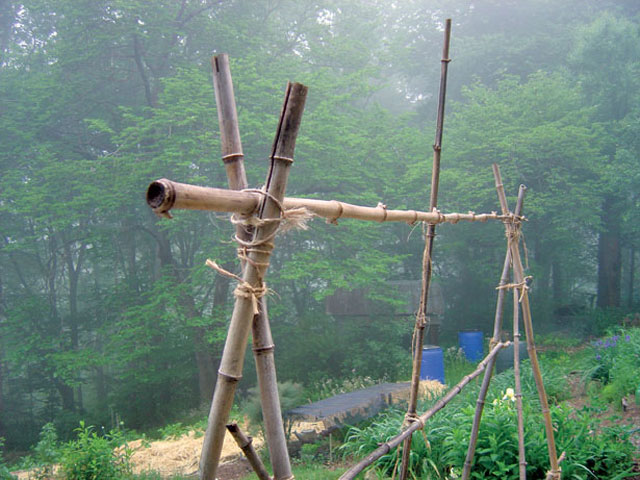
There are lots of ways to do it. Peas have long been grown on brush, and polebeans on teepees fashioned from saplings encroaching on open spaces. A couple of summers ago, my neighbor Meg and I availed ourselves of bamboo that maintenance men at Penland School of Crafts had cut and were about to burn. With their permission we cut lengths of it, tied it in bundles, and attached it to the top of her Subaru with bungee cords to transport it to our respective houses.
Bamboo doesn’t last forever, and becomes brittle (and near impossible to cut) once it’s dried out. So do what I didn’t and cut the lengths you’ll be using sooner rather than later. Then buy a big roll of sisal twine ($7-$10), and you’re in business. This year I’ve used combinations of bamboo, metal fencing, wooden stakes and tomato cages to support peas, beans, cukes and tomatoes. When the season ends, I’ll dismantle everything, store the structural elements away, and compost the twine.
You can use other materials for supports: wood, or metal posts of the sort used for electric fences. (A website I checked also suggested electrical conduit pipe.) Twine, nylon mesh, chicken wire or galvanized fencing will work (or won’t) for trellising, depending on which vegetable you want to support. Bamboo and twine is all peas and beans will need; tomatoes, with their clustered fruit, and squash of all kinds require sturdier structures.
After you’ve create your structure, you’ll most likely still have to help the plants get started on it. When my peas worked their way through the hog wire that encloses the plot behind my old chicken house, the deer made short work of whatever shoots they could reach. So I added more string away from the fence and encouraged their tendrils to clutch it. As the tomato plants grow, I’m suckering them and gently winding the central stem around twine I’ve suspended from a bamboo support. I’ll probably have to add something stronger to hold them up before they begin fruiting, but for now what I’ve built is working.
Vegetables for Structures
Tomatoes: Look for indeterminate varieties, including most of the mouthwatering and colorfully named heirlooms (Brandywines, Big Rainbows, Oxhearts, Accordions and Mortgage Lifters); some paste varieties like San Marzano and Striped Roman; and cherries like Sweet Million and Sungold. Unlike determinate types that grow to a certain height, stop and produce their crop all at once, indeterminate vines keep growing and taller and taller and produce until killing frost ends the season.
Beans: Pole beans are what you want here, and there are plenty of varieties to choose from, from the old standbys like Kentucky Wonders to mottled Rattlesnakes to pole varieties of Blue Lake and Purple Royalties. For fans of filet beans, try some Emerites. For the hummingbirds, plant Scarlet Runners.
Cucumbers: You’ll want trellising vine rather than bush varieties. Among the possibilities: burpless Asians (Suyo Long, Tasty Jade, Orient Express); English greenhouse types (no greenhouse needed); and Armenian (aka Snake or Yard Long) cukes that are really melons.
Peas: There are three types of peas, all with tall varieties. For shelling peas, try Aldermans (a.k.a. Telephone); for snaps, Sugar Snaps; for snow peas, Oregon Giants. Pea developers keep turning out varieties with shorter and shorter vines, but I’ve better luck with the tall ones. You may read that short varieties don’t need support; that’s not my experience.
Squash: The summer squash that begs to be trellised is Tromboncino, a green-to-tan Italian giant with fruit that can grow three feet long, though its better picked before that if you plan to eat it. You can grow vining winter squash like Butternuts (or Vegetable Spaghetti) on a trellis too, but it had better be sturdy. And don’t forget: You’ll need to support the squash as well as the vine when it develops. Slings made from wide strips of cloth (or discarded pantyhose or kneehighs) will solve the problem. —EH
First published in Blue Ridge Country’s March/April 2009 issue.