Skip to content

The famous “Monkey Trial” of 1925 put the little town of Dayton, Tennessee, on the map, as per plan.
It all began with the Butler Act: a rule in Tennessee that said schools could not teach anything that would contradict what’s in the Bible.
The year was 1925, and the American Civil Liberties Union (ACLU) took note of that rule by offering to pay for the legal defense of any schoolteacher who would challenge that law as unconstitutional.

Yet it was business leaders in Dayton, Tennessee, who really took note of that challenge, dreaming instead of how much publicity such a court trial might muster.
Questions lingered: Where did man come from? Was he created according to the stories in the Bible or did he evolve from monkeys?
Turns out, the small town of Dayton—at least in the view of Earle Robinson, a local druggist, and George Rappleyea, a coal and iron company superintendent—would seem like the perfect place to have such a debate.
Why? Well, because this courthouse town between Chattanooga and Knoxville needed an economic shot in the arm with the wane of the coal and iron industry.
So Robinson and Rappleyea conspired with 24-year-old schoolteacher John T. Scopes, figuring a test-case might collect controversy as well as commerce.
Scopes had been a substitute teacher at Dayton. “And he was willing to be that one schoolteacher from Tennessee who would test the case,” says Dr. Rebecca Tucker, a Dayton resident and a member of the Rhea County Historical and Genealogical Society’s board of directors.
Scopes taught the theory of evolution to a handful of students—just to say he did, Tucker says. “It was not that parents were all upset about this teacher who was coming in with all these ideas. It wasn’t that at all.”
This, more or less, followed the plan of a publicity stunt.
Reaching the courthouse at Dayton on July 10, 1925, this “Monkey Trial” attracted about 200 reporters from coast to coast as well as London. Trying to capitalize on all that publicity, a monkey posed at Robinson’s drug store.
“And they had monkeys on the courthouse lawn to add to the circus atmosphere of the day,” says Tucker.
All this was to make Dayton “famous in the sense that they wanted to bring people here that would see what value there was to a place like this. They needed for people to come with investment purposes.”
The actual trial spanned eight days.
In the end, it was agreed that Scopes did teach evolution. And, for that, he was fined $100. But the judge threw the case out of court on a technicality on how the fine was administered, Tucker says.
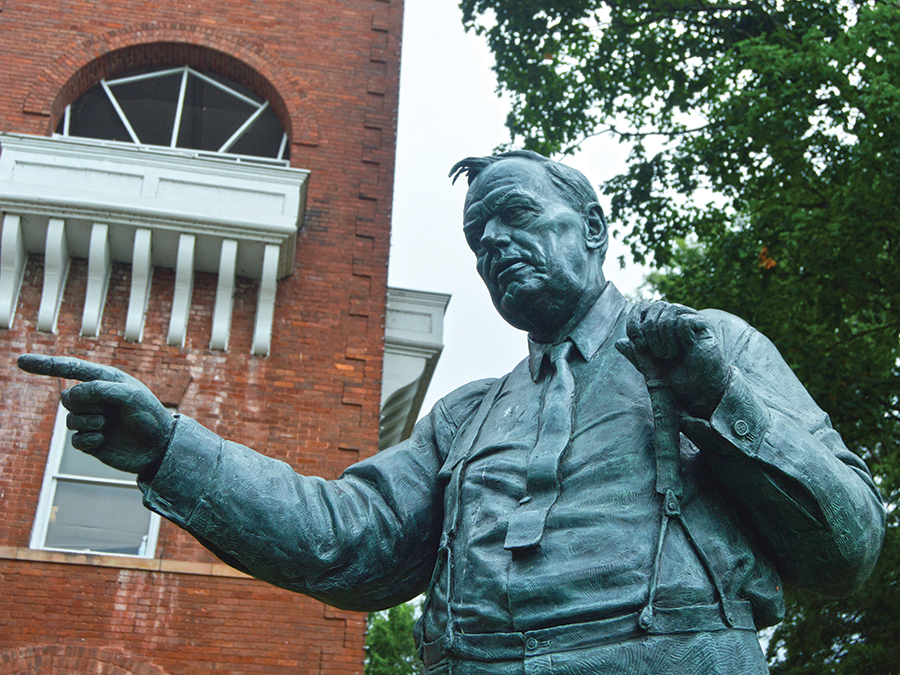
As for Dayton, its 1891 courthouse has since become a shrine to what happened during the summer of 1925. Statues of both William Jennings Bryan, the prosecuting attorney, and Clarence Darrow, the defense lawyer, stand on the courthouse lawn. A newly-refurbished museum explains the story to visitors. And the actual courtroom where the trial took place still contains the original judge’s bench, railing, jury chairs and spectator seats.
“What we were really looking at, in the context of that day,” says Tucker, “was how much can the government dictate what happens in a local community. It was looking at the majority versus the minority. It was looking at academic freedom. And, so, there were some really big over-arching issues of that day.”
Still, Tucker says, “It seemed that the people in Dayton were thinking more about ‘How can we get people and money into this area?’”
Rhea County Heritage and Scopes Trial Museum: 1475 Market St., Dayton, Tenn., 423-775-6171, rheacountyheritage.com.
END OF PREVIEW
The story above appears in our Jan./Feb. 2019 issue.