Skip to content


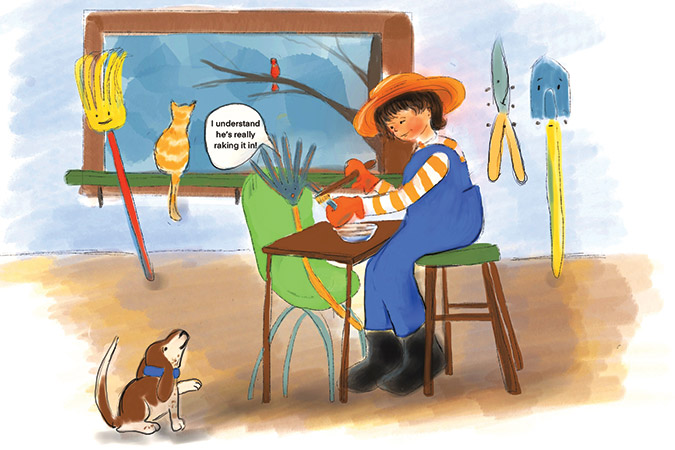
Manicures . . . are basically just holding hands with a stranger for 45 minutes.
—Miranda Hart
Here’s a quick quiz for you. In early fall, after a whole season of hard work digging in the dirt, what has ragged edges and is in desperate need of filing, polishing, and painting?

The answer of course is my garden tools. Oh, and my fingernails could use some help, too.
So, when the last weed is whacked, the last ditch dug, the last limb lopped, and the last plant potted, I gather my tools up and give them the beauty treatment.
First: I sort them into three piles: repair, renew or replace. If the repair involves something I don’t know how to do, the tools are propped up next to the dumpster so some enterprising husband can take them home to his wife and say, “Look at this perfectly good (insert tool name here) that someone threw away.” I’ve gotten several tools this way. Next time, I’ll take them further away before setting them out.
Another efficient way to deal with broken tools is to take them to a hardware store. There, I consult with the owner, who will tell me it can’t be fixed and offer to sell me a new one. This makes buying the latest and greatest feel virtuous rather than frivolous.
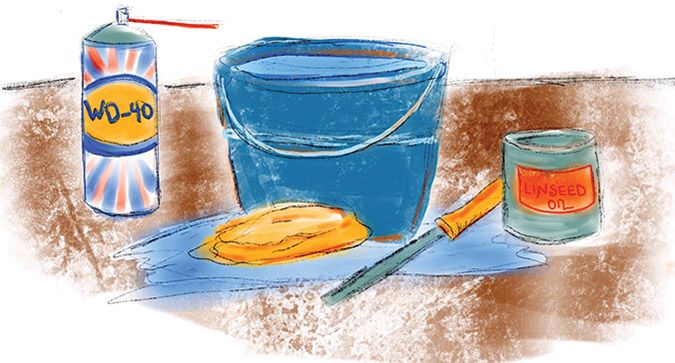
But, if all the tool really needs is a little renewal, then the manicure commences. When I sit down in front of Heidi, first she moans about the huge amount of dirt under my nails. Then, she soaks my hands and scrubs away the mess. The same treatment applies to the metal parts of my tools. Warm water with just a squirt of soap softens the dirt that’s compacted in the hard to reach places. That’s followed by a quick scrub with a wire brush or steel wool or even an old toothbrush to remove the last little crumb of clay.
Heidi follows my soaking with a warm towel, and then she massages some almond-scented oil into my hands. After I dry my tools with an old rag, I also massage oil into the metal parts. It smells like WD-40.
Next up, is the shaping and filing. Heidi uses an emery board to give me a practical, working shape. Hoes and shovels are shaped for work using a tool called a bastard file, while loppers and other two-bladed pruners are shaped with a sharpening stone. The objective is to give each tool an edge appropriate for the job it does, and I’ve found some great video tutorials on-line to help with this step.
The finishing touch involves smoothing and painting. Heidi knows I prefer a colorless finish for my nails and the same holds true for my tools. I take fine sandpaper and buff each wooden handle until it shines. Then I paint on a light coat of linseed oil and buff it to a low gloss.

My hands will reflect Heidi’s care until I start digging in the dirt again next spring. To preserve the beauty treatment I’ve given my tools, I hang them on a pegboard inside an outline showing where each one belongs. This allows me to see at a glance that all the tools are present.
Audrey Hepburn once said that “the true beauty of a woman grows with the passing of the years.” The same holds true when I consider a well-cared-for tool. I have a hoe that belonged to my mother-in-law. It’s over 50 years old and because it’s been given the beauty treatment each year, it’s a pleasure to use. It’s a tool whose true beauty is grounded in the work it’s done and can still do. I hope my hands will reflect the same kind of beauty as they age.
The story above appears in our November/December 2019 issue.