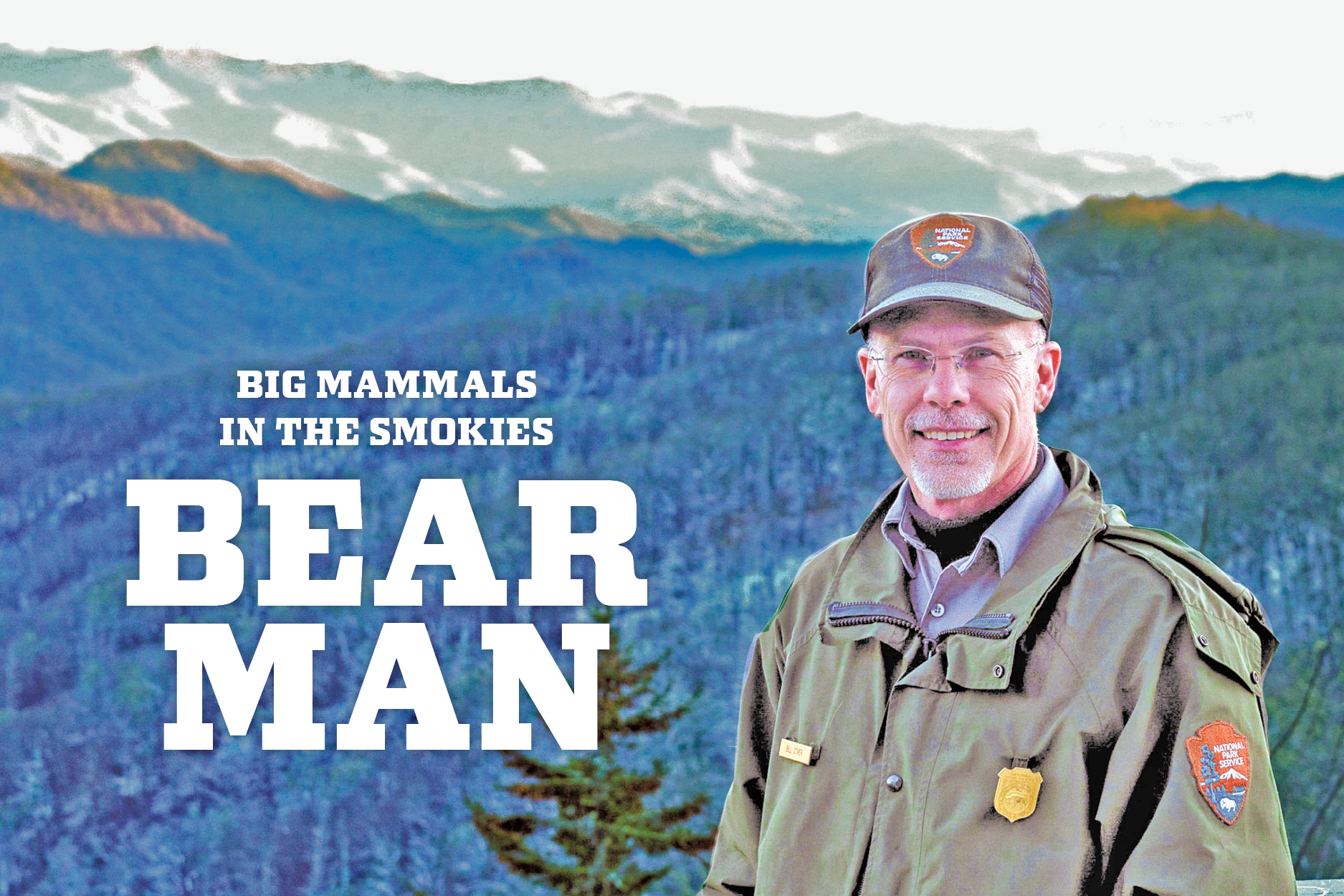
Bill Stiver credits “blind luck” for longtime career looking after large wildlife.
Back in the 1980s, on the first day of class at Michigan State University, Bill Stiver’s fisheries and wildlife professor asked the students to write an essay about the profession. Then he made a pronouncement: “I guarantee that in the future none of you will be doing what you said you would.”

Undeterred, Stiver focused his paper on big-game animals, now referred to as large mammals. Years later, he remembered the teacher’s prediction. “I was like, ‘Well by golly, I am. I’m working with bears. I’m working with elk. I’m working with wild hogs.’”
For the past decade, Stiver, 56, has overseen these animals and others as supervisory wildlife biologist at the Great Smoky Mountains National Park, headquartered in Gatlinburg, Tennessee. Now the go-to guy for managing black bears in the Smokies, he has brought in $2.2 million in funding for research related to wild hogs, bats, elk and, of course, bears.
Midway through college, he still hadn’t decided what he wanted to do for a living, but he knew it involved animals. During orientation for Michigan State’s animal science program, Stiver sat flipping through the catalog, reading about other tracks. To his dismay, he realized that his own path focused on livestock.
“And I thought to myself, ‘I don’t want to work with cows, horses and pigs.’” Fisheries and Wildlife seemed like a better fit, so right then and there, he walked up to the registrar and changed his major.
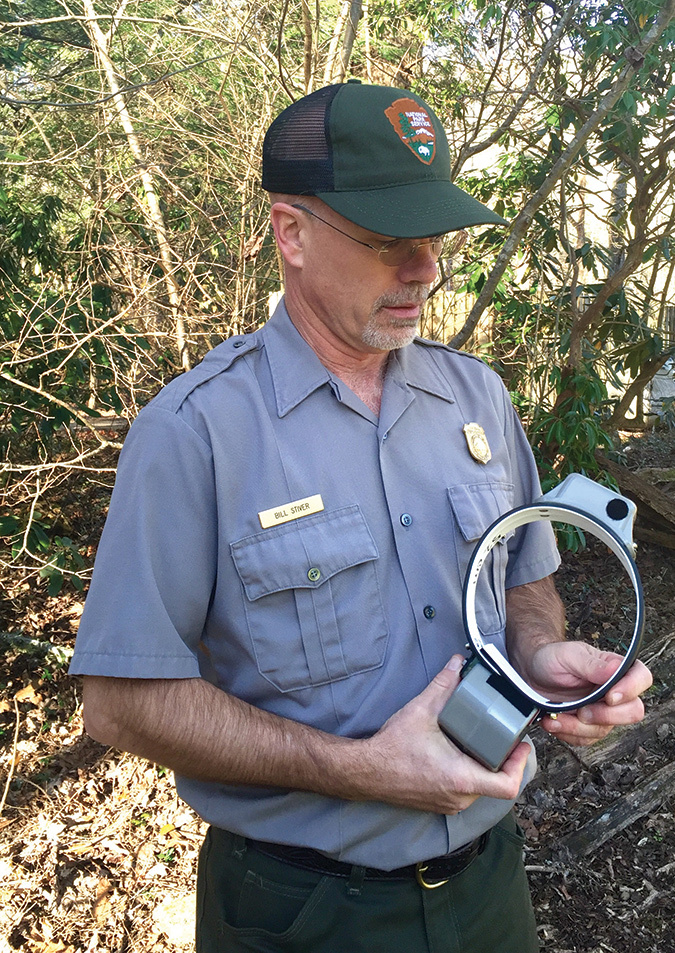
Soon after graduation in 1987, he landed a temporary job electrofishing at Shenandoah National Park. But his roommate’s black bear study at Virginia Tech was far more appealing, so every weekend, Stiver helped his friend tag bears with radio collars.
Stiver distinctly recalls the first time he witnessed a bear in the wild, soon after moving to Virginia. Driving with a Shenandoah coworker, the two spotted a female with a trio of babies by the side of the road.
“The three cubs had shimmied up a tree just briefly,” he says. “They saw us and spooked and took off running. Bears are such an iconic species. You typically remember the first bear you ever saw out of hundreds, maybe even thousands.”
Despite his interest in bears, he planned to pursue an undergraduate degree somewhere in the North, where he’d most likely focus on moose and white-tailed deer. But one day he stumbled across a reference to a likeminded researcher at the University of Tennessee, unaware that his peer was quickly becoming the world’s foremost black bear expert. A few months after writing Mike Pelton a letter, Pelton offered him a project evaluating the effectiveness of relocating “conflict”—formerly called “nuisance”—bears in the Smokies.
“I’ve just been unbelievably fortunate,” says Stiver. “The Lord has blessed me in a lot of ways in terms of my career. And some of it, I swear, is just blind luck.”
Part of which was the Smokies position coming open after a year in Oklahoma. The Smokies post came with no guarantee, but he packed his bags and headed east anyway. “I knew what I wanted to do. … Career-wise, this was the best move I could’ve ever made. And I never moved out of my desk. Over time, I just got promoted to other positions.”
In 2011, after decades of field work, he transferred his belongings to his retiring boss’s desk about 40 feet away.
“Again, I’ve just been very fortunate,” Stiver says. “My career has taken me places I didn’t think I would be able to go just staying here. Most people end up moving all over the country to progressively move up within the Park Service, but I haven’t had to do that.”
When it comes to his staff, the Golden Rule means everything to the easygoing Stiver.
“I try to be respectful of people and who they are, and hopefully they do the same thing back. I like to empower my employees. Just because I’m the supervisor doesn’t mean I know everything.”
Three major things have changed in the Smokies in the last 30 years, Stiver says: the number of visitors, the number of bears and development outside the park.
“When I first came here, there were 400 to 600 bears,” he says. “Now it’s 1,900.”
People cause problems with bears, not the other way around, when they leave garbage or pet food in their yard, camp or picnic area, Stiver asserts. Bears become more intrusive as they get bolder and more dependent on human food. “And then those behaviors can escalate into bears tearing into cabins, tearing into cars, tearing into tents.”
Park regulations specify that a visitor cannot willfully approach within 50 yards of a bear or elk or disturb any type of wildlife. The latter is more difficult to interpret, Stiver says. If a deer lifts its head when you snap a photo, you’ve disturbed it.
A GPS study published in 2019 revealed that of the bears in the Smokies that were fitted with tracking collars, 90% of males and 50% of females left the park at some point.
“It really emphasized the need to work together,” Stiver says. “We need to work with our neighbors, with our communities, to help resolve bear issues, both in and out of the park.”
Starting this year, Stiver and his staff plan to follow conflict bears that have been relocated from the GSMNP and Shenandoah to the Cherokee National Forest for three years and use the data to educate area residents and improve management practices. “This is a big project for me because I started out doing this very thing as a graduate student in 1988,” he says. “It was all based on ear-tag returns, but now the technology has changed where I can literally sit in my office and watch, hourly, where these bears are.”
Despite his lifelong passion for big animals, the part Stiver enjoys most is mentoring young employees and students.
“The guys that work for me are now doing hog control—they’ll call me up at 11 at night and tell me the story for the night, and I just listen. It’s all good stuff.”
BE “BEARWISE”
The Great Smoky Mountains National Park recently joined BearWise, a regional program developed by the Southeastern Association of Fish & Wildlife Agencies that teaches people in “bear country” how to live responsibly with the imposing animals. Here are the six “at-home” basics:
- Never feed or approach bears.
- Secure food, garbage and recycling.
- Remove bird feeders when bears are active.
- Never leave pet food outdoors.
- Clean and store grills.
- Alert neighbors to bear activity.
Source: bearwise.org
The story above first appeared in our May/June 2021 issue.