Skip to content


The “Pray for Rain” sign that our local Weather Guru Ray, of Ray’s Weather [see Blue Ridge Country story here], spotted in front of a Boone, N.C., church in early February was a tongue-in-cheek reference to the copious snowfalls the North Carolina High Country was receiving for the second winter in a row. Still, the region was already experiencing a precipitation deficit for 2011, Ray warned; we’d be praying for rain in earnest this spring and summer. Faced with that prospect, what ought a gardener to do? Here are some suggestions:
Install a rain gauge in or near your garden. (Be sure no overhanging foliage distorts readings.) That downpour you encountered driving home from work may barely have settled the dust in your garden. You need to know how much rain your garden received – or didn’t.

Increase your soil’s water-holding capacity by adding coarse, decomposed organic matter. Different kinds of soil have widely varying capacities for absorbing and retaining water (sand is at one end of the spectrum, clay at the other). You can do this by adding compost; mulching with organic material (leaves, straw, newsprint, etc.) that will break down over time; and cover cropping. (Try buckwheat in warm weather. It grows fast, comes up even when the soil is dry, and the bees love its white flowers. Just chop it down before it goes to seed.)
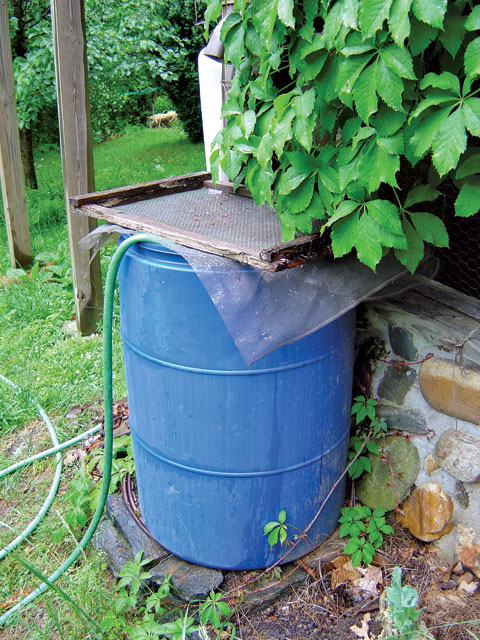
Collect the free water that falls from the sky in barrels below your gutter downspouts. If you’re on city water and water restrictions are imposed, you’ll have a resource that money can’t buy; if you have a well, you won’t have to worry about draining it to water your garden.
Shade or cover your soil to slow evaporation. Working in my garden, I’m always amazed at how much damper soil is under mulch, even in very dry weather. There are downsides to mulching, among them that destructive critters like voles love it. Organic mulches cool the soil below them. That’s a negative in early spring (to warm soil, pull mulch back for a day or two before planting), a blessing in baking summer sun. Other moisture conservers: growing crops under row cover; planting in beds rather than rows. As plants mature, their foliage shades the soil.
Protect your garden from wind. Fronts that bring welcome rain are often followed by drying winds.
Eliminate weeds. They compete with your veggies for moisture, space and nutrients.
Garden Smart
Picking and choosing what and how much you grow is another way to increase your chances of gardening success in a droughty season. Before you plant, consider the following:
Know your veggies’ water requirements, and, to simplify watering, group plants with similar water needs. Forego or reduce plantings of veggies whose water needs are greatest and patronize your farmers’ market.
Grow only what you need, to eat fresh and/or put up. Most gardeners have weaknesses for certain crops, and plant an overabundance of them. (Squash, lettuce, basil and hot peppers are mine.) It’s great to have an overflow to pass along, but when conditions are droughty, you risk everything under-performing by planting more than you can water.
Use transplants. Starting seeds indoors allows you to control moisture during critical germination and seedling stages. Be aware, however, that not all vegetables transplant well and that transplants tend to develop shallower root systems than plants that are direct-seeded. If you buy transplants, find a reputable greenhouse or garden center and buy from them, even if the transplants are more costly. Avoid end-of-season markdowns, at least for vegetables.
Try container gardening. There’s less soil to water (though you’ll likely have to water more often). Remember that one well-tended tomato plant yields lots of tomatoes, and tomatoes grow well in containers. Experiment.
Veggie Water Needs
So how much water do your favorite veggies require? Unfortunately, even reputable sources disagree, although they agree on certain underlying principles.
Plants are most vulnerable from germination until they become established. Newly emerged, shallow-rooted seedlings can be killed by a few days of dry weather. Once established, water requirements vary.
Generally, lettuce and other greens require more moisture than crops grown for their roots or “fruits” (tomatoes, peppers, squash, beans, etc.); fruiting veggies need more moisture from the time they flower until fruit has reached full size (lower thereafter).
Plants respond differently to water stress. Some vegetable crops seem able to sit there and wait out a dry spell; others react more dramatically. One source I consulted said that beans require more moisture than any other vegetable crop. Without it, they drop their blossoms and fail to fill out their pods. Beans do, however, telegraph their distress: when leaves take on a grayish cast, beans need a good watering.
The rule of thumb is that gardens need an inch of rain per week. Since rain seldom falls that way – more often it’s a gully washer one day, then two weeks of nothing – you’ll probably need to water sometime, even in a “normal” season. When you do, water deeply; shallow watering encourages plants to develop shallow roots, which means you’ll have to water more often. Don’t go by the surface color; stick a trowel in the ground to see how deeply the water has penetrated. If you can, water at the base of plants rather than with a sprinkler; best times of day to do this are early morning or late afternoon. (Wet leaves at night, in dry but humid weather, encourage blight and other diseases.)