Skip to content


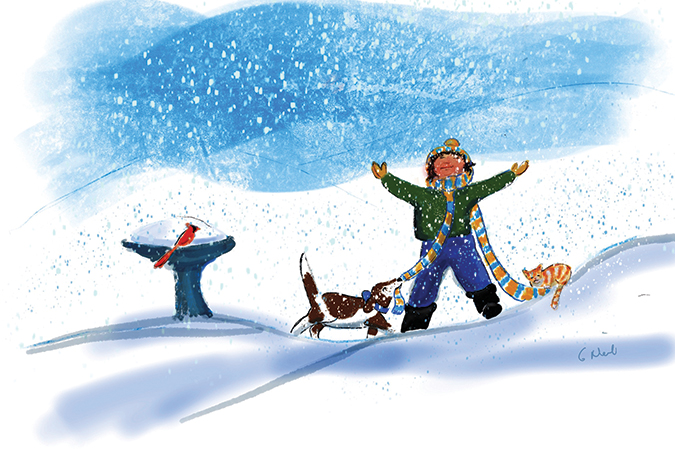
Courtesy: Ginny Neil
Lucy Van Pelt: I never eat December snow[flakes]. I always wait ‘til January. Linus Van Pelt: They sure look ripe to me. —Charles Schultz

If the snow lies in deep drifts across my pastures, then my chicken house and wood pile are much more difficult to reach. While I don’t enjoy shoveling my way out to them, I am still happy when it snows. In addition to adding much-needed moisture to dry soil, it adds nutrients. In fact, my frugal-farmer husband calls snow “poor man’s fertilizer.” The first time I heard him say it, I looked it up. Turns out he knew what he was talking about.
As snow falls, it picks up nitrogen and trace nutrients from the air and carries them to the ground. Nitrogen normally hangs around as a gas, which plants can’t use. But, exposure to microbes in the soil helps fix it into a form that feeds plants. While rain carries the same amount of nitrogen, it often runs off. Melting snow seeps in slowly carrying all the good stuff with it.
Scientific articles point out that hand-applied fertilizers (organic or not) are way more effective at nourishing plants. After all, 10 inches of snow might yield only an inch of water, and it’s the water that carries the nitrogen into the soil. But snow doesn’t segregate itself to farms, flower beds and lawns. It’s an equal opportunity fertilizer, feeding forests and fields alike.
Ironically, snow in our industrial age is a better fertilizer than what fell centuries ago. Turns out the nitrogen released by factories and cars is also picked up by precipitation and deposited into the ground. Although that’s not a good enough reason to keep spewing things into the atmosphere, it’s comforting to know that something good comes of it.
Snow is more than a source of plant food. A continuous cycle of freezing and thawing in a mercurial winter can wreak havoc on things that are only a few inches below ground. When snow covers my garden, it’s like the difference between the freezer above my refrigerator and the chest freezer on my mud porch. Things above the fridge freeze and thaw as the freezer defrosts. I don’t keep anything in there for more than a few weeks, because that freeze-thaw cycle damages it—making for freezer-burned meat and crystallized ice cream. Imagine your plant roots or beetle larvae experiencing the same conditions. But plants and critters under a layer of snow, like the foods in my chest freezer, are protected from such drastic changes. Snow keeps them at a more constant temperature, sparing them the “agony of de-freeze.”
Snow also keeps my soil from freezing too deeply. Bare soil doesn’t have that advantage, which can leave deep roots and rhizomes damaged or dead after an especially cold winter. So, snow provides more than food. It also provides protection.
]Although I don’t like shoveling, I do like making snow cream, sled riding, and following animal tracks across the ridges. I love the luminous light, the soft silhouettes, and the serene silence of a good snow. But, because I am a farmer, I am especially grateful for the unexpected gift of life that snow carries with it. Like many inconveniences, sometimes if you dig a little deeper, you can uncover a blessing. Or, in the case of snow, quit digging. My back is in total agreement with that.
The story above appears in our January/February 2020 issue.