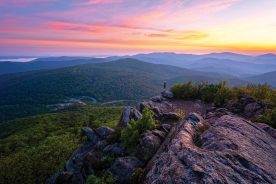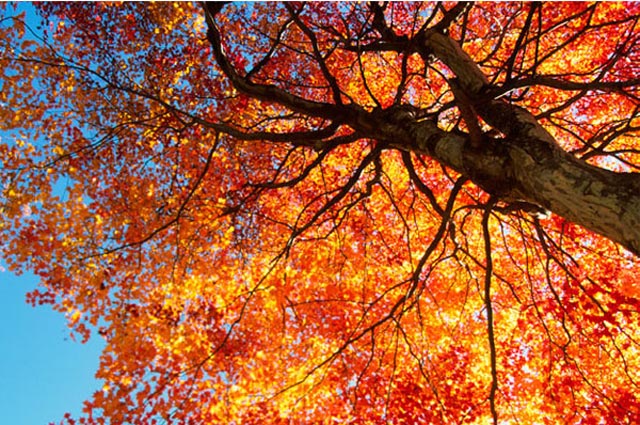
Color and foliage. Put them together and you have autumn. Combine them and you promote weekend excursions. Unite them and you inspire pronouncements of appreciation from the hilltops. See them and you appreciate a visual symphony.
With autumn, the foliage of our deciduous woods and forests prepares to bid adieu. Dying leaves, assuring their demise won’t be ignored, bombard our eyes with a whole spectrum of color. Soon to be gone, they emit an orchestral rainbow to make us feel a tinge of remorse at their impending departure.

Theirs is the hue; ours is the cry.
Reds of oak, red maple, black gum, sourwood, sumac and dogwood are complemented by yellows of beech, hickory, birch, ash, tulip poplar, catalpa, elder, locust, elm, silver maple. Orange, brown, pink, scarlet and purple are omnipresent.
But what causes these colors, these notes that give each tree’s foliage its own particular “sound?”
First, a little about leaf structure and the substances flowing through the leaf. Each leaf has its own stem, a petiole, that connects it to a twig. It is the final passageway through which soluble nutrients, absorbed by roots and conducted through the tree’s trunk, and out through the branch and twig, can finally flow into the leaf.
Throughout the leaf itself, floating in its cell sap, are tiny capsules, or disk-like bodies, called chloroplasts. They contain chlorophyll, the very substance necessary for food- (starch-) making in the process of photosynthesis. It is during this process that a leaf also needs the energy of the sun’s rays, and carbon dioxide, which the leaf absorbs from the air through microscopic holes called stomates.
Two pigments that aid chlorophyll in food-making also dwell in the chloroplasts. They are xanthophyll, which is yellow, and carotene, which is orange. Because they are present in such small quantities, these pigments are easily masked by chlorophyll’s green.
But with summer’s passing, the days grow shorter. Less sunlight means less food-making. The nights turn cooler. The dip in temperature arrests chlorophyll production. To shorter days and lower temperatures is added a third phenomenon: the shutting off of nutrients to the leaf. With the retardation of the leaf’s life processes, a corky layer forms across the base of the petiole.
The using up of chlorophyll allows xanthophyll and carotene to show their colors. Yellow, orange and red are manifested in the leaf. These pigments are common.
There are other pigments too. They are the anthocyanins, water soluble pigments not found in chloroplasts but accumulated in the leaf’s upper cell layer, eventually masking or partially masking xanthophyll and carotene. Anthocyanin formation is encouraged by sugar concentration in the leaf – especially at the time when the separation layer in the petiole not only isolates sugar broken down from starch, but also shuts off the flow of nutrients to the leaf.
The anthocyanins, absent from leaves in summer, give them their brilliant cast in autumn. Dissolved in cell sap, these pigments are responsible for vivid scarlet, crimson and purple colors in fall. These shades evolve when anthocyanins are not successful in completely hiding carotene or the lingering green of chlorophyll in the lower cell layers. This explains why reds of sumac and black gum have such a deep glow. Also, production of anthocyanin is, in part, determined by heredity, perhaps explaining why some maples are red, some yellow.
Knowing what leaf substances are involved, one might ask what external forces best influence the most vivid colors. Just what kind of late-summer/early-fall weather makes for the most spectacular fall?
Contrary to common belief, frost in itself does not presage pretty foliage. A sudden frost will kill leaves, making them turn brown and fall off sooner. Ideally, the leaf should die slowly.
First, let there be a dry summer. This starts the formation of the corky layer across the petiole that will soon trap the sugar in the leaf. But to keep leaves from falling off too soon rain should come in the early fall. The alternation of heavy rain and lavish sunshine stimulates production of anthocyanins. Low temperatures should arrive gradually to arrest chlorophyll production. Diminishing chlorophyll unmasks the yellow and orange pigments. Abundance of sugar, sunshine and rain buffs up brilliance in the anthocyanins.
By mid-November the “instruments” are either on the forest floor as humus, or scooped up in heaps to be burned – perhaps as an offering to the Old Master Painter.