Skip to content


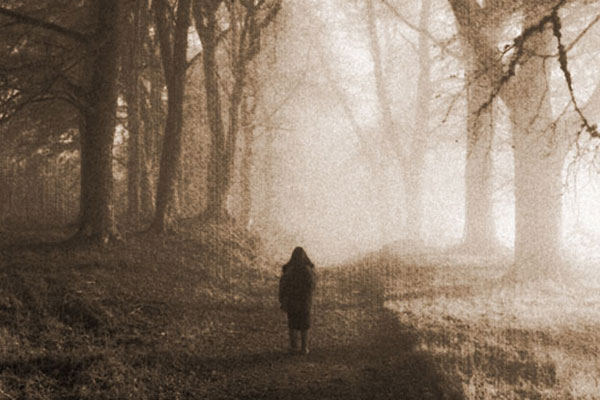
Hiking trails always seem to lead up, and the long section of the Appalachian Trail rising from VA 130 near Snowden to the top of Bluff Mountain is no exception. The ascent takes your breath away; so does the view from the mountain summit.
Bluff Mountain is a special place for still another reason. In a dappled clearing among the trees at the mountain’s crest is a memorial to the youngest person ever to climb Bluff Mountain alone. He was four-year-old Ottie Cline Powell.

Psychologists say four is an age where fantasy and fact have no clear line between them. Imagination has no limits, and anything seems possible.
Ottie Cline Powell was the fifth of Edwin and Emma Belle Powell’s eight children. His parents married in 1874, establishing their home near Dancing Creek on farm land shared with Ed’s brother, James. When Ed wasn’t farming, he was a circuit-riding Dunkard preacher.
November 9, 1891, was a dreary Monday. The sky had clouded with the promise of rain, and the air was taking on the chill of winter. The first snow of the season–three inches–had fallen the previous week.
Miss Nannie Gilbert, the only teacher in the one-room school near the Powell farm, had been forced to use most of her small store of kindling for the pot-bellied classroom stove during the earlier spell of cold weather. It was time to send her class out into the nearby forest to gather fallen branches for the woodpile.
Ottie Cline Powell, one of Miss Gilbert’s smallest pupils, would be only five years old on his upcoming birthday in mid-November. The boy had blue eyes, a fair complexion, and light hair, and was described as intelligent.
Ottie marched outdoors with his classmates to gather wood for Miss Gilbert, but did not return to class when the recess ended. When no one at the schoolhouse could find him, Miss Gilbert sent her students home to get help from parents and neighbors. Soon, entire families were walking through the forest. Their calls–“Ottie! Ottie Cline Powell!”–were answered only by rustling leaves and cries of troubled birds. By evening, rain had begun to fall and an ice storm was forming in the mountains.
Newspapers in Central Virginia carried the story of the little boy lost in the mountains. Over the next few days and weeks, hundreds of volunteers came and went, combing the area surrounding the schoolhouse in wider and wider circles. No one thought of scaling the rocky old animal and Indian trails leading up Bluff Mountain. No one could have imagined a small child with the tenacity to reach the mountain top.
Winter came, and snow upon snow covered the mountains. Reverend Powell had posted a reward for his son, alive, in The Lynchburg Virginian, but no one came forward to claim it. There was almost no hope for the child’s return. Then, quite by accident, the little boy’s body was found.
On April 3, 1892, hunters who were crossing the mountains on an old trail followed their barking dog up a side path to the top of Bluff Mountain. They found the dog standing proudly beside his retrieval prey, the tattered remains of Ottie Cline Powell.
Medical evidence indicated the little boy had died from exposure to below-freezing temperatures the first night he slept on the mountain. He had simply fallen asleep before the rain began, never to be awakened. That thought was comforting, but only for awhile. Finding a lost child is one thing; accepting the final loss of a child is another. As the weeks passed, his mother became increasingly despondent. Her husband had the small casket moved from the cemetery to a place in a pasture where Emma could see the grave from a window in their home.
Emma’s grief threatened her health as the months wore on. Ed Powell felt a move to another area might help his wife recover. He relocated his family to a farm-road intersection not far from Buena Vista, where he operated a general store. Emma Belle Powell died in their house near the store in 1897, still mourning the loss of her little son.
Around 1917, the U.S. Forest Service built a fire lookout tower on Bluff Mountain. The tower stood only a few yards from the spot where Ottie Cline Powell had died. He had been found beside a tree, and the tree and a large field-stone served as memorials. The tower could be seen for miles, and the story of the lost child on “Tower Hill” was becoming a legend.
In 1925, J.B. Huffman, a teacher in Buena Vista, wrote a book about the boy, using recollections of Powell family members and old-time residents in the community. Mr. Huffman, a kindly man, then did even more to perpetuate the memory of the lost child’s courage. He made a wooden form in the shape of a cross, filled the form with wet cement, and allowed the cement to harden. When his cross was ready, he transported it to the top of Bluff Mountain, where it served as a memorial to the little boy for 43 years.
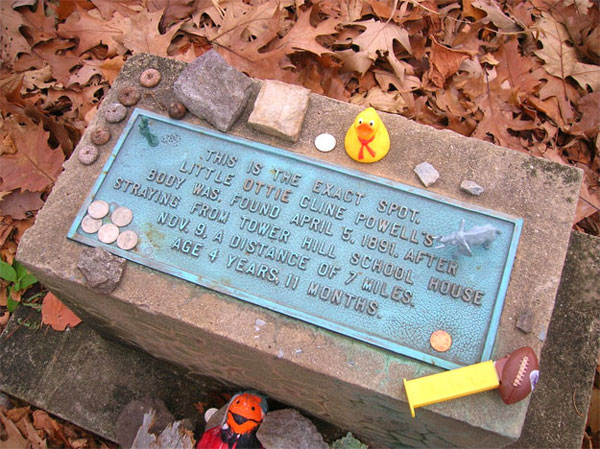
But soon times were changing. The Blue Ridge Parkway and the Appalachian Trail were bringing new visitors to the mountains. People who saw the cross on Bluff Mountain for the first time wanted to know more about it. Huffman decided to prelace the cross with a memorial more descriptive of the event it commemorated. He had copies of his book made up to sell, with all proceeds to be donated for a new memorial to Ottie Cline Powell. Sales were brisk, and a concrete block crowned by a bronze plaque was set in place in 1968.
The dates and other details on the plaque disagree with records contemporary to the lifetime of Ottie Cline Powell, but mistakes do occur, even when data is set in bronze.
The plaque reads:
This is the exact spot
Little Ottie Cline Powell’s
body was found April 5, 1891
after straying away from
Tower Hill School House
November 9th. A distance of 7 miles
Age 4 years, 11 months
Tower Hill has once again become Bluff Mountain. The old fire lookout tower is gone; aircraft now patrol the forests during seasons of high fire danger. Many hikers use the trails on Bluff Mountain, and through the years a number of these hardy nature-lovers have said they felt an eerie, unseen presence near the mountain top. Their comments fill the log books at the shelter there.
On the 100-year anniversary of the death of Ottie Cline Powell, Tom Jamerson, a member of the Natural Bridge Appalachian Trail Club, led a hike from the old Powell farm to the top of Bluff Mountain. The hikers were delayed by a couple of timber fires long enough to sap some of their enthusiasm, so the hike was shortened. Only Jamerson stayed the night on Bluff Mountain. He camped beside the Ottie Cline Powell Memorial.
During the night, an ice storm hit the forest. As tree branches weighted by ice snapped around him, Jamerson sensed a shared experience from another time.
“I had real insight into how little Ottie died,” he says. “It was a strange feeling.”
Ottie Cline Powell’s grave is still in a pasture, marked only by field-stones. Hikers in the Natural Bridge Appalachian Trail Club want to place an inscribed memorial there. They have adopted the little boy as one of their own, and they want to give him this final honor.