Skip to content


Veteran forester John Scrivani dedicated his career to restoring American chestnut trees — and helped lay the groundwork for the effort’s next generation.
Photo Above: John Scrivani bags female flowers from atop a 40-plus-foot-tall chestnut.
Photos Courtesy of John Scrivani.
The forest road trail crests after a long uphill trek through a corridor of dense, submontane hardwoods in Lesesne State Forest, and the peaks of Virginia’s famed Three Ridges Wilderness burst into view as glorious as a pod of breaching humpback whales. My wife and I turn onto a dirt path etched into the high grass, climb toward a hillside clear-cutting and spot the American Chestnut Foundation (TACF) board member John Scrivani standing near a bucket truck parked along the woodline.

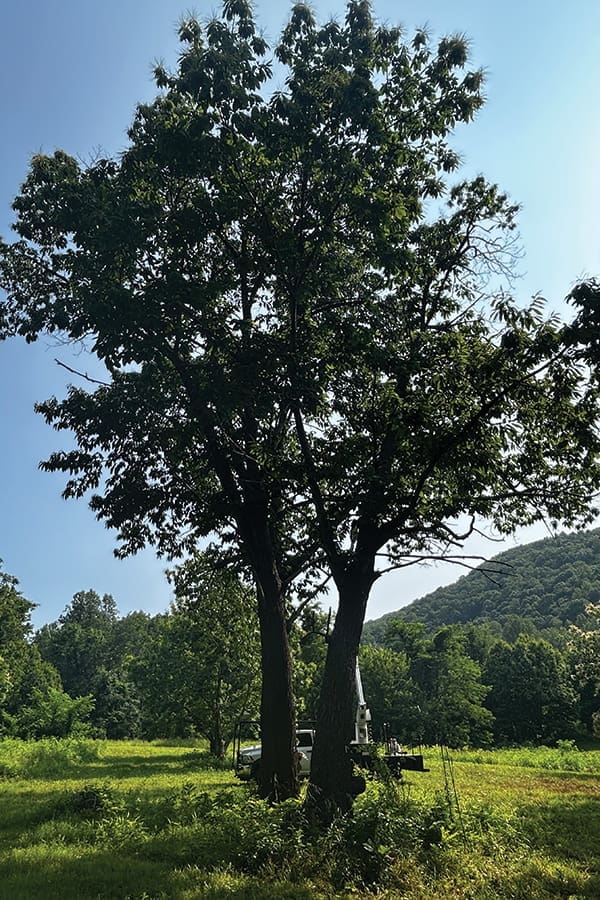
He wears hiking boots, faded jeans and a weathered flannel shirt under a trimmed salt-and-pepper goatee, metal-wire spectacles and a TACF-logoed cotton hat. We watch him scoop a leather-gloved hand into a bucket and retrieve a spiky, baseball-sized, yellow-green bur — which was just harvested from the canopy of a 70-foot-tall, blight-resistant tree that’s nearly genetically identical to a wild American chestnut.
“This is the oldest and largest second-growth stand of experimental American chestnut trees in the country,” says Scrivani. The iconic hardwoods once covered 200 million acres from Georgia to Maine, but a devastating, turn-of-the-century blight from Asia rendered the species functionally extinct by the 1940s. The 72-year-old has spent more than four decades working with the Virginia Department of Forestry (VDF), TACF and other conservation organizations to bring them back.
Today’s harvest is part of that larger mission. The group is gathering both burs and leaf samples from individual numbered trees throughout the 30-acre grove. They’ll mail leaf portions to a national lab for DNA testing and genomic analysis to identify trees with superior blight resistance. Their nuts will then be planted in research orchards so foresters can crossbreed them with other top-tier specimens and increase overall resistance. Technological advances like this one have ushered in a new wave in the restoration effort.
“Scientists have been working on this problem for more than a century,” notes Scrivani. “And I think we’re entering a new chapter that’s starting to yield some very exciting results.”
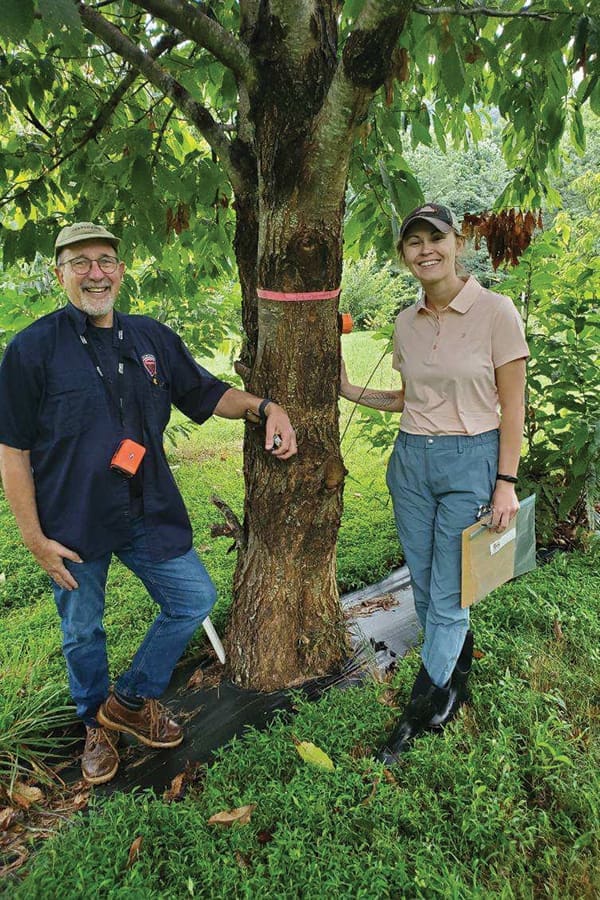
While the sum product of most of our careers is intangible — the stories I pen for magazines, for instance, vanish as websites update and decades march on — visitors can literally experience Scrivani’s at landscapes like Lesesne. He planted many of the trees there and studied the above-mentioned grove as it rewilded over time.
“I like to look out on the orchards from the upper hillside and think of myself as the momentary steward of a multigenerational effort that will continue long after I’m gone,” says Scrivani. The fact that the trees he’s dedicated his career to saving could live for hundreds of years and fuel the work of countless scientists to come “feels both humbling and deeply meaningful — I couldn’t think of a more rewarding way to have spent my time on this planet.”
Scrivani grew up in Florida and caught the conservation bug early on during camping trips to the Everglades with his parents. Outings while visiting family in Virginia and West Virginia introduced him to the mountains and helped inspire a career in environmental policy. But the endless red tape and political jockeying proved demoralizing. “I wanted to be outside working in the field, so I switched to forestry.”
He earned a doctorate from Oregon State then landed a professorship at Virginia Tech. The classroom, however, felt more half-glass than full, and when offered a Virginia Department of Forestry position in Charlottesville in 1989, Scrivani didn’t hesitate. His boss, Tom Dierauf, had planted the first hybrid American chestnut trees in Lesesne in 1968 and was an avid proponent of restoration. “I blame Tom for introducing me to this crazy obsession and lifestyle in the first place,” jokes Scrivani.
Dierauf became a close friend and mentor, and the two funded the office’s formidable chestnut efforts by leveraging a successful breeding program that produced about 50 million superior loblolly pines per year that they sold for reforestation. The same equipment and similar processes could be used for chestnuts. “That was never the official focus,” admits Scrivani, “but it was certainly our passion.”

He became involved with TACF’s Virginia Chapter just after it formed in 2006 and helped set up around 16 research orchards around the state based, at least in part, on Lesesne. Scrivani became a board member in 2008 and was later elected chapter president. Though he retired from VDF in 2017, he “thought sitting around at home would be boring, so I pitched a volunteer part-time position and basically just kept on working.”

TACF tapped Scrivani for its national board in 2021 to help develop infrastructure and a related sales program for distributing direct-to-market, blight-resistant American chestnuts at scale. While the breakthrough tree doesn’t yet exist — all remain more or less susceptible to blight and their long-term survival is effectively a crapshoot — the organization is at least moving toward a pivotable position.
“I love this work and don’t think I’ll be able to give it up as long as I’m still capable of climbing out of bed,” says Scrivani. These days, “I still deeply enjoy being outside with a purpose, but I’m even more grateful for the opportunity to work with talented young scientists that are committed to taking this effort to the next level.”

The story above first appeared in our March / April 2026 issue.