Skip to content


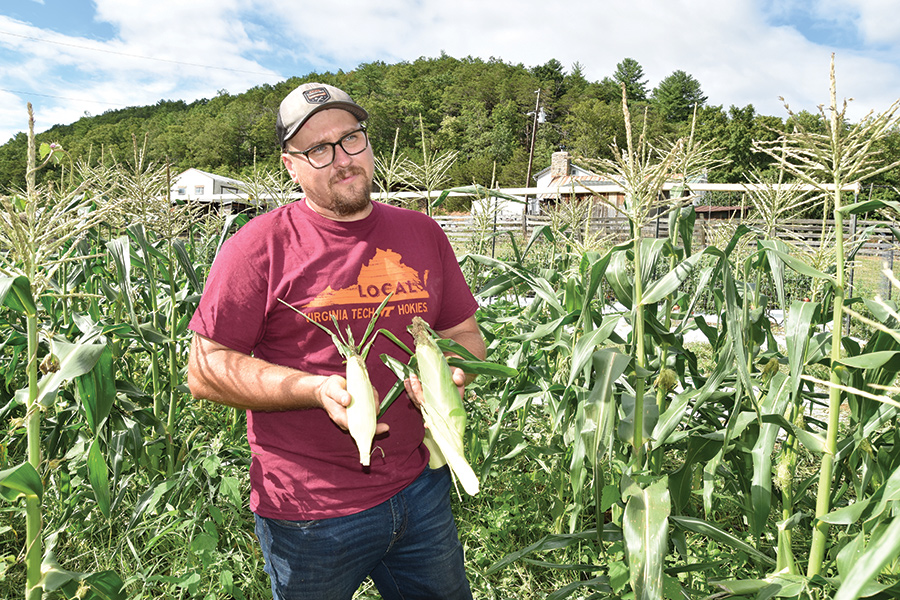
Trevor Saville has transformed the land his family has owned since the 1700s toward good stewardship both upon it and beyond.
“C’mon over, it’s sweet corn season so I’ll be busy with the harvest,” says Trevor Saville, a 33-year-old conservationist, habitat manager, adjunct college professor, certified forester, farmer and beef cattleman from Eagle Rock, Virginia. I had asked him if I could observe how he sustainably manages his 635-acre farm.

Our first stop, of course, is his cornfield. Saville picks an ear that he grew with his drip irrigation system, and then shows me one that is merely “field corn.” The former flaunts perfect, plump yellow rows while the latter’s kernels are ill-formed and undersized.
“Basically, my fertilizing system involves putting manure from my chickens and turkey manure from farms up the valley into these raised beds come March,” he begins. “At the same time, I also run a tape with little slits in it under all the plants. Then every Monday, Wednesday, and Friday, I run water through the tape so that the plants consistently receive moisture. And every now and then, I send some Miracle Gro through the tape, too.”
The system’s advantages, explains Saville, are that both water and fertilizer are conserved, and none of the latter becomes runoff that ends up in Craig Creek, which runs through the property. One of our region’s major environmental problems, he continues, is algae blooms resulting from farmers fertilizing their crops, then rain events sending residue into nearby streams. Another serious issue involves cattle denuding stream banks, which leads Trevor to take me down to the stream.
“Back around 2008, I decided it was time to get our cattle out of the creek,” he says. “I felt guilty that feces and urine from my stock were going downstream toward someone else’s farm, then on into the James River, and ultimately into the Chesapeake Bay. I had read about how the bay was struggling with pollution from upstream, and I didn’t want to be part of the problem anymore. My stream bank was also caved in and barren causing silt to enter the stream every time it rained.”
So Saville contracted with the National Resources Conservation Service (NRCS) to receive cost-share money to restore the creek’s riparian zone. After constructing a fence along the stream, on one section of the creek the farmer planted some 6,000 trees (oaks, black walnuts and alders) to create wildlife habitat and protect the waterway. On another section, Saville established native warm season grasses (big and little bluestem) so that songbirds and mammals would have places to breed and feed.
Today, the NRCS sometimes pays as much 90 percent of the cost to help farmers conduct habitat projects such as this, so the conservationist says that no valid excuse exists not to take advantage of these funds. Saville is driven to spread the word among his fellow landowners about the need to practice sustainability, which is one of the reasons he began another of his businesses, T. Saville Forestry (540-520-9100).
I ask Saville why he placed the farm under a conservation easement to permanently protect it from development.
“My family has been on this land since the 1700s,” he says. “I didn’t want there to ever come a time when people would drive down this country road and see rows of houses here. The conservation easement was just my way of having a positive impact on wildlife and what this place would look like a 100 years from now.”
Saville also sustainably manages his forestland.
“Many people have this misguided notion that every forest should be old growth,” he says. “The reality is that in a given ecosystem, the forest should be a mosaic of different-age stands to benefit the maximum number of wildlife species. Yes, there should be old growth made up of, for example, oaks.
“But there should also be young forests under 10 years of age and other sections of various ages, too. In our region, there are over three dozen species of songbirds in decline because of the lack of young forest. We just have to help those birds, so they won’t disappear from these mountains.”
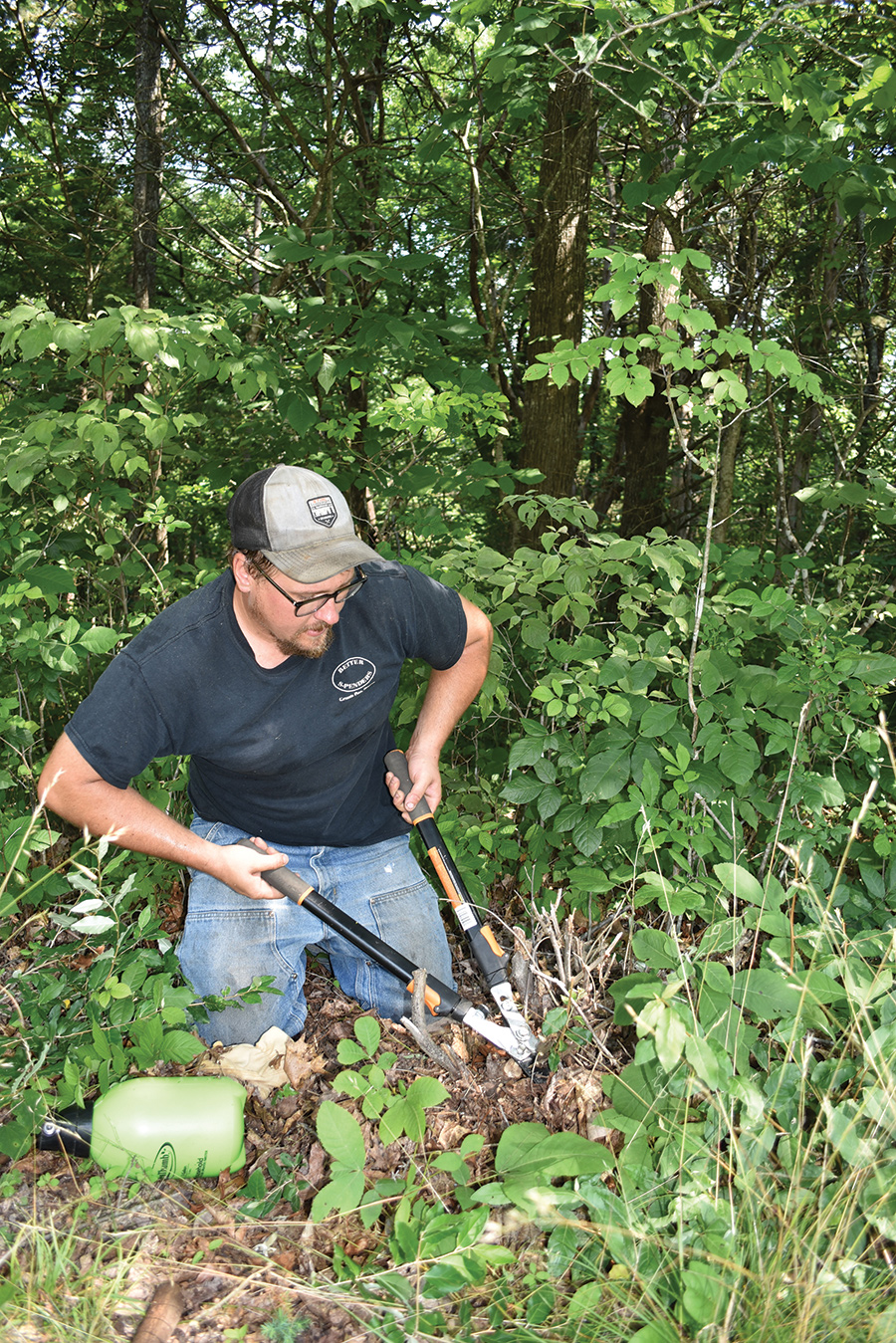
As we leave the banks of Craig Creek, the conservationist stops to show me where he sprayed some Johnson grass, an Asian invasive plant. On an earlier excursion with him, he had explained how he eliminates many of the worst invasive flora in the Blue Ridge such as autumn olive, multiflora rose, and Japanese barberry. Every day in every way he can, Trevor Saville strives to improve his land and to help others do the same.
The story above first appeared in our November / December issue.