Skip to content


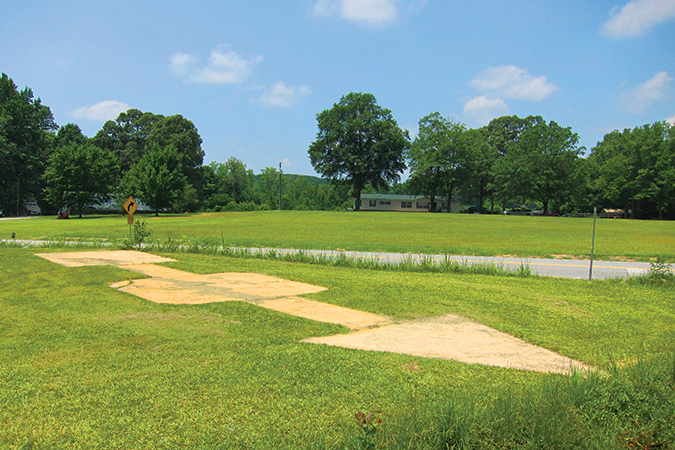
This postal arrow, one of the few still preserved in the Southern Appalachians, is in Spartanburg County, South Carolina, and directed airplanes on the Atlanta-New York Airway. Courtesy: Brian Lee © Dreamsmithphotos.com
The determination of what they are involves a combination of modern-day satellite technology and the delivery of snail mail.

They’re oftentimes visible only from the sky. They point in seemingly random directions. They’re about 70 feet long and made of deeply sun-bleached concrete.
What are they?
The answer combines the digital-tech satellites from which they’re visible and a trip back in time. To 1920, when two human activities—one ancient and the other in its infancy—joined together: Written correspondence met up with airplane flight.
Mail delivery of the letter-envelope-stamp variety had until then taken weeks or even months. Now it could happen in a matter of days via a satchel on a newfangled airplane.
The problem? Early pilots had to look out the cockpits and navigate by finding and identifying geological landmarks below. This limited the new partnership for air mail delivery to daytime, fair weather conditions.
The solution? The Transcontinental Air Mail Route. This early U.S. 1920s infrastructure project, the first of its kind in the world, built some 1,500 airway beacon stations. These ground-based navigation structures were constructed every three to 10 miles, pointing pilots between major cities and fledgling airports. The stations consisted of a 70-foot-long concrete arrow painted chrome yellow; a 51-foot-tall tower with flashing lights; a generator shed on the “feather” end of the arrow for power; and large route-designation letters and numbers visible from above.
This system successfully advanced mail delivery until the 1940s, when the advent of instrument panel controls on airplanes shut the system down.
Today, most of the beacon stations have been lost to development and the ravages of time. However, interest in these ingenious creations is gaining momentum. Folks travel the ground and scour satellite images on a citizen-science quest for the archaeological remains.
While more arrows have been spared in the western states, the eastern part of the country is left with a small percentage of the hundreds once in service. Stations in the Blue Ridge were originally dotted along the eastern and western edges of the mountains and across West Virginia. To date, only six sites at varying degrees of preservation have been found in our area:
• Spartanburg County, South Carolina: Atlanta-New York Airway Beacon #14
• Hart County, Georgia: Atlanta-New York Airway Beacon #9
• Anderson County, Tennessee: generator shed at Oak Ridge National Laboratory
• Hawkins County, Tennessee: Airway Beacon #23
• Bristol, Virginia: Tri-Cities 14 Airway Beacon
• Randolph County, West Virginia: Airway Beacon #25
The existence of hundreds of these sites is still classified as “undetermined”—just waiting for the next explorer!
For information on the latest findings complete with detailed maps, GPS coordinates of original routes and how to contribute discoveries of your own, visitthesurveystation.com.
The story above first appeared in our January/ February 2022 issue.