Skip to content

Why would the U.S. Chief Justice, at age 57, take on the treacherous New River in a batteau? And why would somebody do it again in the same kind of vessel, 150 years later?
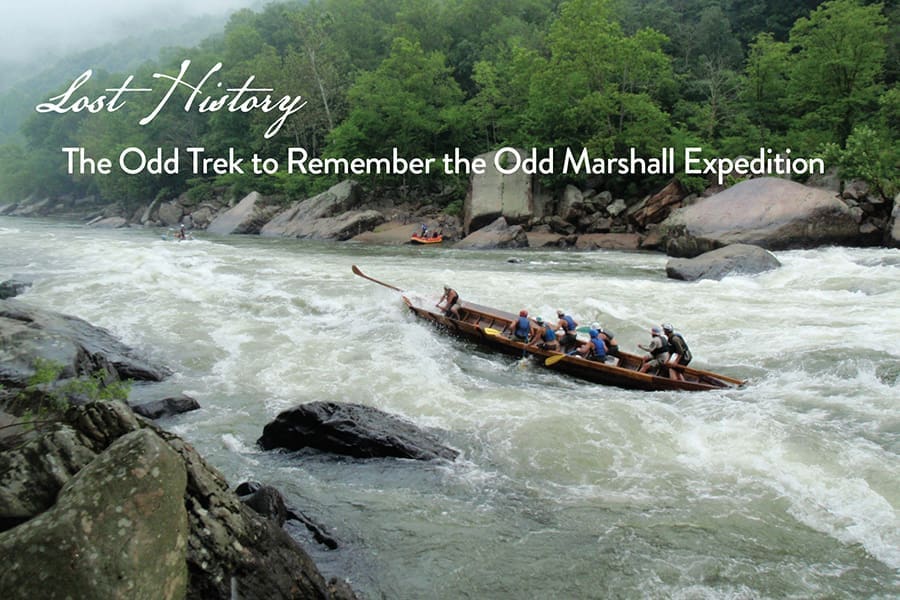
Photo Above: Andrew Shaw and company run the New River Gorge’s class IV rapids to re-create the 1812 trek.
Imagine 57 year-old John Marshall—who, in 1812, just so happened to be the Chief Justice of the U.S. Supreme Court—poised at the stern of a 60-foot-long wooden batteau. Picture his arms braced about the rudder’s wooden handle, shouting commands to his crew as they crash through the New River Gorge’s wildly churning 10-foot waves, seeking to guide his vessel through the treacherous, class IV rapids. That’s preposterous, you say. Could never have happened.

And yet, astonishingly enough, it did.
And why would the Chief Justice be out risking his noteworthy neck adventuring in what was then a largely uninhabited wilderness area?
“Into the early 19th century, the mid-western territories were highly contested,” says Bill Trout, founder of the Virginia Canal Society. “To control those territories, the U.S. needed to establish strong economic ties with its settlers.”
In other words, the fledgling nation had to find a way to make transporting goods to and from the eastern seaboard easier. Which, prior to the advent of the railroad, meant connecting the Ohio River Valley (via the Kanawha River) with the James River by means of a network of canals.
Hence the purpose of Marshall’s expedition: to determine the feasibility of such an endeavor.
Now, fast-forward to the year 2012.
Despite the fact that the railroad ultimately doomed the James River and Kanawha Canal, and bolstered by a National Geographic Young Explorer’s grant, Virginia native Andrew Shaw decides to retrace Marshall’s route in commemoration of the expedition’s bi-centennial. With the help of five close friends, he reconstructs a batteau, compiles atlases of the various waterways, and sets out from Powhatan, Virginia, poling up the James River.
As a three-time veteran of the Virginia Canal Society’s yearly, week-long Batteau Festival (celebrating early-19th-century trade routes), Shaw had served as crewman on a number of trips downriver from Lynchburg to Richmond. It was on one such venture that he heard Bill Trout tell of the Marshall expedition. An avid whitewater kayaker and outdoorsman, Shaw was dumbfounded.
“The fact that John Marshall, at 57 years old, got on a batteau, poled upstream to the source of the James River, crossed the Alleghenies via a team of oxen, and then went down the Greenbrier and the New River Gorge sight unseen—that’s unbelievable,” says Shaw. “So I started considering retracing the route as a tribute to the vision of the bold men dedicated to forging a lasting and successful political entity from a group of rebellious colonies.”
When it was all said and done, upon reaching the mouth of the Kanawha River in Fayette County, West Virginia, Shaw and company had followed in Marshall’s wake, cart-tracks and boot-prints, traveling a touch over 360 miles.
More on the Canals of Virginia
There is a wealth of additional information on the waterways of Virginia from the Virginia Canals & Waterways Society. As their website asserts: “History, exploration, archaeology, modeling, local lore and legend, restoration, preservation, park and trail development—these are some of the many areas of interest our members pursue to their own great satisfaction and frequently to the lasting benefit of their communities and state.” vacanals.org
About This Story: a BRC History Classic
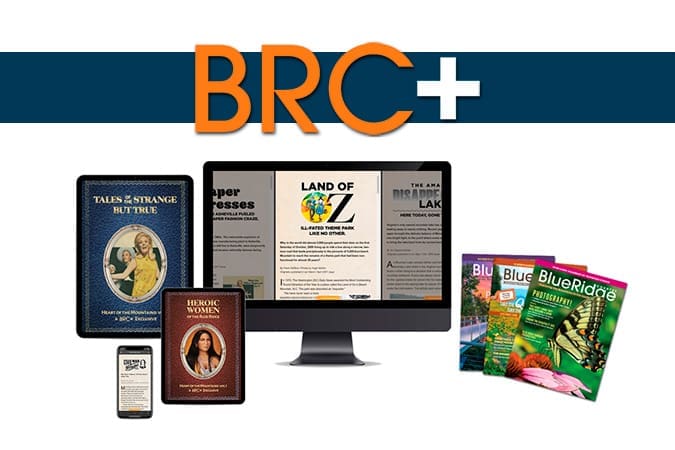
This piece, which originally ran in our January/February 2016 issue, is presented here as part of the magazine’s ongoing dedication to the amazing history of the Southern Appalachians. In that context, subscribers can now access the first three installments of Blue Ridge Country Plus, which are sets of archival history pieces. Those first three sets are Heroic Women of the Mountains, Tales of the Strange but True and Famous Crime Stories and Their Mysteries.
We present this piece as a sort of tease toward a coming set—Sports in the Mountains. Yes, the Marshall Expedition was based on exploration more than pure sport, and the re-creation also had elements beyond the adventure, but in both cases, the particpants needed ample measures of athleticism, planning and execution.
Please keep your eye out for the coming BRC+ sets, and subscribers can explore them all at BlueRidgeCountry.com/PLUS
The story above appears in our September/October 2020 issue.