Skip to content


Simple tools and simple times make for poignant memories on a drive along the Blue Ridge Parkway.
Photo Above: Condia Lynch was a prim soldier in World War I; thus by the time of his Civilian Conservation Corps service in the 1930s, he was older than most of the workers in the program.
On a Sunday afternoon in 1970, my father, mother, friend Susie and I loaded up in our Chrysler and headed to Highway 226. After a drive up the mountain road, we came to the Blue Ridge Parkway.

On the parkway, we rode slowly, taking in hillsides covered in wildflowers and bordered by split-rail fences. When we came to an overlook, my father pulled off and parked so we could get out and see the deep valley and mountain ranges that stretched for miles. The air was cool, and we sat and ate our picnic dinner, feeling we had traveled back in time.
It was a memorable summer drive on the Blue Ridge Parkway and one of several we would take during my girlhood.
When we started back home and passed under a stone bridge, my father said, “My uncle helped build this parkway.” He said this often in those days.
As I grew older, I came to understand that his uncle Condia Lynch did indeed help build the Blue Ridge Parkway.
Like others in my father’s family, Condia was born in Newcomb, Tennessee, and eventually settled in Marion, North Carolina. In his 20s, he served as a U.S. Army infantryman during World War I, was wounded in action in France, and treated at a base hospital. Upon his military discharge in 1919, he returned home to Tennessee and to his job as a coal miner.
But in the 1930s, after settling in North Carolina, he was employed by the Civilian Conservation Corps—the work relief program created by President Franklin Delano Roosevelt. Sympathetic to World War I veterans, FDR put many of these men, along with others unemployed, to work in the CCC. In Western North Carolina, one of their projects was to help build the Blue Ridge Parkway, which involved landscaping, road and bridge building, and stone masonry.
My mother remembers seeing CCC workers during her girlhood in Marion.
“You’d see them in town on Saturday,” she recalls. “You knew they were in the CCC camp because of their uniforms. They dressed like servicemen, and you kind of looked up to them. When we drove up the mountain, you could see them working along the highway. Some of them boys was good-looking.”
In photographs made during his World War I days, my great-uncle Condia was attractive. Tall and slender in his doughboy uniform, he posed with his rifle and bayonet and made a striking soldier.
But when he worked in the CCC, he was in his 40s and divorced, there being no age or marital status restrictions for veterans. Unlike the single boys my mother remembers—typical CCC enrollees who were between 18 and 25 years old—Condia was a mature man, tempered by war and life, when he worked on the Blue Ridge Parkway.
Of course my father’s best memory of the CCC was his uncle Condia’s connection with it.
Years ago while I was visiting my parents, my father said he wanted to give me something.
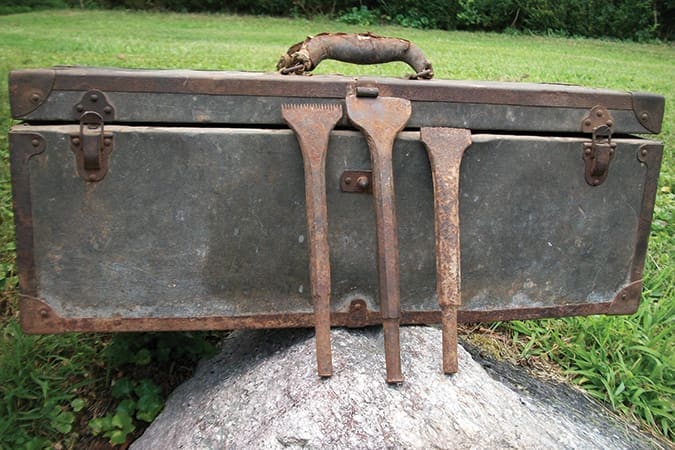
I followed him outside to his tool building. He unlocked the door, and we went inside. On a wooden shelf sat a tattered toolbox.
“This belonged to my uncle,” he said and opened the toolbox. He removed several chisels. “He used these stone cutter’s tools when he worked on the Blue Ridge Parkway.”
I remembered how often he had spoken about his uncle’s stone work.
“I want you to have these tools,” he said.
“Are you sure?” I asked, surprised he would give them up. He had been a hosiery mill machine fixer for years and treasured his own tools. As a child, I spent Saturday mornings with my parents while they worked in the mill. To pass the time, I played with my father’s tools. Perhaps he remembered this.
“Yeah,” he confirmed. So with my husband’s help, I lugged the toolbox home, honored by the gift.
Today I still have the old toolbox, though I transferred the tools to a newer metal toolbox my father gave me before he died. I felt the tools would be safer in this container.
Occasionally, I open my toolbox to inspect the stone cutter’s tools and imagine how Condia might have used them. And now when I drive with my family on the Blue Ridge Parkway, I find myself saying, “My great-uncle helped build this parkway.”
The story above appears in our November / December 2020 issue.