Skip to content


The story below is an excerpt from our November/December 2016 issue. For the rest of this story and more like it subscribe today, log in to read our digital edition or download our FREE iOS app. Thank you!
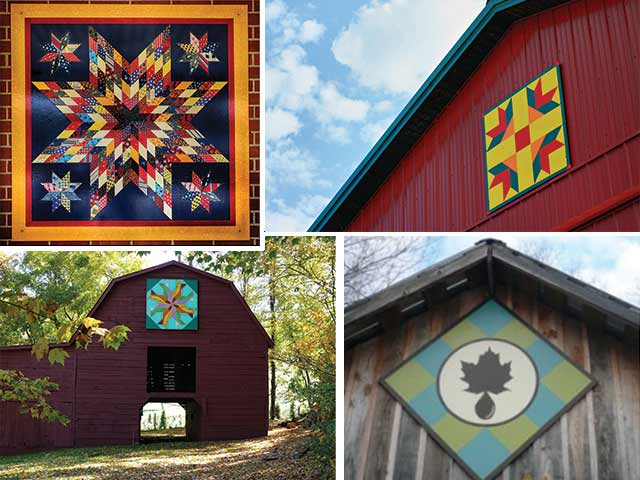
The genesis is a way to honor farm women—to take their indoor work and put it on display outside for all to see. The current-day result is a movement, and one that has put beauty on structures all over the mountain South.

It all started in Kentucky. Not in the mountains, mind you, but the Land Between the Lakes. About 10 years ago, that’s where author Suzi Parron first took notice of a square painted like a quilt on a barn. And, there, Parron wondered not only what this was—but, more importantly, what this meant.
Parron asked a local woman. “And her take on it was they were kind of trying to honor farm women,” says Parron, a former high school English teacher. “You see a barn and you think about a man, but there’s a woman who works on their farm very hard, too. It’s to honor these women and their work and their art.”
Perhaps that’s true.
“Quilting has always been women’s art. Are there man quilters? Yes, there are,” says Parron, who grew up in Orlando, Florida. “But it’s something that women have always done. Any time you’re honoring quilters and quilting, you’re honoring women and women’s place in society.”
Just ask the “Quilt Square Girls” in the towering mountains of Ashe County, North Carolina, a Blue Ridge Parkway community wedged between Virginia and Tennessee.
This married couple—Renee and Syndi Brooks—are among the quilting characters that Parron has met over the past decade while writing a couple of books on the growing popularity of barn quilt squares, including the recently released “Following the Barn Quilt Trail” (Ohio University Press, 278 pp., 2016, $29.95).
“They have just created a community around these barn quilts,” Parron says.
But, oh, it’s even more than that.
“Barn quilts? First of all, they make you happy,” Syndi Brooks says. “When you see them, and you go around the curve, and there’s that old, worn barn with that big, neat barn quilt, it makes you happy.”
Syndi Brooks also shares some of Parron’s sentiment, saying these squares are “a celebration of women’s work—in how they save bits and pieces of fabric for years and years and years to make quilts with.”
To date, the “Quilt Square Girls” have painted 2,000 barn quilt squares of various sizes. “Not all are 8-by-8,” says Syndi Brooks. “The majority are probably small—3-by-3 or 4-by-4—and we ship them all over the United States.”
This pair of painters started with a home studio in 2010. Then they moved in to a larger shop called Quilt Square Girls: Barn Quilts and More at West Jefferson, North Carolina. Today, their fees start at $180 to paint a 4-by-4 reproduction of a quilt to hang on a barn. “And if you wanted it duplicated graphically and put on aluminum,” Brooks says, “you’re talking about $396 to put on a 4-by-4.”
Why the popularity of quilts and quilt squares?
“I think the mountains, because they are so cold, I think there’s a really rich tradition,” Syndi Brooks says. “And I think mountain people are just survivors. They save every piece of fabric and they’re like, ‘How can I use this again?’”
Following a trail of barns—with quilt squares—can tell even more of a story. “It’s a celebration of joining communities together—one quilt joining another quilt,” Syndi Brooks says.
Parron knows even more. The author travels full-time with her husband in an RV, going across the country, speaking on barn quilts and teaching art. In North Carolina’s mountains, Parron has also spent much time studying the barn quilts of Yancey County and Burnsville to work on her first book, 2012’s “Barn Quilts and the American Quilt Trail Movement.”
North Carolina’s barn quilt squares fit into the landscape naturally, Parron insists.
“Those mountains are just so beautiful. And you’ve got all the wonderful drives up through there. So I think the barn quilts just kind of added to what’s already there. Whereas, in some places, the barn quilts kind of create a destination.”
That’s what happened in Highland County, Virginia. “It’s an area that you might not normally visit,” says Parron, 56, a former longtime resident of Atlanta, Georgia. “One of the things about quilt trails is people try to draw people into their area. A quilt trail kind of gives people a reason to visit the rest of the year. And Highland County? We loved it there. Gosh, it’s beautiful.”
Much of Highland County’s beauty comes from three-dozen barn quilts linked on a tour. “They were created by all local people, local artisans,” says Dorothy Stephenson, the executive director of the Highland County Chamber of Commerce.
Now, with more squares being affixed to more barns, Stephenson says, “We’re actually toying with the notion of making a second barn-quilt trail. There are over 50 in the county.”
Artist Margie Boesch painted many of the quilt squares in Highland County. And that’s what visitors want to see—the squares, Stephenson says. “The barns are an added [aspect], though, because some of the barns are really beautiful. And some of the barn quilts are actually on houses or garages or out-buildings. So they’re not specific to barns.”
Interest grows just like the bluegrass.
… The story above is an excerpt from our November/December 2016 issue. For the rest of this story and more like it subscribe today, log in to read our digital edition or download our FREE iOS app. Thank you!