Skip to content



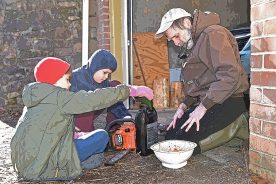
Granddad and grandsons ready the land for the arrival of spring.
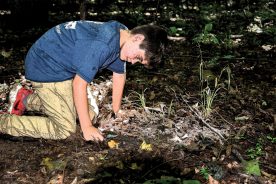
Photo Above: Eli and Sam gather watercress from the spring on their grandparents’ Botetourt County, Virginia, land.
Photo by Bruce Ingram | Photo styling by Janette Spencer
It’s mid-March in the Blue Ridge Mountains surrounding our Botetourt County, Virginia, 38 acres. That means that though winter is about to leave the premises, spring’s not quite sure it’s time to completely arrive either. It also means that our grandsons, 12- and 10-year-old Sam and Eli, respectively, and I have much to do on the land that their parents share with Elaine and me.

The first chore is to remove the Japanese holly that we paid a landscaper to plant when we had the house built in 1989. We had also arranged for the person to plant Japanese barberry along the foundation — a decision that confirms our ignorance at the time regarding invasive plants and the harm they do to these mountains’ native flora and fauna.
Some 25 years after that ill-fated planting, a neighbor (after he had toured our land and told us that we had a small — and rare — cluster of American barberry thriving on our place) pointed out our foolishness in paying someone to establish the two Japanese species.
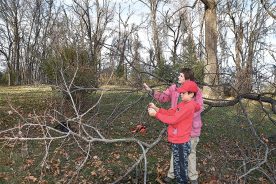
Elaine supervises Sam as he attacks the holly’s limbs with loppers and the roots with a shovel. Meanwhile, Eli and I labor in the garden and along the driveway. Eli plants row after row of white onions and Yukon Gold potatoes while I anchor six broccoli plants and three rows of spinach seed strips. We also admire our handiwork of two years ago … a dozen asparagus spears in a raised bed of their own. The shoots have already broken through the ground and will be ready for their initial harvest in a week or so.
Sam is still struggling with the barberry when Eli and I head for the driveway to cut down a red maple and two sycamores lining the lane. The threesome is shading oaks that I want daylighted so they will produce more acorns for wildlife. Besides, winter has decimated our woodpile. Six wood pallets sit mostly barren when just five months ago, they brimmed with nearly two cords of firewood. I’ll feel unsettled and unprepared for next winter until at least three of those pallets groan under the weight of cut and split hardwoods.
I fell the maple and first sycamore fairly easily, but just when the second appears ready to fall, the wood splits in such a way that the saw’s blade becomes hung, and I have to turn off the chainsaw. I explain to Eli that I want him to carefully wield an axe so that he cuts through the offending wood fibers without hitting the chainsaw or injuring himself.
This is the boy’s first use of an axe, and he treats the task with appropriate seriousness, successfully freeing the saw, which allows the sycamore to tumble. He is quite pleased with himself … and so am I. Next, we cut up the three trees into woodstove-size chunks and tote them to the woodpile.
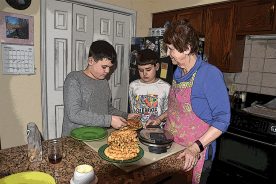
Elaine then announces that it’s a half hour to lunchtime, and how about some fresh vegetables? We know what she means. The grandsons retrieve scissors and a plastic bag from the kitchen, and the three of us head for the two springs that commingle with Catawba Creek, which flows through our land.
Arriving at the larger spring, Eli cuts watercress leaves and hands them to Sam to deposit in the bag. On the way back to the house, Sam is in charge of gathering wild onions for the salads that will accompany the mashed potatoes and watercress dish Elaine will create. With the starch and vegetable part of the menu established, we are delighted to learn that the protein source will come in the form of deer burgers originating from a doe I harvested the previous fall.
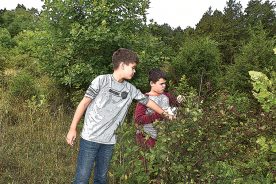
Dessert is even better: a wild blackberry pie, courtesy of berries we gathered from our land last July. The grandsons and I are exhausted, but I can tell they feel good about their labor. As do I.
The story above first appeared in our March / April 2026 issue.