Skip to content

Legend has it that after a weeklong battle, the Catawba and Cherokee tribes settled a territorial dispute and joined two trees to commemorate the peace.
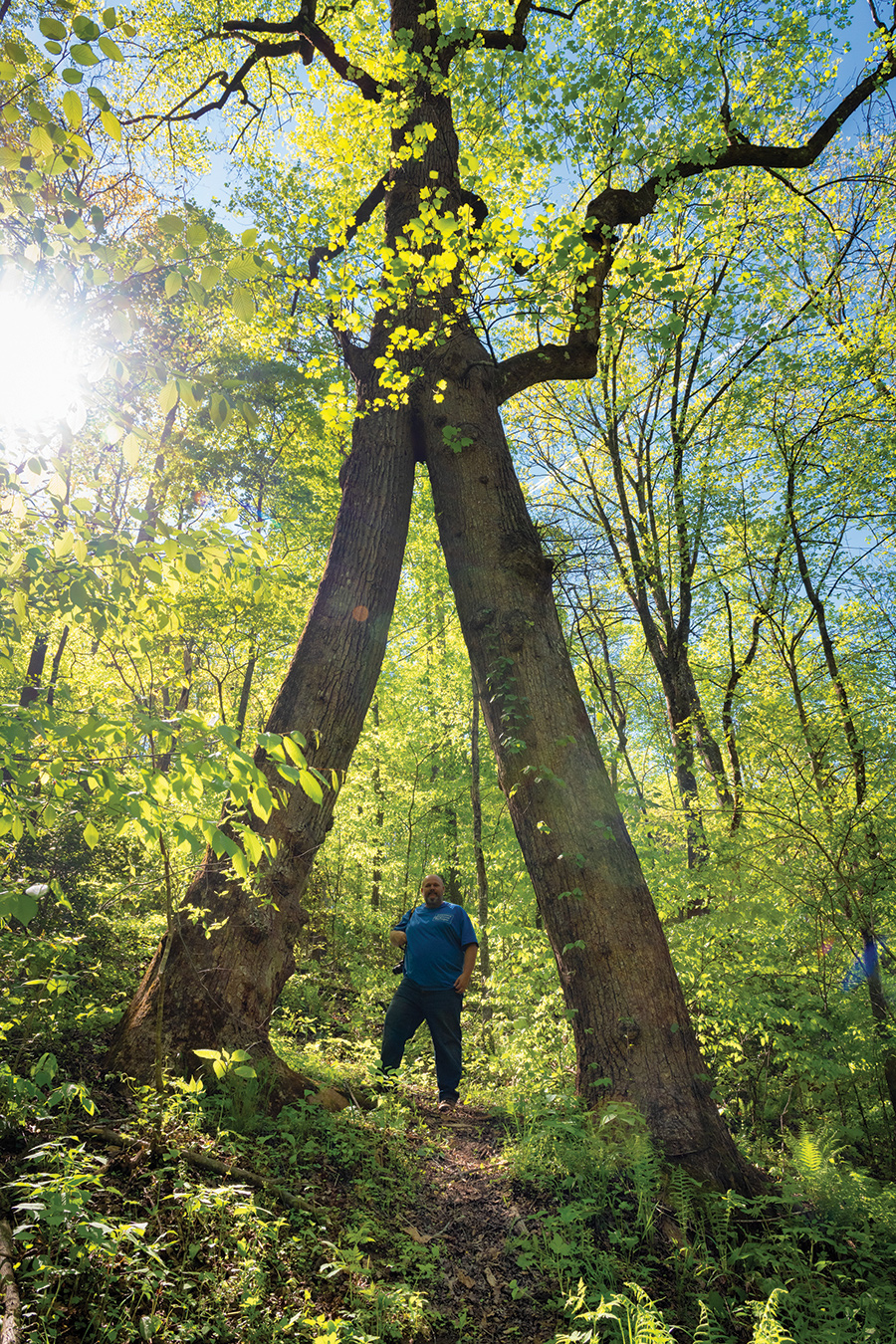
Photo Above: Tim Green stands beneath the Twin Poplars of Caldwell County, North Carolina, which legend has were joined together in 1737. © Mike Koenig.
Along the headwaters of North Carolina’s Catawba River in northern Caldwell County, you could blink and miss the small Warrior Gap community completely. Not to mention two Siamese poplar trees, locally referred to as the Twin Poplars.

The tree pair, just off U.S. 321, are separated by roughly 12 feet and rise 20 feet above the earth before joining together, uniting to form the unique wishbone-shaped archway.
As a child, I would hear about the great battle that had taken place between the Catawba and Cherokee tribes over area hunting rights, and every spring we would forage in area farmers’ freshly disked fields finding jars of arrowheads, presumably from the feuding tribes.
Twin Poplars is the literal symbol of a peace treaty entered upon by the Cherokee and Catawba by grafting two poplar trees together in the spring of 1737.
The Catawba lived in the southern part of the county. They were generally a friendly and peaceable tribe who hunted the forests and fished along the banks of the Catawba headwaters with the early “pale faced” traders and trappers who first visited in this wilderness.
The less-accepting Cherokees resented the intrusion on what they considered their hunting grounds, and the clash over the matter brought serious strife and conflict between them. Tradition has it that a number of battles ensued. A great many warriors met in combat about four miles north of Lenoir at Warriors Gap, so named from this historic confrontation, wherein brave warriors fought until death.
The battles were so furious that six times the Cherokees were said to have been driven back, each time rallying to advance again. The battle raged for almost a week until both sides were too spent and exhausted to continue.
And after that week of bloody battles, a conclusion was agreed upon by both sides too tired and diminished to continue.
The few remaining warriors stayed to bury some of the dead, and a pact was made declaring that hereafter there would be peace between the tribes. The Cherokee would now resort to hunting west of the Catawba and the Catawbas east.
A mound of erected stones, surviving today, marks the agreement. Alongside the mound two young poplar trees were grafted together, apparently by members of the tribes, and with the legend that if the trees survived, then so would the peace between the tribes. The trees, which survived the ravages of Hurricane Hugo in 1989, are now forest giants, having remained united for more than 285 years.
The Caldwell Heritage Museum holds some artifacts and writings by Caldwell County historians about the battle.
The story above first appeared in our January / February 2023 issue.