Bill Robertson is happiest on the trail, in the Great Smokies’ backcountry, when there’s no one else around. He has hiked every trail in Great Smoky Mountains National Park, exploring its interior over the course of nearly two decades since moving back to Greenville, S.C., where he grew up, after years in California and Lake Tahoe.
He bought a trail map, he says, and “I’d take my green highlighter” and highlight all the trails he hiked with the Natural History Hiking Club or with his significant other, hiking/photography partner Lynne Scoggins. As time passed, he noticed he was highlighting a lot of trails, and so he decided to see if he could cover all of them. About four years ago, he did.

“It took me about 2,200 miles to do them,” he says, “and there’s only about 900 miles” in the park, many of which he had to retrace time and time again to reach trails deeper in the park. “It’s really a maze of trails.”
While the last stretch of trail he completed was about a mile long, out to the old schoolhouse, accompanied by friends with a picnic and party favors, most are more strenuous.
“I think the longest day hike we did was about 25 miles,” he remembers, describing early mornings and late nights, getting back to the car past dark, home past midnight. “Once you get several miles back in on a trail, you don’t see a soul. You kind of imagine yourself as one of the old pioneers.”
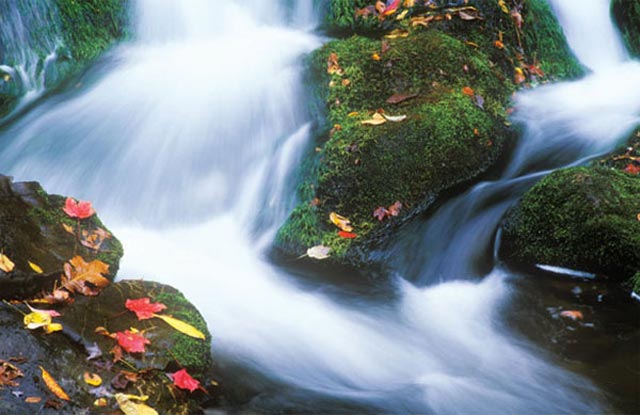
Robertson loves and photographs the waterfalls, the wildlife, “the flowers, the trees, the rocky trails, the streams… I’ve run into, I don’t know, 12, 15 bears over time.”
But “the beauty of the park,” he says is also in “the remnants of the past, the settlers, how they must have struggled.”
Two favorite hikes for photography are places where human history and the natural world coexist. First, Porters Creek at Greenbrier Day Use Area: “That’s loaded with flowers, and remnants of old logging steam engines [along Grapeyard Ridge Trail]…
“Tremont is also a beautiful photography hike,” he says. “All kinds of trails that lead you up to the Appalachian Trail; there’s a roaring creek, there’s waterfalls, there’s flowers, there’s old cars” and more logging remnants.Ramsey Cascade he loves to photograph too, “a very beautiful waterfall along a tumbling creek.”
But many of the hikes Robertson takes are too long and too difficult to take along camera, tripod and a bag of lenses, so those he enjoys without the click of the shutter (and it’s a real shutter, too – “I’m still 100 percent film”).
“I have two favorite [nonphotographic] hikes,” he says. “One of them was over by Fontana Lake, where we had to charter a boat.” The hike was along Eagle Creek Trail to the Spence Field Shelter, continuing a loop to Jenkins Ridge Trail and back by the Lakeshore Trail. The spring they trekked it, the water was high and he estimates they had more than 20 stream crossings. “It’s a steep, kick-your-butt trail, too.”
“Probably the toughest hike” was Forney Creek from Clingman’s Dome to Lake Fontana. He and Scoggins reached the end of it around 10:30 at night, “and we were tired puppies.”
Greenville was full circle for Bill Robertson when he came back in 1990. At the time, his father was still alive and living there. Robertson had left in the early ’60s – “bored with the South Carolina short hair and white socks,” as he puts it. He lived in downtown LA for two and a half years, and then “was actually kind of a ski bum for 20 years” at Lake Tahoe.
When he came back to the Upstate three decades later, he didn’t leave. He worked in sales and marketing. He started hiking, and started taking pictures in earnest, and follows both passions on a weekly basis.
“Out west, I carried around a little point-and-shoot camera, and I would document things,” he remembers, “but no, not serious photography at all.”
It was back in Greenville that a friend who owned an old Canon AE-1 taught him how to really take pictures. “I started really looking and seeing things in a different way. The colors became more vivid in the things I saw, the places I went.” In 1999, photography became Robertson’s full-time job.
Photography also became a way to show people the beauty of the Smokies, to entice them out on hikes he would lead every Saturday for friends and friends of friends, heading from home to the park, an hour and a half to Cataloochee, two hours or a little over to Gatlinburg.
And then, the interior of the park. “To me, it’s just a magical place.”